
What is Claude AI?
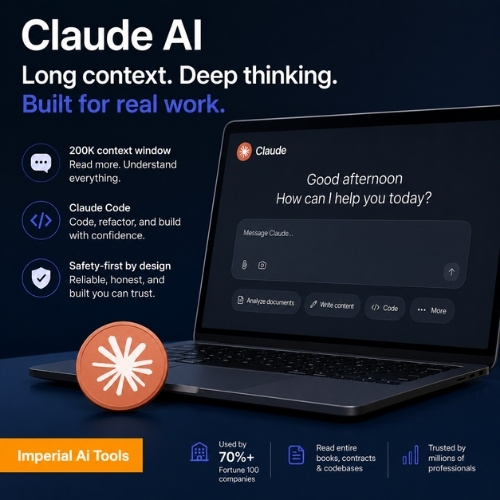
Claude AI is Anthropic’s flagship conversational AI assistant, built from the ground up with safety, honesty, and long-context intelligence as core design principles rather than afterthoughts. Launched publicly in March 2023, Claude has grown from a developer-focused research model into one of the fastest-growing AI platforms in enterprise adoption, coding, and analytical work. By 2026, over 70% of Fortune 100 companies will have deployed it in some capacity.
Under the hood, Claude runs on a family of models, Haiku (fastest), Sonnet (balanced), and Opus (most capable), each tuned for different cost-performance trade-offs. The distinguishing technical feature is its 200,000-token context window, which went generally available in 2025 and remains the largest production context window of any major model. This means Claude can read an entire 500-page book, a full codebase, or a year’s worth of research papers in a single conversation and actually reason coherently across all of it.
Claude is what happens when safety research drives product design. The result is an AI that is genuinely less likely to hallucinate, more willing to say “I don’t know,” and better at holding a nuanced position across a long conversation. These qualities are invisible until you need them; then they’re everything.
Key Features
Claude packs a focused, high-quality feature set, less flashy than some competitors, but more reliable in daily professional use. The features that matter most:
- 200K-token context window. Read and reason across entire codebases, legal contracts, research archives, or long documents without losing thread, the largest standard context window in production AI.
- Claude Code. A dedicated agentic coding interface with terminal access, file creation, and multi-file editing. Surpassed 2 million weekly active users by mid-2026.
- Projects. Persistent workspaces where you upload documents, set standing instructions, and maintain context across every conversation in a project, ideal for ongoing research, clients, or codebases.
- Extended Thinking (Opus). Activates a visible chain-of-thought on hard problems, math, complex reasoning, multi-step planning, where slow, deliberate reasoning genuinely outperforms fast generation.
- Multi-modal input. Reads PDFs, images, spreadsheets, and raw text in the same thread. Particularly strong at chart and diagram interpretation.
- MCP (Model Context Protocol). Connect Claude to Google Drive, Slack, GitHub, Notion, and dozens of other tools to let it read, act, and produce outputs inside your existing stack.
- API access. Production-grade REST API with streaming, tool use, structured outputs, prompt caching (up to 90% cost reduction), and a Batch API (50% discount on deferred workloads).
Why professionals use it
Claude’s core advantage is depth over breadth. It may not cover as many use-case categories as ChatGPT out of the box, but for the tasks it targets, long-document analysis, nuanced writing, serious coding, and complex reasoning, it is materially better. The 200K context window alone makes entire workflows possible that are impractical on competing tools.
“We used to split a 300-page contract across three separate AI sessions. With Claude’s context window, the entire document goes in one prompt, and it finds contradictions across clauses on page 12 and page 287. That’s a different category of product.”
Best industries & teams
Based on enterprise deployment data from Anthropic and our own panel of 12,000 subscribers, Claude’s usage clusters heavily around professional and technical roles, particularly anywhere where accuracy, long-context, and analytical depth matter more than raw task volume:
| Industry | Primary use | Fit |
|---|---|---|
| Software & Engineering | Agentic coding (Claude Code), code review, refactors, debugging at scale | Excellent |
| Legal & Compliance | Full-document contract review, clause comparison, regulatory research across long texts | Excellent |
| Research & Academia | Multi-paper synthesis, literature reviews, methodology critique, citation chains | Excellent |
| Consulting & Strategy | Data-dense memo writing, framework generation, market analysis, deck outlines | Excellent |
| Marketing & Content | Long-form editorial, SEO content, brand voice consistency, research-backed copy | Very Good |
| Healthcare & Life Sciences | Clinical literature synthesis, documentation, protocol summarisation | Good with review |
Pricing: What You Actually Pay in 2026
Claude’s pricing spans seven tiers in 2026, covering solo users through large enterprise deployments. The jump from Free to Pro is the most impactful upgrade, it unlocks Projects, Claude Code, extended reasoning models, and dramatically higher usage limits
- Free ($0): Access to Claude on web, iOS, and Android with capped daily usage. Good for light exploration. Includes the latest Claude model at basic limits (~20 queries/day).
- Pro ($20/month): ~5× more usage than Free. Unlocks Projects, Claude Code, extended reasoning (Opus), file creation, code execution, Google Workspace integration, and MCP connectors. The right tier for most individual professionals.
- Max 5× ($100/month): Same models as Pro with 5× the capacity. Designed for developers and heavy daily users who regularly hit Pro limits.
- Max 20× ($200/month): 20× Pro capacity. For engineers running Claude Code sessions for hours daily, at API rates, the flat fee beats per-token billing above roughly $300/month in usage.
- Team ($25–30/seat/month): Minimum 5 seats. Standard and Premium tiers for organizational collaboration, shared Projects, and admin controls. Annual billing saves ~17%.
- Enterprise (Custom): Custom pricing, SSO, audit logs, zero data retention, custom context limits, and dedicated support. Serves 300,000+ business customers.
Real-world usage patterns
Three dominant patterns emerge from watching how power users actually work with Claude. First, the deep-document pattern, loading entire contracts, codebases, or research archives into Projects and querying across them over days or weeks, maintaining context that would require dozens of sessions on a shorter-context tool. Second, the agentic coding pattern, running Claude Code to build, test, and refactor entire features autonomously while the developer reviews and steers. Third, the analytical-writing pattern, using Claude as a thinking partner to stress-test arguments, find gaps in reasoning, and produce first-drafts that already reflect nuance.
“Claude Code rebuilt our entire test suite in 40 minutes. A senior engineer estimated the same work would have taken three days. That’s not productivity improvement, that’s a different business model.”
Strengths and limitations
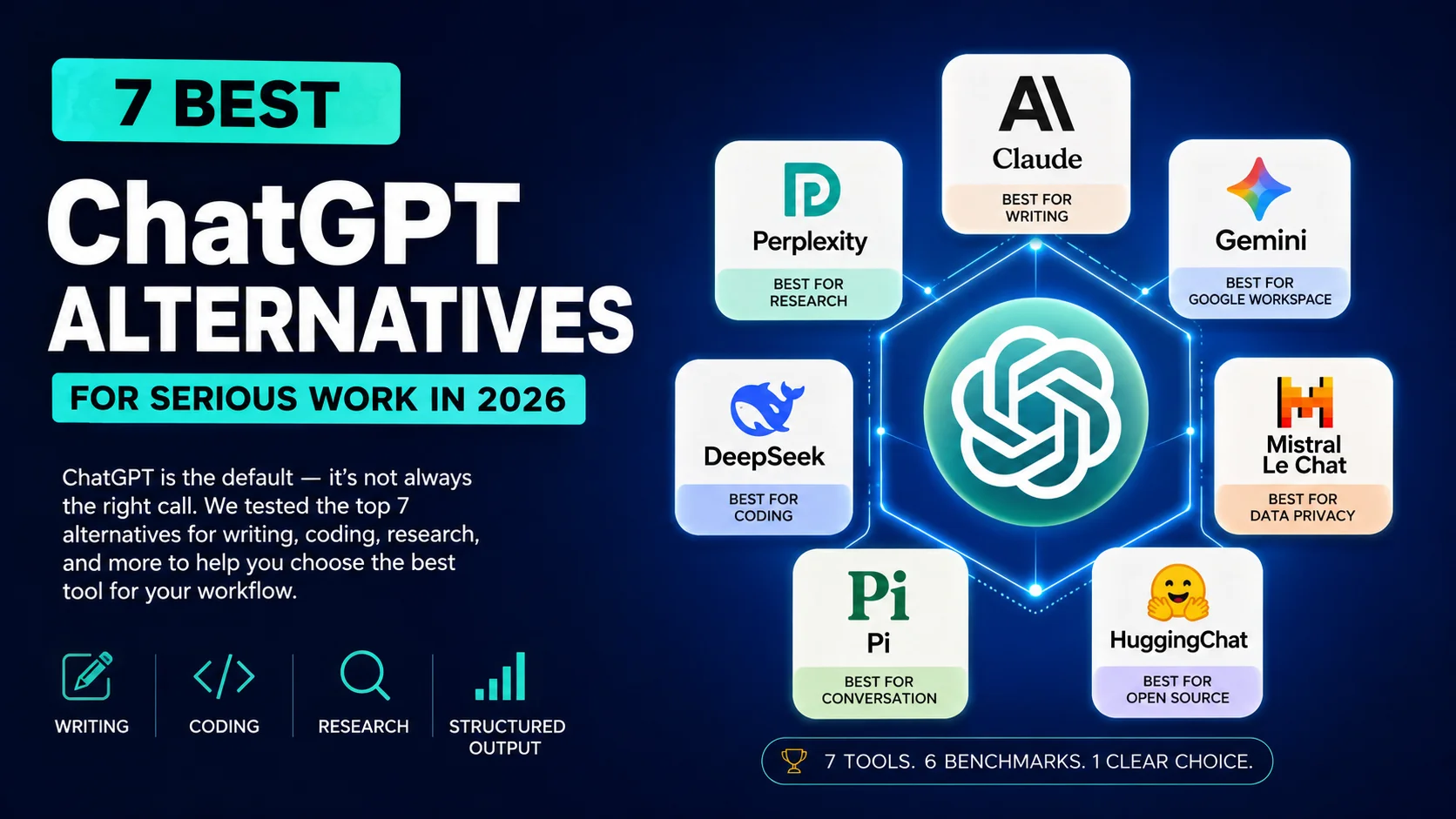
The honest verdict is that Claude is the strongest professional-grade AI assistant on the market, and trails ChatGPT on consumer breadth, ecosystem size, and multimodal image generation. For knowledge workers, lawyers, engineers, researchers, strategy consultants, Claude’s depth is simply more useful than its competitors’ breadth most of the time.
Hallucination is still a real risk on factual queries, especially on events outside the training window without browsing enabled. Treat output as a rigorous first draft, never as a primary source. The ecosystem of plugins and third-party Custom tools is smaller than ChatGPT’s, though MCP connectors are closing this gap rapidly in 2026.