
Choosing a project management tool is not a decision you make lightly. Whatever you pick will shape how your team plans work, tracks progress, communicates, and spends its software budget for years. Switch later, and you face messy migrations and frustrated staff. So the choice matters, and two names come up again and again: ClickUp and Asana in almost every asana vs clickup shortlist.
Both rank among the top-rated project management platforms of 2026. Both have millions of users, active development, and loyal fans. Yet they were built on opposite philosophies, and that difference decides which one is right for you. That is the core of any ClickUp vs Asana decision.
“A world with less ‘work about work’ is a world with more breakthroughs. It’s a world with bigger ideas, better execution, and faster progress. It’s a world full of happy individuals… Realizing humanity’s potential”
Clickup vs Asana at a Glance
Here is the quick-scan comparison. All prices reflect annual billing, verified July 2026.
| Factor | ClickUp | Asana |
|---|---|---|
| Best for | Agencies, ops, dev teams wanting depth and value | Cross-functional teams wanting speed and polish |
| Free plan | Unlimited users, 60MB total storage | 2 users, unlimited storage (100MB/file) |
| Ease of use | Powerful but steeper learning curve | Clean, fast to onboard |
| Automation | 1,000 to 250,000 runs/mo by tier | Unlimited on all paid plans |
| Views | 15+ views | ~5 core views |
| Native time tracking | Yes, from $7 Unlimited | Advanced tier only ($24.99) |
| Integrations | 1,000+ apps | 270+ to 400+ apps |
This ClickUp vs Asana table covers the headline differences; the sections below go deeper on each.
What is ClickUp?
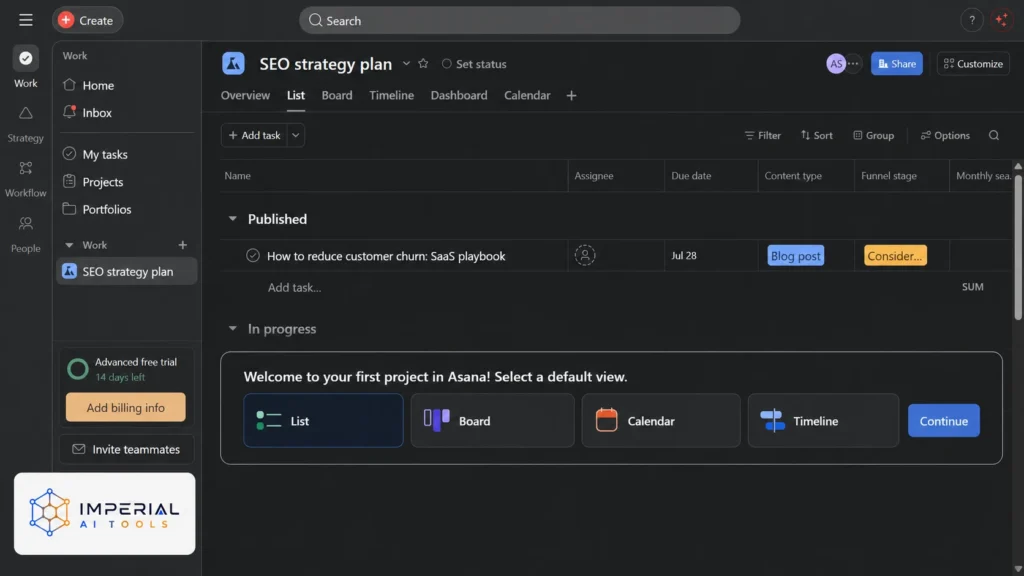
ClickUp is a customizable, all-in-one work platform that merges project management with docs, chat, whiteboards, and time tracking. It aims to be the single window where a whole team operates.
The core use case is consolidation. Teams tired of paying for Notion, Slack, Toggl, and a PM tool separately turn to ClickUp to fold them into one subscription. Its deep hierarchy (Spaces, Folders, Lists, Tasks, Subtasks) and 15+ views make it a favorite for agencies and operations-heavy teams juggling many clients.
What is Asana?
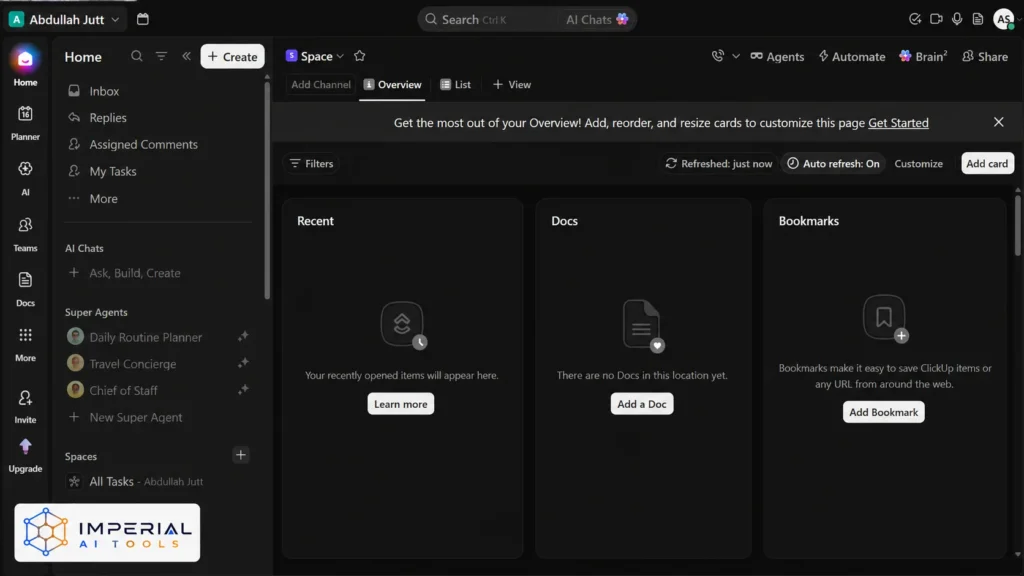
Asana is a work management platform focused on task tracking, project visibility, and strategic planning through Goals and Portfolios. It does project management with polish and expects you to integrate the rest.
The core use case is structured team execution at speed. Marketing, operations, and enterprise teams pick Asana because accountability is clear and new members become productive within their first week. Trusted by names like Spotify, Uber, and Amazon, it favors depth in a focused feature set over sprawling breadth.
Core Feature-by-Feature Comparison
Now the head-to-head this is where the ClickUp vs Asana gap shows up in daily work. Each section compares both tools directly and names a winner with a reason.
Views and Project Visualization
ClickUp offers 15+ views, including Gantt, Kanban, Calendar, Workload, Mind Map, and more. Asana provides around 5 core views: List, Board, Timeline, Calendar, and Gantt. For teams that visualize work in many formats, ClickUp gives far more flexibility. Asana’s fewer views are cleaner and easier to read, which suits non-technical stakeholders who just need clarity.
Winner: ClickUp, because 15+ configurable views cover nearly any workflow, from sprint boards to capacity planning.
Docs and Wikis
ClickUp includes native Docs for collaborative writing and wikis, built right into the workspace. Asana has no native document editor, so teams rely on Google Docs, Notion, or Confluence alongside it. If in-context documentation matters, ClickUp keeps everything in one place.
Winner: ClickUp, because native Docs remove the need for a separate wiki tool.
Time Tracking
ClickUp bundles native time tracking starting on the $7 Unlimited plan. Asana locks native time tracking behind its Advanced tier at $24.99/user/month, so lower-tier users must bolt on Harvest, Toggl, or Clockify. For agencies billing hours, this gap is significant.
Winner: ClickUp, because time tracking is included early and cheaply.
Automation
Asana gives unlimited automation runs on every paid plan, with a natural-language rule builder that needs no technical skill. ClickUp caps automation by tier: roughly 1,000 runs on Unlimited, 5,000 on Business, and up to 250,000 on Enterprise. ClickUp’s automations allow deeper multi-condition logic, but heavy users can hit the cap and see automations pause until the cycle resets.
Winner: Asana, because unlimited runs on all paid plans remove any usage anxiety.
Agile and Sprints
ClickUp offers native sprint management with sprint points, sprint reporting, and burndown and burnup charts built in. Asana handles sprints through templates and boards but lacks a native burndown chart, so agile teams often add a reporting layer. For software teams running scrum, ClickUp is the more complete out-of-the-box fit.
Winner: ClickUp, because native burndown and sprint reporting serve dev teams without add-ons.
AI Showdown: Clickup vs Asana AI
AI is the biggest differentiator in 2026, and the two tools take opposite approaches. In the ClickUp vs Asana AI race, the two tools take opposite approaches.
Architecture Difference
ClickUp Brain (relaunched as Brain 2 in June 2026) is a persistent AI layer across the whole product. It handles workspace-wide knowledge retrieval, AI writing, automated standups, and Super Agents you can @mention and assign. It offers multi-model access (GPT-5, Claude, o3) and MCP integration, giving it the highest capability ceiling in the category. Asana AI is built into its Work Graph data model. Asana’s AI Teammates understand the “why” the ai teammates asana ships in its work graph behind your work because they read your goals, dependencies, and structure, and every AI action is logged and auditable.
Cost Reality
Here is the crucial gap. ClickUp Brain is a paid add-on at $9/user/month (a higher Everything AI tier runs $28/user/month), charged per seat, not per user who actually uses AI. Asana bundles AI Studio Basic into every paid plan at no extra cost, metered by monthly credits (50,000 on Starter, 75,000 on Advanced). For a 10-person team wanting AI, Asana Starter includes it at $10.99/user. ClickUp Business plus Brain totals about $21/user, close to double.
Winner: depends. Asana AI wins on value and faster time-to-value for most teams. ClickUp Brain wins on raw capability and multi-model flexibility for power users. If AI features are your deciding factor, our Salesforce vs HubSpot comparison shows how the same “bundled vs add-on” split plays out in CRM tools too.
Ease of Use: Is ClickUp Harder to Learn Than Asana?
Yes, generally. ClickUp’s density is its strength and its burden. More settings, more views, and more configuration create cognitive overhead, and most teams need two to three weeks to reach proficiency. Asana is designed for fast adoption: a clean interface, intuitive navigation, and features discoverable without a manual. New members are usually productive within their first week.
The practical rule: if your team will invest in setup, ClickUp rewards that effort. If you need people working next week, Asana is the safer bet.
Winner: Asana, because faster onboarding and lower friction drive higher adoption.
Integrations
ClickUp supports 1,000+ integrations, including Slack, Google Drive, GitHub, and Zoom. Asana offers 270+ to 400+ a native asana clickup integration and a dedicated ClickUp importer, Microsoft Teams, Google Drive, Salesforce, Power BI, and Tableau. ClickUp wins on raw count, but Asana’s integrations are often praised for depth and reliability, and its Salesforce and BI connections suit enterprise reporting. There is also a native Asana-to-ClickUp integration and a dedicated ClickUp importer, so the two can pass data between them.
Winner: ClickUp on breadth. Asana is competitive on depth for enterprise stacks.
Decision Matrix by Persona
| Your team | ClickUp | Asana | Better pick |
|---|---|---|---|
| Solo freelancer | Generous free plan, native time tracking | Free plan capped at 2 users | ClickUp |
| Agency | Docs, time tracking, client workflows, 15+ views | Clean client reporting, less setup | ClickUp |
| Small business | Low cost, all-in-one consolidation | Fast adoption, bundled AI | Either |
| Software / dev team | Native sprints, burndown, custom fields | Templates, no native burndown | ClickUp |
| Large enterprise | Feature depth, custom quote | Goals, Portfolios, audit trails, easy rollout | Asana |
Who Should Choose Each Tool
Choose ClickUp if…
- You want the most features per dollar
- You need native docs, whiteboards, and time tracking in one app
- Your team runs sprints and wants native burndown charts
- You are an agency juggling many clients and views
- You will invest a few weeks in setup
Choose Asana if…
- Fast adoption and a clean interface come first
- You want AI bundled into the price
- You need unlimited automation runs
- You run OKRs, Goals, and portfolio planning
- You are a non-technical or cross-functional team
Weighing other business tools before you commit? Our Brex vs Ramp and Adobe Express vs Canva breakdowns use the same value-versus-depth lens for finance and design stacks.
Conclusion
There is no single winner, because the right choice depends on how your team works. ClickUp is the value and depth champion. For $7/user/month it hands you 15+ views, native docs, whiteboards, sprint reporting, and time tracking, making it the stronger fit for agencies, operations teams, and software teams willing to invest in setup. Its biggest reason to win is unmatched features per dollar.
Asana is the adoption and polish champion. It costs more upfront at $10.99/user/month, but it onboards faster, bundles AI on every paid plan, offers unlimited automations, and leads the category on Goals and portfolio planning. Its biggest reason to win is that teams actually use it from week one, with clean audit trails that regulated industries value. If you are still comparing options, browse our full library of tool comparisons to see how other platforms stack up.
Frequently Asked Questions
ClickUp is popular mainly for its generous free plan with unlimited users, its all-in-one feature set (tasks, docs, chat, whiteboards, time tracking). Teams looking to consolidate several subscriptions into one workspace find that combination hard to beat on value.
ClickUp reports use across large organizations in tech, marketing, and operations, and cites a Forrester-documented ROI study for a composite 1,000-employee enterprise. It is especially common among agencies, startups, and operations teams that want feature depth at a low per-seat cost.
ClickUp has a real learning curve. Most teams need two to three weeks to reach proficiency because of its density. If your team is new to project management tools, Asana’s simpler interface is an easier starting point.
Asana’s main drawbacks are price and gating. Native time tracking, Goals, and Portfolios sit behind the $24.99 Advanced tier, the free plan is capped at 2 users, and seat blocks above 5 users mean a 6-person team pays for 10 seats. It also lacks native docs and chat.
Yes. ClickUp’s Free Forever plan supports unlimited members and unlimited tasks, which is rare among PM tools. The catch is a 60MB total storage limit shared across the entire team, so it suits small teams that do not attach many files.
Yes. A native asana clickup integration plus a ClickUp importer let you move tasks and data between them.