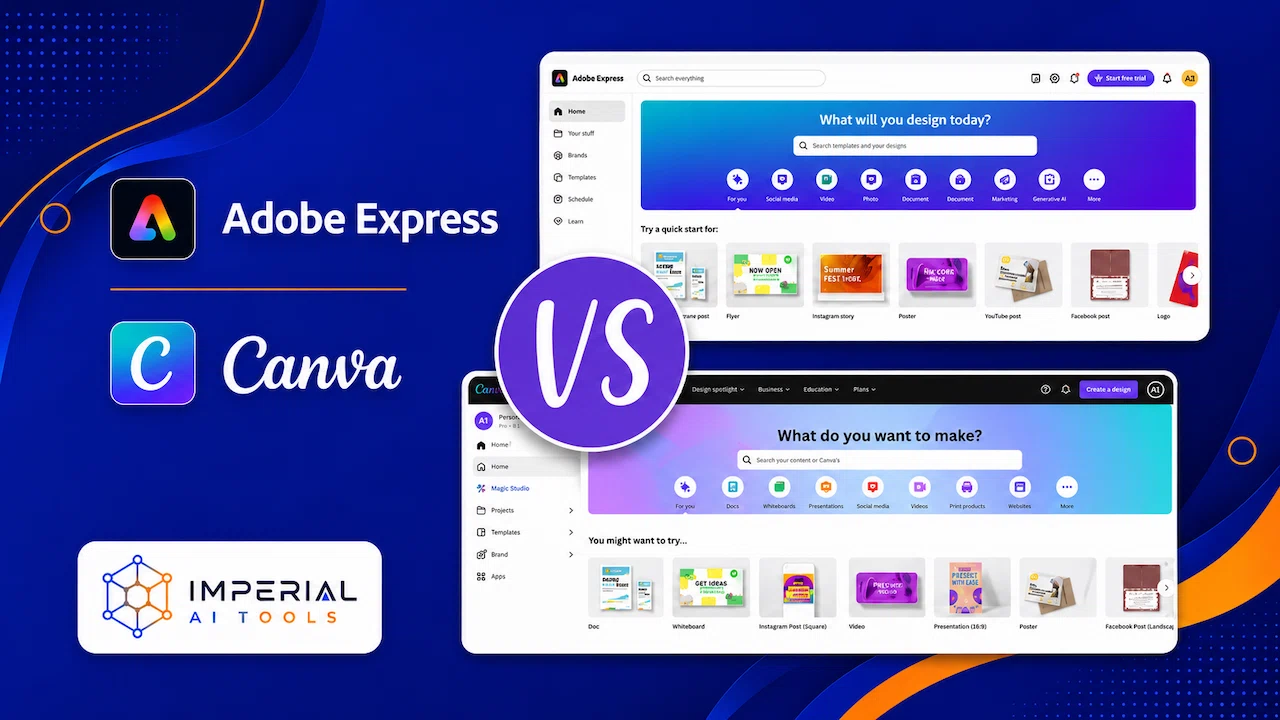

Adobe Express and Canva make the same promise: design for everyone. Yet they solve different problems, and the marketing pages rarely admit it. Most people end up comparing feature lists side by side, but a feature list will not tell you which tool feels faster, which produces cleaner output, or which quietly costs more over a year.
So we tested both. We ran identical projects through each tool and scored them on the four things that actually decide the choice: templates, AI features, pricing, and integrations. Canva leans on the largest template library in the category, real-time collaboration, and a learning curve so gentle that beginners finish a design within minutes. Adobe Express leans on Firefly AI, unlimited free background removal, 30,000 plus Adobe Fonts, and a tight round-trip with Photoshop and Illustrator.
You can only grow as big as your dreams!
Adobe Express vs Canva At a glance
| Dimension | Adobe Express | Canva |
|---|---|---|
| Best for | Adobe ecosystem users, fast branded content | Teams, beginners, social media at scale |
| Free plan | Strong. Free unlimited background removal, 100k+ templates, 25 AI credits | Strong. 1.6M+ templates, 5GB, ~50 AI credits |
| Ease of use | Simple, but more options on screen | Easiest learning curve in the category |
| Standout feature | Firefly AI images and free background removal | Huge template library and Magic Studio |
| Platforms | Web, iOS, Android | Web, desktop app, iOS, Android |
| Integrations / API | Deep Creative Cloud round-trip; limited third-party apps | 340+ app marketplace; native scheduling to 8+ platforms |
What is Adobe Express?
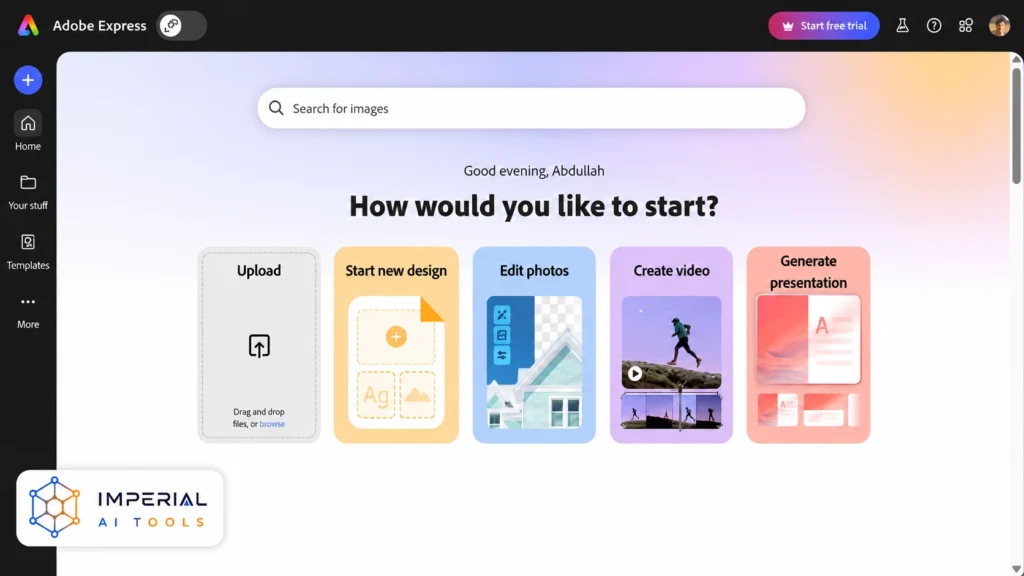
Adobe Express is Adobe’s free, browser-based design tool. It launched in 2021 as a rebrand of Adobe Spark. The goal is simple: bring professional-grade design to people who do not want to learn Photoshop or Illustrator. Users create social posts, flyers, short videos, thumbnails, and simple web pages with drag-and-drop templates.
Its engine is Adobe Firefly, a generative AI trained on licensed and public domain content. That makes its AI images commercially safer, with Content Credentials attached. A standout section called Quick Actions handles one-click jobs like background removal, file conversion, and resizing.
Who Adobe Express is built for
Adobe Express suits people already inside the Adobe ecosystem, budget-conscious creators, and anyone who needs fast, on-brand output backed by strong photo AI. It works best as a bridge between heavy Adobe tools and quick everyday publishing.
What is Canva?
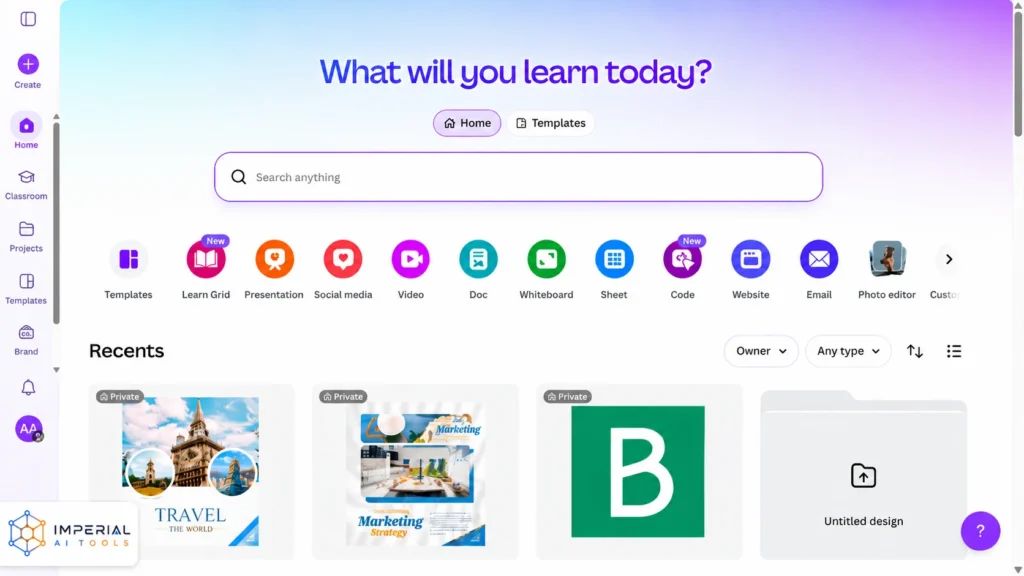
Canva is an all-in-one, cloud-based design platform. You build social graphics, presentations, documents, videos, websites, and print products in one place. The drag-and-drop editor needs no design background, which is why beginners love it. A vast template library gives users a strong starting point for almost any format.
Canva bundles its AI under Magic Studio. That suite includes Magic Design, Magic Write, Magic Edit, Magic Eraser, Magic Expand, and a Background Remover. The AI feels built into the workflow rather than bolted on. Canva launched in Australia in 01 january 2013 and now serves over 265 million users. In 2024 it acquired the Affinity design suite, and in 2026 it made Affinity free, pairing pro-grade vector and photo tools with the main editor. That move sharpened Canva’s pitch as a full Adobe alternative for many creators.
Who Canva is built for
Canva fits teams, beginners, social media managers, educators, and small businesses that value breadth and collaboration. If several people need to create and approve content, Canva is the natural home.
Adobe Express vs Canva: Feature-by-Feature Comparison
Here is how both tools compare across the features that shape daily design work.
Does Adobe Express have more templates than Canva?
No. Canva has far more. Canva offers over 1.6 million free templates and millions more behind Pro, spanning nearly every format. Adobe Express Free includes around 100,000 templates. Adobe’s library is smaller but often higher in average quality, since Adobe designers build them. For sheer volume and variety, Canva wins clearly.
AI tools compared
Canva’s Magic Studio spans more than 20 features and covers text, images, video, and layout generation. Adobe Express offers a tighter set of about seven AI tools powered by Firefly. In hands-on tests by independent reviewers, Adobe’s AI images looked cleaner, while Canva sometimes produced uncanny artifacts, especially on hands. Canva wins on breadth, Adobe wins on image quality.
Asset libraries, stock photos, and icon makers
Adobe Express taps 200 million plus Adobe Stock assets on Premium and 1 million on Free. Canva’s Pro library holds 140 million plus assets, plus a strong built-in icon and element system. Canva’s icon and shape tools feel more integrated for quick graphics, while Adobe’s stock depth suits polished, photo-led designs.
Video editing capabilities compared
Both tools handle short-form video, timelines, and social clips. Canva’s video editor is more mature for multi-scene projects and team edits. Adobe Express adds video background removal on Premium and clean animation controls. For a deeper look, read our guide to the best design and video tools. Canva edges ahead for everyday video volume.
Fonts and typography options
Adobe Express includes 30,000 plus Adobe Fonts on Premium, roughly ten times what Canva ships. For editorial teams and brands that care about type hierarchy, that is a decisive gap. Canva’s fonts are ample for social work but narrower. Typography-led work favors Adobe Express.
Background removal: side-by-side test
This is Adobe’s clearest win. Adobe Express removes backgrounds free, unlimited, at full resolution, and with no watermark. Its edge detection handles fine hair and complex edges cleanly. Canva’s Background Remover sits behind Pro and can leave visible artifacts on tricky edges. For this single task, Adobe Express is the stronger pick.
Logo design capabilities
Both tools help beginners make simple logos from templates. Neither replaces true vector software for scalable, precise marks. Canva exports SVG on Pro, which helps for basic logo work. For serious vector logos, a dedicated tool like Adobe Illustrator or Affinity Designer remains the right choice.
Winner: Canva, because it wins more feature categories on breadth, though Adobe Express takes AI image quality, fonts, and background removal.
Ease of use and Learning Curve
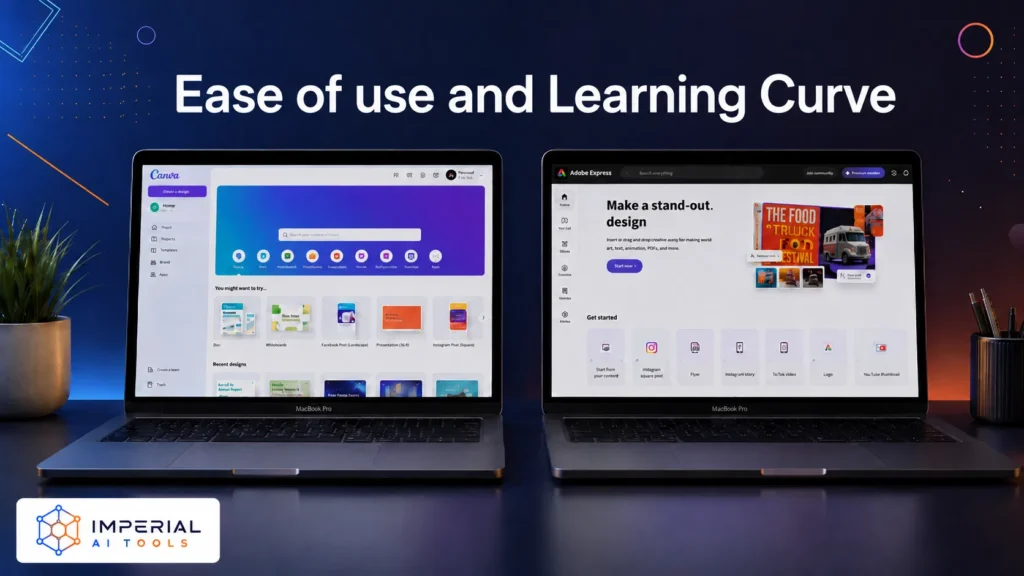
Best for beginners: Adobe Express vs Canva
Canva has one of the shortest learning curves in the category. Its template-first approach means users rarely face a blank canvas. Most people finish a professional design within minutes of signing up. Adobe Express is also simple, but its interface shows more options and can feel slightly denser, especially inside advanced AI tools.
Interface and drag-and-drop editor comparison
Both editors use clean drag-and-drop layouts. Canva feels friendlier for first-timers. Adobe Express offers more precise property panels once you pick a template, which power users prefer for fine adjustments. Canva optimizes for speed; Adobe optimizes for control.
How to use Canva free: quick-start walkthrough
Sign up at canva.com with an email or Google account. Pick a format, choose a template, then drag in text, photos, and elements. Use the free 5GB storage to save projects and download in PNG, JPG, or PDF. The free plan includes about 50 monthly AI credits for light Magic Studio use.
Pros and Cons of Both Tools
Adobe Express
- + Free removal:Unlimited, watermark-free background removal.
- + Better AI:Cleaner Firefly images, commercially safe.
- + More fonts:30,000+ Adobe Fonts on Premium.
- + Cheaper premium:$9.99 per month undercuts Canva Pro.
- + Adobe handoff:Round-trip to Photoshop and Illustrator.
- – Fewer templates:Far smaller library than Canva.
- – Limited apps:Thin third-party integration marketplace.
- – Weaker teamwork:Collaboration lags behind Canva.
- – Capped credits:Monthly AI credits run out fast.
- – Bundled pricing:Premium often tied to Creative Cloud.
Canva
- + Huge library:1.6M+ templates for any format.
- + Easiest start:Shortest learning curve around.
- + Team ready:Real-time editing and approvals.
- + Broad AI:Magic Studio spans 20+ features.
- + Big marketplace:340+ app integrations.
- – Paywalled removal:Background remover needs Pro.
- – Pricier Pro:$18 per month tops Adobe Premium.
- – AI artifacts:Weaker on realistic images and hands.
- – Seat jump:Adding users forces Business pricing.
- – Shared credits:One AI pool drains quickly.
Who should Choose Each Tool
Choose Adobe Express if…
- You already pay for Creative Cloud or use Photoshop.
- You need free, high-quality background removal.
- You want the sharper Firefly AI images.
- Brand typography and Adobe Fonts matter to you.
- You want the cheaper premium plan at $9.99 per month.
Choose Canva if…
- You want the largest template library available.
- A team needs real-time collaboration and approvals.
- You publish social content across many platforms.
- You are a complete beginner who wants speed.
- You rely on many third-party app integrations.
Imperial AI Tools verdict
There is no single winner, because needs differ. Pick Canva if you want breadth, the largest template library, real-time collaboration, and the gentlest learning curve. It is the safer default for teams, beginners, and social media managers who juggle many formats. Pick Adobe Express if you already live in Creative Cloud, want cleaner AI images, need free background removal, or care about brand typography. Its $9.99 Premium plan is also the cheaper individual option. For many creators, the smartest move is to run both free tiers together and let daily work decide. If your team is Adobe-native, stay Adobe-first. If your team is mixed and collaboration-heavy, Canva earns its place. Match the tool to the job, not to the hype.
Frequently Asked Questions
Yes, and many creators do. A common stack uses Canva for templates and teamwork, then Adobe Express for background removal and AI images. Both free tiers cover different strengths, so running them side by side often costs nothing while giving you the best of each tool.
Switch only if you value Firefly AI quality, free background removal, or Creative Cloud integration. Factor in switch costs first, including re-learning the editor and migrating brand kits and fonts. If your work is template-heavy and team-based, staying on Canva is usually the better call.
They serve different jobs. Adobe Illustrator is better for precise, scalable vector art like logos and icons. Canva is better for fast, template-based social and marketing design. Neither Canva nor Adobe Express replaces Illustrator for professional vector work that needs exact control.
The most reliable way to access Canva Pro at no cost is through its official 30-day free trial. Additionally, educators, students, and eligible nonprofit organizations can qualify for free, ongoing premium access by applying through Canva’s dedicated verification programs.