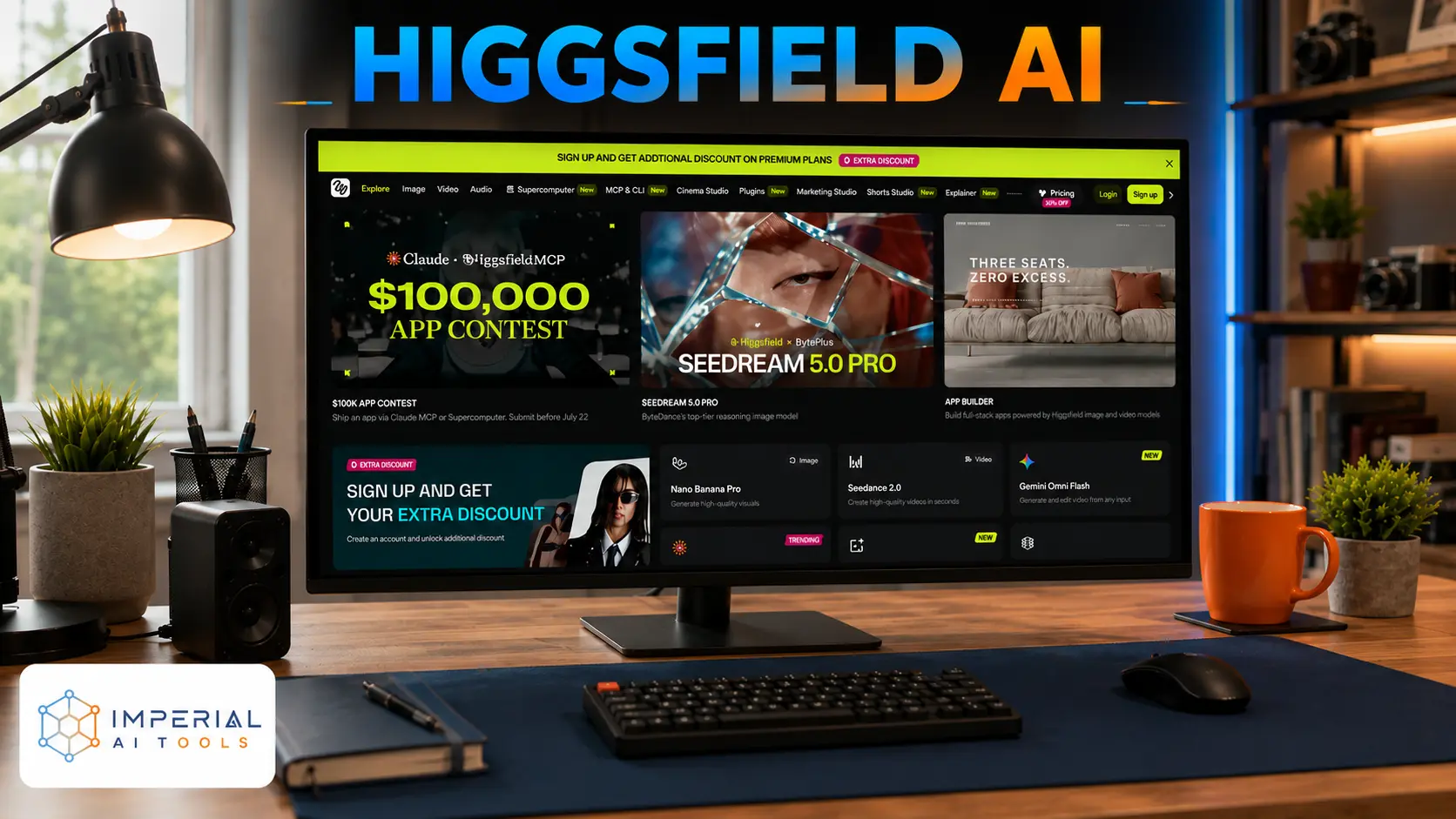

Higgsfield AI has become one of the most talked-about names in generative media, and for good reason. Instead of forcing you to bounce between a dozen separate tools, it pulls image generation, video generation, advertising, animation, and cinematic production into a single browser-based studio.
That unified approach is the whole pitch. Higgsfield isn’t a single-generation model; it’s a workspace that routes your prompt or reference to the right engine and lets you keep editing, reuse characters, and build sequences without starting over.
It’s built for a wide crowd: content creators, filmmakers, marketers, agencies, and complete beginners experimenting with AI for the first time. Features like Cinema Studio, the Soul image system, character consistency, motion control, and dedicated marketing workflows are what set it apart from simpler text-to-video apps. The platform runs on a credit system and offers both free and paid access.
In this guide, you’ll learn what Higgsfield can do, how to use it step by step, how to write prompts that actually work, what it costs, whether it’s free, and how it handles safety and commercial use, plus its limitations and quick fixes when something goes wrong.
What Is Higgsfield AI?
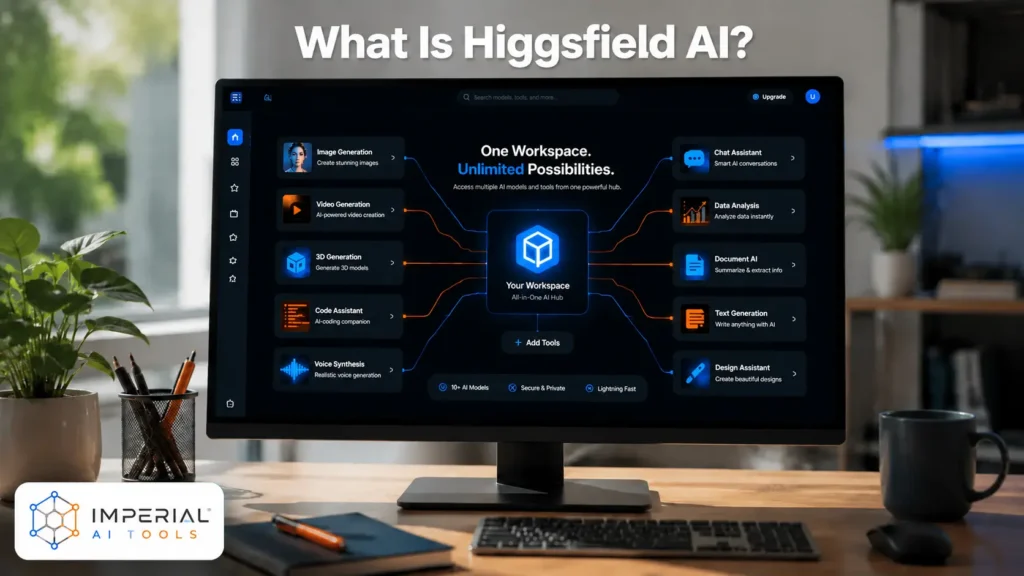
Higgsfield AI is a cloud-based creative studio that turns text, images, and audio into cinematic-quality videos and images. Rather than building a single proprietary model, it aggregates 50-plus AI models under a single subscription and connects them through generation, editing, character identity, and marketing tools within a single project structure.
The result is a platform you work inside, not a button you press once. You generate an asset, then relight it, inpaint it, animate it, or drop it into a storyboard, all in the same place.
What can you create with Higgsfield AI?
- Text-to-video clips
- Image-to-video animations
- AI-generated images
- Cinematic scenes and short sequences
- Social media videos
- Product advertisements
- Consistent virtual characters
- Talking avatars and lip-sync videos
- Motion graphics and transitions
- Storyboards and previsualization
- Marketing campaign assets
- AI influencer content
Who is Higgsfield AI designed for?
- Content creators and YouTubers
- Filmmakers and previz artists
- Social media marketers
- Advertising agencies
- E-commerce businesses
- Designers and creative teams
- Beginners exploring generative media
Higgsfield describes itself as an all-in-one creative studio combining cinematic video and image generation for creators, agencies, and filmmakers. Reporting on the platform notes that social media marketers make up a large share of its user base, which tracks with its heavy focus on ads and short-form content.
How Higgsfield AI Work?
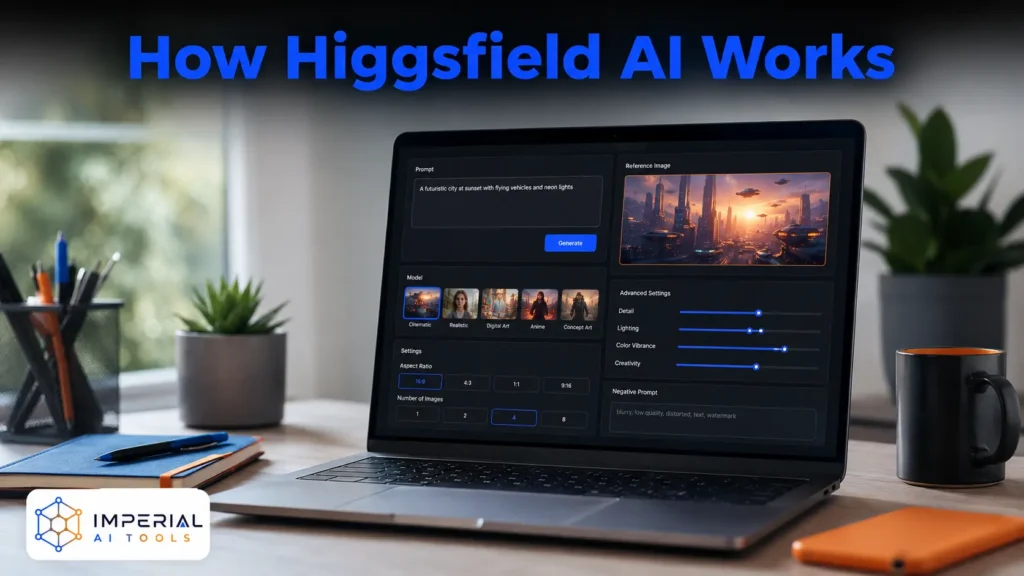
The core loop is simple: you provide an input, choose how it should be generated, and refine the output. Under the hood, the platform handles the model selection and processing.
Input
You start with one or more of these:
- A written prompt
- A reference image
- An existing video
- A product URL
- A character reference
- Opening and ending frames
- A reusable project asset
Model and workflow selection
Next, you decide the settings that shape the output:
- Image or video generation
- Which AI model to use
- Aspect ratio and clip duration
- Camera behavior and movement
- Visual style and resolution
- Supporting effects or apps
Generation and refinement
Before you commit, the estimated credit cost is shown. The selected model then processes your prompt and references, and you review the result. From there, you can regenerate, edit, upscale, or export.
Key point: Different models and settings consume different amounts of credits, so a 4K premium video costs far more than a short, standard-resolution clip.
Main Higgsfield AI Features
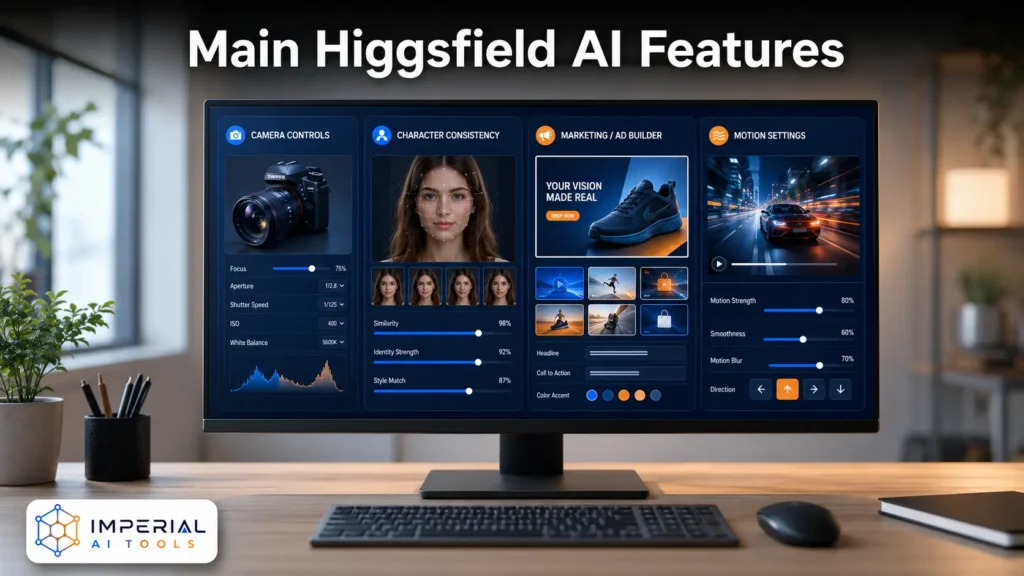
Higgsfield’s strength is the breadth of tools that share one workspace and one credit balance. Here’s how the main pieces fit together.
| AI Video Generator | Creates videos from text, images, or footage | Social videos, ads, and films |
|---|---|---|
| AI Image Generator | Produces original and edited images | Concepts, campaigns, product visuals |
| Cinema Studio | Controls shots, lenses, movement, and lighting | Cinematic video production |
| Soul 2.0 | Generates aesthetic, photorealistic images | Fashion and editorial content |
| Soul Cinema | Produces cinematic, film-style images | Storyboards and keyframes |
| Soul ID | Maintains a recurring character’s identity | AI influencers and campaigns |
| Soul HEX | Maintains color and palette consistency | Branded visual projects |
| Marketing Studio | Builds ads and product content | Brands and e-commerce |
| Canvas | Organizes connected creative workflows | Multi-stage projects |
| Apps & Effects | Applies one-click transformations | Short-form and trend content |
| Lip Sync | Matches audio to character movement | Avatars and presenter videos |
| Team Workspace | Organizes shared projects and assets | Agencies and production teams |
Cinema Studio and camera control
This is the feature most creators come for. Cinema Studio brings director-level control that generic text-to-video tools don’t offer:
- Virtual camera and lens selection
- Focal length, aperture, and depth-of-field
- Defined camera movements (dolly, orbit, pan, tilt)
- Lighting and color direction
- Genre-based motion behavior
- Reusable characters, locations, and props
- A built-in AI co-director for shot suggestions
- Real-time team collaboration
The current Cinema Studio environment combines these camera controls with reusable “Elements,” AI-assisted direction, multiple models, and live project collaboration.
Soul, Soul Cinema, Soul ID, and Soul HEX
The Soul system is Higgsfield’s image and consistency engine, split into four connected tools:
- Soul
- Aesthetic and photorealistic image creation.
- Soul Cinema
- Cinematic composition, texture, grain, and mood.
- Soul ID
- Keeps a character’s identity consistent across generations.
- Soul HEX
- Keeps color palettes consistent across a set of images.
Soul Cinema officially supports both Soul ID and Soul HEX, so you can lock a character and a palette in film-style shots.
Marketing Studio, Canvas, and Apps
For commercial work, three tools do the heavy lifting:
- Marketing Studio handles product-to-ad workflows and reusable brand assets.
- Canvas organizes multi-step projects visually so a campaign stays connected.
- Apps & Effects provide templates, transitions, editing tools, and social/ad formats in one click.
How to Use Higgsfield AI Step by Step
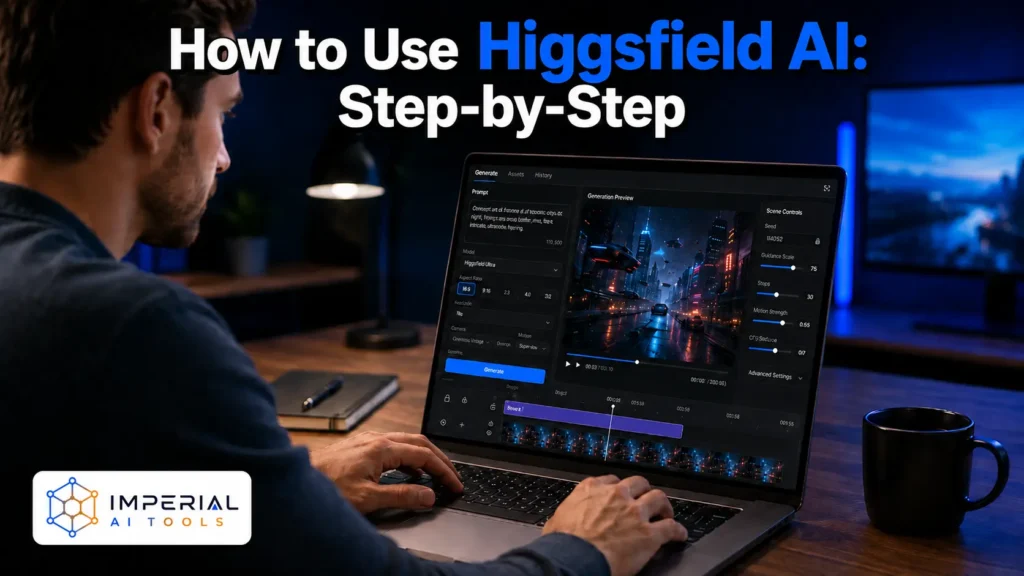
Here’s the full workflow from account to export. Follow it in order the first time, then adapt.
Step 1: Create a Higgsfield account
Visit the official platform, register or sign in, and check your available free credits and account options. Access can differ by account, plan, and region, so what you see may vary.
Step 2: Choose what you want to create
Pick your starting point: generate an image, generate a video, animate an image, edit a video, create a product ad, build a recurring character, apply an effect, or open a Cinema Studio project.
Step 3: Select a generation model
Weigh these factors before choosing: realism, prompt accuracy, motion complexity, audio support, reference support, resolution, generation speed, and credit cost. Higgsfield currently lists multiple models, including Seedance, Kling, Veo, Wan, and Sora, alongside its own creative tools, though availability can change.
Step 4: Choose the aspect ratio and format
Match the format to the platform:
- 16:9 for YouTube and websites
- 9:16 for TikTok, Reels, and Shorts
- 1:1 for social posts
- 21:9 for cinematic scenes
Step 5: Write the prompt
Describe your subject, action, location, composition, camera angle, camera movement, lighting, style, mood, and any restrictions. (There’s a full prompt formula below.)
Step 6: Upload reference assets
References help preserve character appearance, product design, composition, color palette, clothing, environment, and first/last frames. This is the single biggest lever for consistency.
Step 7: Configure camera and motion settings
Choose one primary movement: static, dolly, tracking, orbit, zoom, pan, tilt, handheld, or subject motion. Combining too many at once usually looks unnatural.
Step 8: Review the credit cost
Check the estimate before generating. Test expensive concepts at lower settings first, avoid unnecessary repeats, and save prompts and settings that work.
Step 9: Generate and review the result
Evaluate prompt accuracy, face consistency, product accuracy, motion quality, hands and objects, lighting, camera behavior, and any text or logo distortion.
Step 10: Refine and export
Change one variable at a time before regenerating. This tells you exactly what fixed (or broke) the shot, and saves credits.
How to Write Better Higgsfield AI Prompts
Prompt quality is the difference between a usable clip and a wasted generation. Structure beats length.
Use a structured prompt formula
Subject + action + environment + composition + camera angle + camera movement + lighting + style + mood + restrictions
| Subject | Main person, product, or object | A black luxury sports car |
|---|---|---|
| Action | What the subject is doing | Driving along a coastal road |
| Environment | Location and background | Rocky coastline at sunset |
| Composition | Shot size and framing | Low-angle medium-wide shot |
| Camera | Lens, angle, or camera type | 35mm anamorphic lens |
| Movement | Camera and subject motion | Smooth front-left tracking shot |
| Lighting | Direction, intensity, color | Warm golden-hour backlight |
| Style | Visual treatment | Premium automotive commercial |
| Mood | Emotional atmosphere | Powerful and aspirational |
| Restrictions | What must not change | No logos or distorted wheels |
Text-to-video prompt structure
For text-to-video, lead with the subject and its main movement, then the background, shot type, lens, lighting, and camera movement. Add a note on physical realism and a short list of negative restrictions (what you don’t want).
Image-to-video prompt structure
When animating an image, first tell the model what to preserve: face, outfit, product, background, color palette, and starting composition. Then describe only the movement you want added. Everything you don’t mention should stay put.
Product advertisement prompt structure
For ads, specify product placement, surface and background, camera movement, brand colors, reflections, atmosphere, and output ratio. Always include a label-preservation instruction so text on the product stays legible.
Higgsfield prompt best practices
- Put the most important action near the beginning.
- Describe camera motion separately from subject motion.
- Use one main movement per short clip.
- Avoid contradictory styles.
- State clearly what must remain unchanged.
- Use realistic physical actions.
- Keep prompts detailed but logically ordered.
- Test one variable at a time.
- Reuse prompt structures that work.
- Keep the same references across connected scenes.
Best Higgsfield AI Use Cases
Filmmaking and previsualization
Storyboards, mood films, shot planning, character and location concepts, camera experiments, and short cinematic sequences all before a real camera rolls.
Social media production
TikTok, Reels, and Shorts content, trend effects, vertical ads, and recurring content series built to a repeatable look.
Marketing and e-commerce
Product ads, campaign variations, demonstrations, UGC-style videos, virtual spokespeople, and assets for websites and social channels.
AI influencers and character-led content
Consistent digital personalities, fashion content, branded characters, recurring scenes, and multi-post campaigns held together by Soul ID.
Motion design and editing
Motion graphics, transitions, mixed-media visuals, reframing, background removal, upscaling, and prompt-based editing.
Higgsfield AI Pricing and Credits
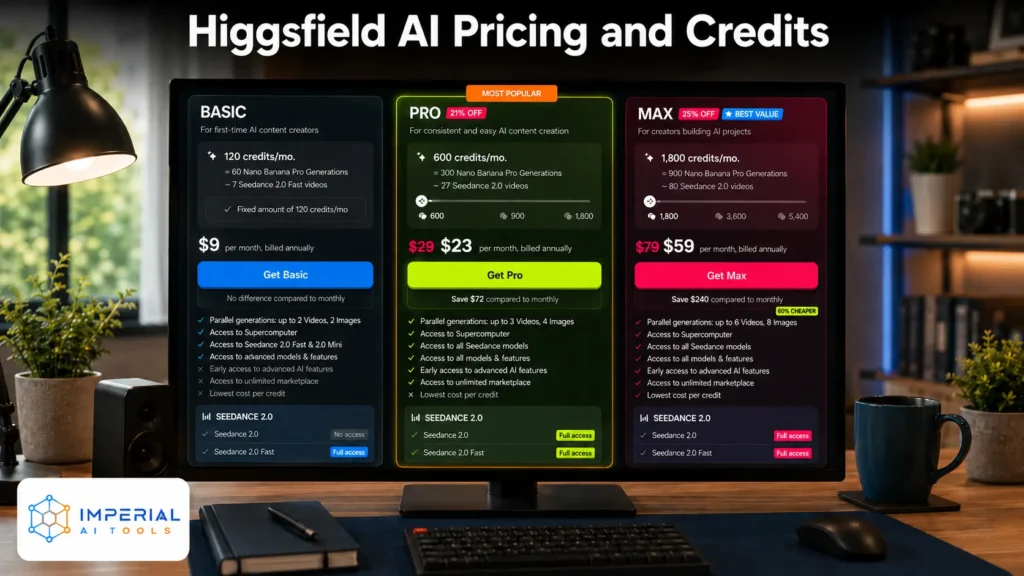
Pricing checked in July 2026. Plans, promotional discounts, credit allowances, and model access change often. Always verify the live pricing page before you buy.
Current official Higgsfield material lists Basic at about $9/month with 120 credits, Plus at $49 with 1,000 credits, and Ultra at $129 with 3,000 credits. Because the platform has restructured pricing several times, treat these as a snapshot rather than a permanent quote.
How Higgsfield credits work
Credit use depends on the selected model, whether you’re making an image or video, clip duration, resolution, audio generation, upscaling, premium effects, priority processing, and the number of outputs. Premium models and 4K output burn credits fastest.
Do Higgsfield credits roll over?
- Monthly subscription credits normally reset at the billing cycle.
- Purchased credit packs can carry their own expiration period (often around 90 days).
- Promotional credits may expire according to the specific offer.
- Unused credits can be forfeited when an account is canceled.
The official terms state that purchased and promotional credits may have set usage periods and can be forfeited after cancellation, so don’t stockpile credits you won’t use soon.
Unlimited generation options
Higgsfield promotes “unlimited” access, but read the fine print:
- Unlimited access may apply only to selected models.
- It can be sold as a limited-time plan benefit or add-on.
- Unlimited generations may run through a shared queue with dynamic speed.
- Check exactly which model, duration, resolution, and queue are covered before relying on it.
Is Higgsfield AI Free?
Yes, up to a point. Higgsfield offers free access for new users to explore the platform and generate some initial content. But premium models, higher limits, advanced features, and steady production generally require a paid plan.
Before you assume the free tier is enough, check whether sign-up requires payment, how many starter credits you get, which models are limited, whether outputs carry a watermark, how long generation queues are, what export quality you get, and any commercial-use limits. Higgsfield’s own materials confirm you can start without a subscription, while some models and higher usage need payment. Free-credit amounts shift frequently, so verify the current allowance directly on the site.
Does Higgsfield AI Have an API or Integrations?
API access
Higgsfield has moved well beyond the browser, but API availability and limits can change. Before building anything around it, confirm whether API access is publicly available for your account and plan, its usage limits, authentication method, credit consumption, and the current state of documentation. Don’t assume unrestricted access; the terms allow availability to change.
MCP, CLI, and AI agent skills
This is where Higgsfield is expanding fastest. It currently provides MCP (Model Context Protocol), command-line access, and agent-skill workflows for image and video generation, including product-photoshoot and Soul-related skills that let AI assistants generate media directly.
Worth knowing: MCP-generated images typically still consume credits, even when “Unlimited” is toggled on in the web interface.
Editing plugins
Higgsfield offers plugins for popular editing software, such as Adobe Premiere Pro, After Effects, Photoshop, and DaVinci Resolve, where supported. These plugins draw from the same account and credit balance as the web platform, so your usage is shared across surfaces.
Commercial Use, Privacy, and Safety
Commercial use on paid plans
Now that it opens, paid-plan generations can be used for commercial projects under the applicable usage terms. But responsibility sits with you: you must own or have permission to use any uploaded images, videos, music, trademarks, products, and likenesses. Third-party model terms may also apply. For client work or high-value campaigns, verify the current terms first.
Responsibility for uploaded content
Now that the user is responsible for everything they upload. That includes consent from anyone appearing in uploads, copyrighted materials, brand assets, trademarks, music and audio, personal likenesses, and how you distribute the outputs. Higgsfield’s Trust materials state that users must hold the rights to the content and likenesses they upload.
Content handling and privacy
Now opens “Higgsfield’s terms address content storage, account privacy settings, platform processing rights, moderation, data collection, account deletion, and privacy rights for international users. Notably, storage isn’t guaranteed, and the company retains the rights it needs to operate the service. Its privacy policy also explains its data-processing grounds and international privacy protections; read it if you handle sensitive or client-confidential assets.
Content restrictions
Higgsfield restricts unauthorized likenesses, explicit material, harmful or unlawful content, intellectual-property violations, impersonation, and general platform abuse.
Higgsfield AI Limitations and Troubleshooting
No AI video tool is flawless, and results depend on your model, prompt, references, settings, and scene complexity. Most problems have a straightforward fix.
| Character’s face changes | Weak or inconsistent references | Use Soul ID and the same reference set |
|---|---|---|
| Camera motion looks unnatural | Conflicting movement instructions | Use one primary camera movement |
| Product label changes | Fine text is being regenerated | Instruct the model to preserve the label |
| Hands or objects look distorted | Complex movement in the scene | Simplify the action and composition |
| The prompt is partly ignored | Too many competing instructions | Shorten and prioritize the prompt |
| Credits drain quickly | Premium model or high settings | Test with lower-cost settings first |
| Generation is slow | Shared queue or high demand | Retry later or use priority processing |
| Scenes don’t match | Models, styles, or references changed | Reuse the same settings and assets |
| The prompt is rejected | Restricted or ambiguous wording | Rewrite clearly, remove restricted content |
Important limitations to keep in mind
- Credit costs add up fast during repeated testing.
- Complex scenes often need several generations.
- Fine typography can be inconsistent.
- Character and product consistency aren’t guaranteed.
- Model availability can change without notice.
- Longer videos usually require several connected clips.
- Confidential assets deserve a careful privacy review.
The platform is provided on an “as-is” basis under its terms, so build a little iteration time into every project.
Is Higgsfield AI Worth Using?
For the right user, yes. Higgsfield is a strong fit if you produce regular videos or images, want real camera controls, build product ads, work with recurring characters, or need several models and shared team assets in one place.
It’s a good fit if you’re:
- A creator producing regular videos or images
- A filmmaker who wants camera controls
- A marketer making product ads
- An agency working with recurring characters
- Someone who wants many models in one workspace
- A team needing shared assets and projects
It’s less ideal if you:
- Only need occasional generations.
- Have a very limited budget.
- Require guaranteed typography accuracy.
- Don’t want to learn prompt and camera controls.
- Haven’t reviewed the privacy terms for sensitive work
Conclusion
Higgsfield AI bundles image generation, video creation, camera control, character consistency, marketing workflows, and editing into one connected studio. That makes it genuinely useful for both beginners and seasoned professionals as long as you understand that output quality depends on your prompts, references, model choice, and willingness to iterate.
Keep an eye on credit usage, and check current pricing and legal terms before committing to serious work.
A practical first move: start with one short project, test a single camera movement, note the credits it uses, and save the successful prompt as a reusable workflow. Build from there.
Frequently Asked Questions About Higgsfield AI
Each generation deducts credits based on the model, clip duration, resolution, audio, effect, or editing feature you select. Premium models and higher resolutions cost more, so a short standard clip is far cheaper than a 4K premium video.
es. Upload your image, tell the model what to preserve, and describe the subject movement, environmental motion, and camera behavior you want added on top of the still.
Motion-design workflows can animate visual compositions, but AI-generated typography should always be reviewed for spelling and consistency before you publish.
It handles character motion, camera movement, image animation, effects, transitions, and motion-design workflows well, though complex scenes may need several attempts.
Watermark rules vary by account, model, and plan, and they change over time. Confirm the current conditions for your exact setup before relying on watermark-free output.