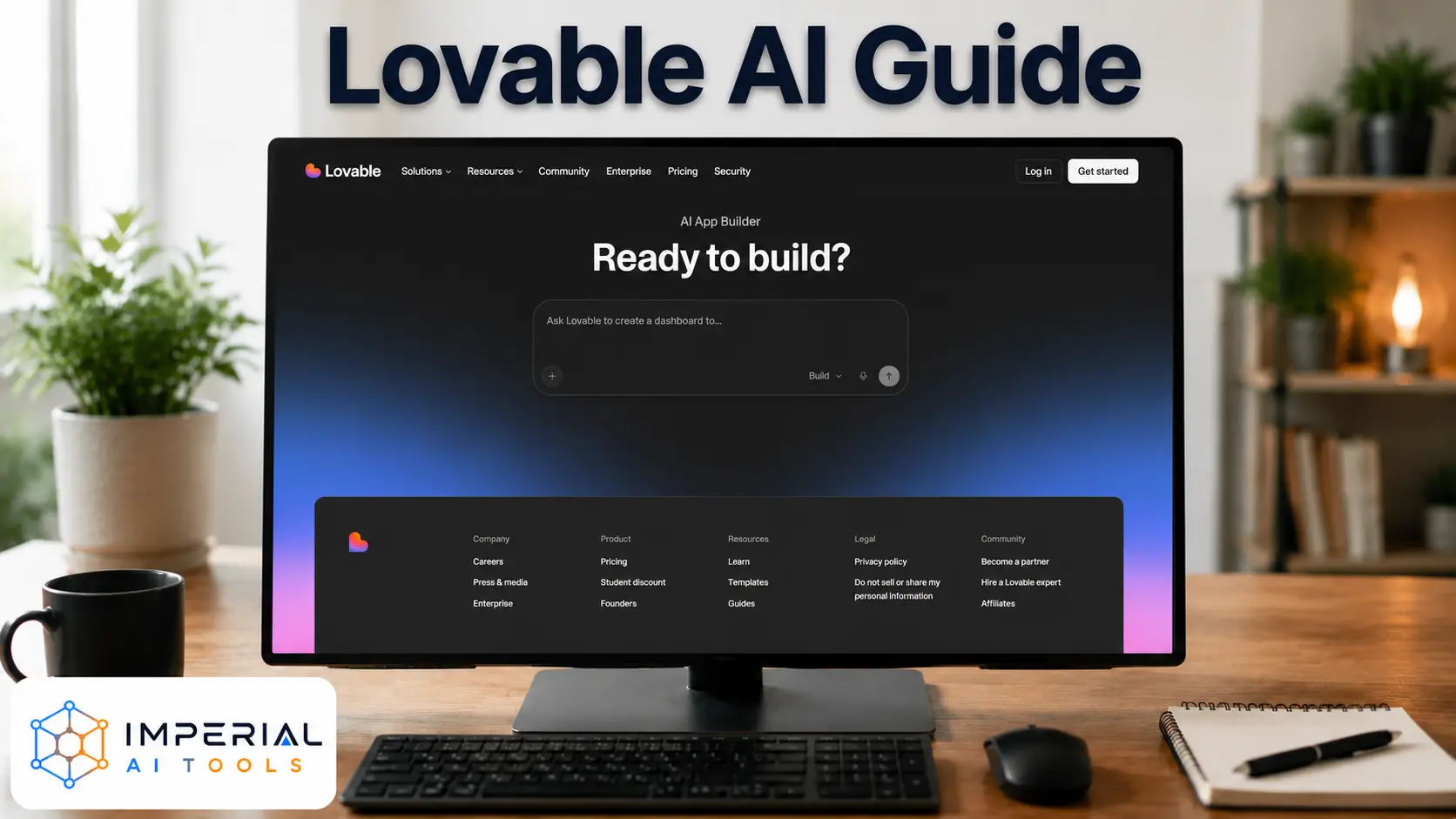

Building a functional app used to mean juggling code, design, databases, hosting, and deployment all at once. Lovable AI tries to collapse that into a single conversation: you describe what you want, and the platform generates a working app around it
This guide walks through what Lovable is, who it’s actually good for, how to use it step by step, what it costs today, and where it falls short. We’ll also cover prompting techniques that save you credits and headaches. One thing worth setting expectations on early: AI-generated apps still need human testing before you ship them to real users. Lovable speeds up the build, but it doesn’t remove the review step.
What Is Lovable AI?
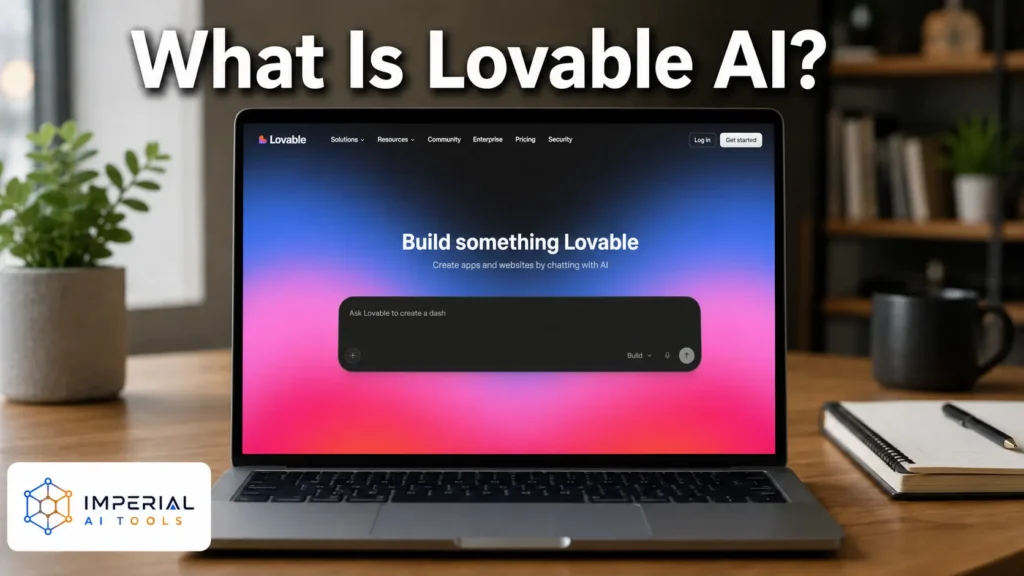
Lovable describes itself as an AI software engineer that lets you build websites and web applications by chatting with it. You start with a prompt, and the project takes shape from there, refined through follow-up chat messages, screenshots, visual editing, backend integrations, and code syncing. It differs from classic drag-and-drop website builders like Framer AI because Lovable focuses more on generating functional web applications with editable code rather than only creating visually designed websites.
A few things worth knowing up front:
- Lovable is an AI app and website builder, not just a design tool
- It’s focused primarily on web applications, not native mobile apps.
- It generates both the interface and the underlying application logic.
- It supports full-stack capabilities, including databases and authentication.
- It’s built to work for both non-technical founders and experienced developers.
How to Optimize a Lovable Website for SEO and AI Search
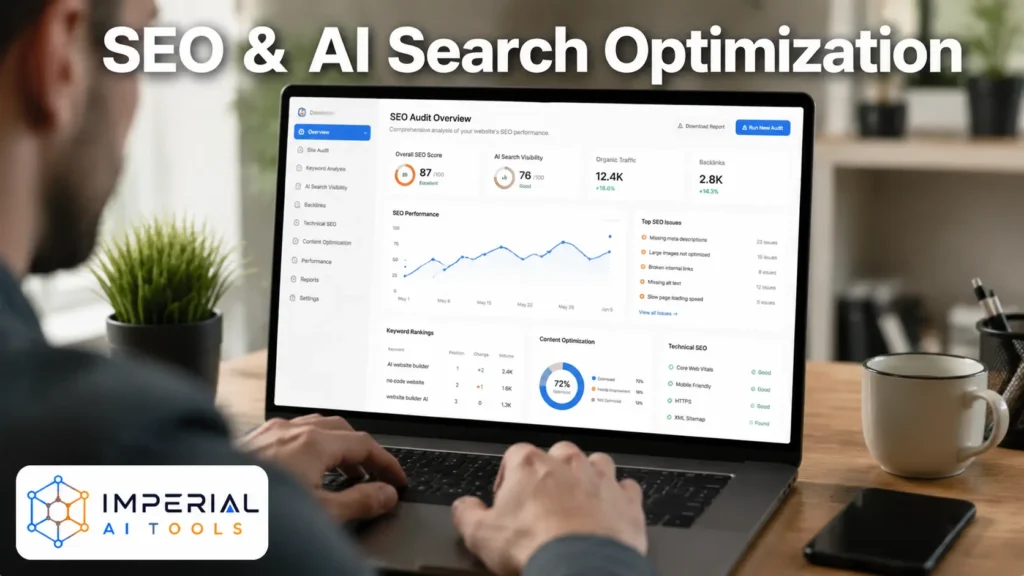
Publishing a functional website doesn’t automatically guarantee rankings. Before expecting traffic from Google, ChatGPT, Perplexity, Gemini, or other discovery platforms, you need to configure indexing, metadata, page structure, performance, and AI-search signals yourself.
Lovable currently provides an SEO and AI-search review that checks metadata, indexing, semantic HTML, accessibility, performance, structured data, sitemap settings, robots.txt, canonical tags, mobile usability, and other technical issues.
Run Lovable’s SEO and AI Search Review
Review these before launch:
- Missing or duplicate page titles
- Weak meta descriptions
- Incorrect canonical URLs
- Indexing restrictions
- Broken internal links
- Missing image alt text
- Heading-order problems
- Mobile usability
- Page-loading performance
- Sitemap and robots.txt configuration
SEO Checklist: Before launching, check title tags, descriptions, canonical URLs, sitemap, robots.txt, schema, mobile layout, page speed, internal links, image alt text, and Google Search Console connection. It differs from classic drag-and-drop builders because it writes real, editable code rather than assembling fixed templates.
Is Lovable a no-code tool? It’s closer to “low-code with an AI layer.” You don’t have to write code to get started, but developers can drop into the codebase, connect to Git, and edit directly whenever they want more control.
Lovable AI Quick Facts
| Tool type | AI full-stack web app builder |
|---|---|
| Main input | Natural-language prompts, screenshots, and design references |
| Main output | Responsive websites and web applications |
| Backend options | Lovable Cloud or Supabase |
| Code management | GitHub and GitLab synchronization |
| Publishing | Lovable URL or custom domain, depending on plan |
| Free version | Available with limited monthly usage |
| Paid price | Starts at $25 per month |
| Best for | MVPs, SaaS prototypes, internal tools, and websites |
| Native mobile apps | Not generated directly; PWA or wrapper required |
Lovable builds web applications rather than native iOS or Android apps directly. If you need an app-store presence, you’d typically publish as a PWA or wrap the project with something like Capacitor.
Who Should Use Lovable AI?
Lovable is best for
- Founders validating an app idea before committing to a dev team.
- Freelancers building client prototypes quickly.
- Marketers creating campaign landing pages or interactive tools
- Product managers test workflows before handing them to engineering.
- Developers who want to accelerate front-end work
- Small teams building internal dashboards
- Students are learning how apps are structured.
- Agencies producing fast proofs of concept for pitches
Lovable may not be ideal for
- Highly regulated applications built without technical oversight
- Complex enterprise systems that need custom infrastructure
- Teams that need native mobile apps immediately
- Users who can’t review or test the code that gets generated
- Projects with a very specialized backend architecture
- Anyone expecting every single prompt to produce production-ready output.
The verdict: Lovable is strongest when speed and experimentation matter. It’s weaker when a project needs deep infrastructure control or specialized engineering work that goes beyond what a prompt can reasonably describe.
Lovable AI Pros and Cons
| Pros | Cons |
|---|---|
| Fast initial app generation | Credit use can be hard to predict |
| Beginner-friendly prompting | Complex prompts can produce inconsistent changes |
| Full-stack capabilities | Generated code still needs testing |
| Visual and conversational editing | Debugging can consume extra credits |
| Supabase and managed backend options | Native mobile apps aren’t generated directly |
| Git synchronization | Advanced controls require higher-tier plans |
| Code ownership | Security isn’t fully automatic |
| Fast publishing | Free and Pro publishing generally provides public-link access |
Worth flagging: free and Pro published apps are accessible to anyone who has the link. Business and Enterprise plans add private and workspace-level access controls, which matter if you’re building something you don’t want indexed or discovered.
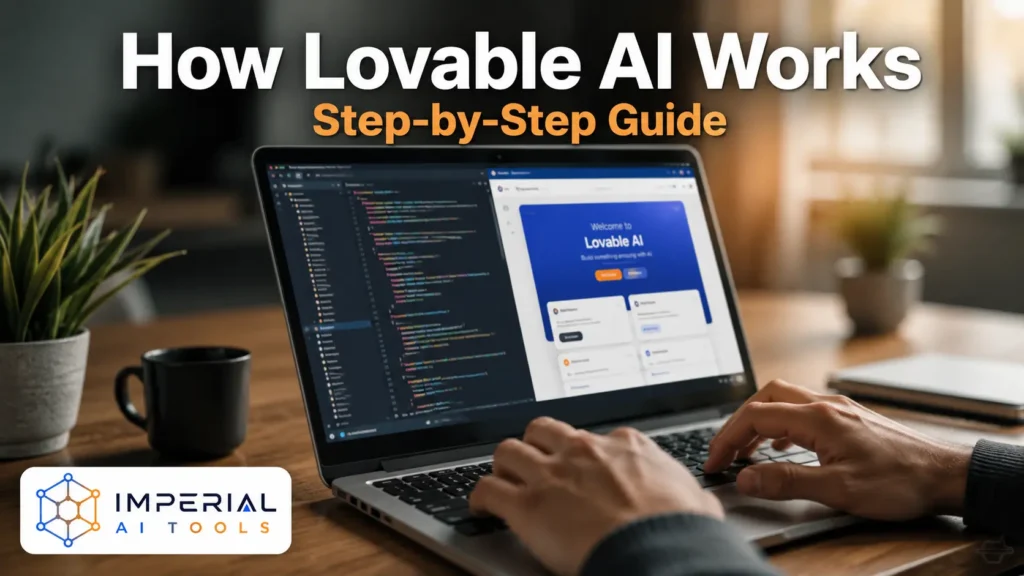
How Does Lovable AI Work? Step-by-Step Guide
Step 1: Define Your App Before Building
Before you type a single prompt, get clear on:
- Who the target users are
- The core problem the app solves
- Which pages do you actually need?
- The main action a user should take
- What data does the app need to store or display
- Any integrations you’ll rely on
- The visual direction you’re going for
Skipping this step is the number one reason people burn credits and redo work.
Step 2: Create a New Lovable Project
From the dashboard, choose a blank project or start from a template, then enter your initial prompt. If you’re planning something with several moving parts, use Plan Mode first; it lets Lovable outline an approach without touching any code yet.
Step 3: Write a Detailed Initial Prompt
A reusable structure that works well:
Build a [type of app] for [target audience]. Include [pages], [features], [data requirements], [design direction], and [technical requirements]. Do not change [constraints].
The more specific you are about constraints, the less cleanup you’ll do later.
Step 4: Generate and Review the First Version
Once the first version is generated, check:
- Overall page structure
- Mobile responsiveness
- Whether buttons and links actually work
- Placeholder content that needs replacing
- The full user journey from start to finish
- Anything obviously missing
Step 5: Edit With Chat and Visual Controls
From here, you can select an element directly and change its text, color, layout, or spacing. You can also upload screenshots to show Lovable exactly what you want changed.
The habit that saves the most credits: ask for one focused change at a time, and revert instead of stacking fixes on top of a change that didn’t work. Lovable supports prompt-based editing, image attachments, visual element selection, Plan Mode, Build Mode, version history, and reverting to previous states. Use all of them.
Step 6: Add a Backend and Authentication
You’ve got two main paths here. Lovable Cloud gives you a managed setup with a database, authentication, storage, and real-time functionality out of the box. Alternatively, you can connect a Supabase project if you want more direct backend control.
Step 7: Connect GitHub and Review the Code
Connecting GitHub or GitLab gives you a code backup, supports collaboration, enables branching, and lets you deploy externally or work in your own IDE. Lovable supports two-way Git sync, so changes made in Lovable and changes made directly in GitHub stay connected.
Step 8: Test, Scan, and Publish
Before you publish for real:
- Create a test account and check permissions.
- Test forms and any database actions
- Run a security scan
- Review the mobile layout one more time.
- Set the title, description, and favicon.
- Publish and republish after any future edits.
Publishing creates a live snapshot at a shareable URL. Edits you make afterward don’t go live until you update or republish the project, which is a common point of confusion for new users.
Lovable AI Features Explained
| Natural-language generation | Creates apps from written instructions | Faster prototyping | Output depends on prompt quality |
|---|---|---|---|
| Plan Mode | Analyzes tasks without modifying code | Reduces unnecessary changes | Each message still uses a credit |
| Build Mode | Generates or edits the project | Direct implementation | Credit cost varies by complexity |
| Visual editing | Edits selected interface elements | Easier design refinement | Complex changes may still need prompts |
| Image/screenshot input | Uses references for layout direction | Better visual matching | Results aren’t always pixel-perfect |
| Lovable Cloud | Provides managed app infrastructure | Easier backend setup | Usage consumes credits |
| Supabase integration | Adds database and authentication | More backend control | Row-level security must be configured carefully |
| Git synchronization | Connects projects with repositories | Backup and collaboration | Code review is still necessary |
| Publishing | Deploys the web app | Fast sharing and launching | Access controls vary by plan |
| AI features | Adds chatbots, summaries, and AI functions | Faster AI-product creation | AI usage adds extra cost |
Lovable’s built-in AI features can support chatbots, document Q&A, translation, image generation, semantic search, text-to-speech, and similar AI-powered functions, useful if you’re building an “AI-powered” product on top of an AI-powered builder.
How to Write Better Lovable AI Prompts
The seven-part prompt framework
- Product purpose
- Target audience
- Required pages
- Main features
- Data and backend requirements
- Visual style
- Acceptance criteria
Prompting best practices
- Plan before generating
- Define the user journey up front.
- Establish your design direction early.
- Build one component or feature at a time.
- Use realistic content instead of generic placeholder text.
- Name exact pages, routes, and user roles.
- Explain what must not be changed.
- Attach screenshots when describing visual problems.
- Ask Lovable to explain its plan before implementing.
- Revert instead of stacking fixes on top of broken code.
Lovable’s own guidance points in the same direction: plan first, map the user journey, define the visual direction early, and prompt by component rather than requesting unfocused, page-wide changes.
Credit-Saving Tip: Use Plan Mode to investigate a problem first, then combine the related changes into one precise Build Mode request. Avoid repeatedly asking Lovable to “redesign the whole thing” that’s the fastest way to burn through a monthly allowance.
Lovable AI Pricing and Credits
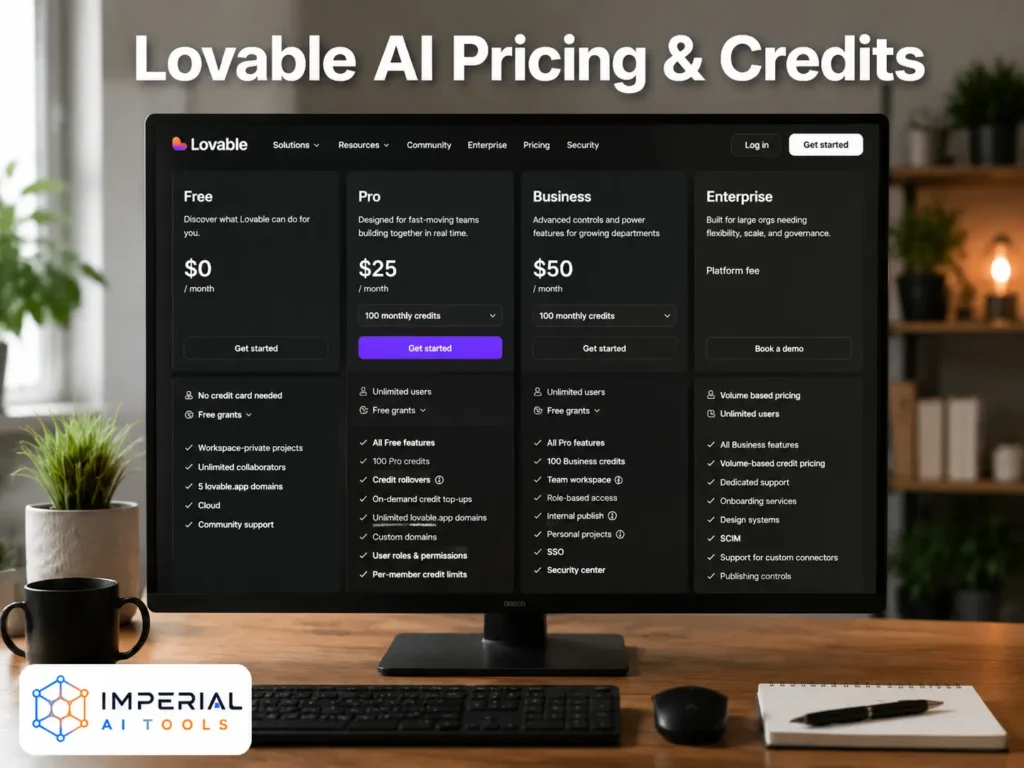
Pricing checked: July 15, 2026. Prices and credit allowances may change; verify on Lovable’s site before subscribing.
How Lovable credits actually work
- Plan Mode costs one credit per message.
- Build Mode pricing varies depending on task complexity.
- Credits cover building, Lovable Cloud usage, and in-app AI features.
- Free, Pro, and Business plans all get monthly Cloud and AI grants.
- Unused credits can expire.
- Paid plans support credit top-ups: Pro top-ups run $15 per 50 credits, Business top-ups run $30 per 50 credits.
The Free plan currently gives you five daily build credits, capped at 30 per calendar month, plus its own monthly Cloud and AI grants, enough to get a feel for the platform before committing to a paid tier.
Is there a student discount?
Verified students can currently get 50% off the Pro 100-credit plan, subject to eligibility checks and current terms.
What Can You Build With Lovable AI?
- Startup MVPs
- Authentication, dashboards, onboarding flows, and payment integration.
- Business websites
- Service websites, landing pages, and lead-generation pages.
- Internal tools
- CRMs, admin panels, inventory tools, and reporting dashboards.
- SaaS applications
- Subscription products, customer portals, and productivity apps.
- AI-powered tools
- Chatbots, content assistants, document tools, and search interfaces.
- Client prototypes
- Demos, wireframes, and interactive concepts for client approval.
Lovable is better suited to responsive web apps than to direct native-mobile development, so keep that in mind if a dedicated iOS or Android app is the end goal.
Is Lovable AI Worth It?
Lovable AI is worth considering for fast prototypes, MVPs, internal tools, and web-first products. It becomes less suitable when a project needs highly specialized infrastructure, strict native-mobile development, or heavy custom engineering.
| Nontechnical founder | Strong option for validating ideas |
|---|---|
| Freelancer | Useful for prototypes and client projects |
| Developer | Valuable for accelerating repetitive work |
| Enterprise team | Consider Business or Enterprise controls |
| Native mobile developer | Not the most direct option |
| Security-sensitive organization | Use technical review and governance controls |
Conclusion
Lovable AI turns detailed prompts into functional web applications, complete with editing, backend, code, and publishing tools built in. Its biggest strengths are speed and accessibility; you can go from idea to a working prototype in one sitting. Its biggest limitations are unpredictable credit consumption, debugging overhead, and the ongoing need for a human to review what gets generated. If you’re weighing whether this lovable AI guide’s recommendations fit your project, the short version is: great for speed and validation, less great as a total replacement for engineering judgment.
Explore more AI app builders and no-code development tools on Imperial AI Tools before choosing the right platform for your project.
Frequently Asked Questions About Lovable AI
Plan first, make one clear feature request at a time, set explicit constraints, use realistic content instead of placeholders, and review each result carefully before requesting additional changes.
It builds responsive web apps rather than native mobile apps. You can turn a published project into a PWA or wrap it in another framework for app store distribution.
Paid plans support downloading the full codebase, and projects can also be synced with GitHub or GitLab for external access.
No, users own their generated projects and code, subject to relevant third-party rights and Lovable’s platform terms.
Lovable includes built-in security tools, but you still need to review authentication, secrets, database permissions, dependencies, and generated code yourself before launching anything live.