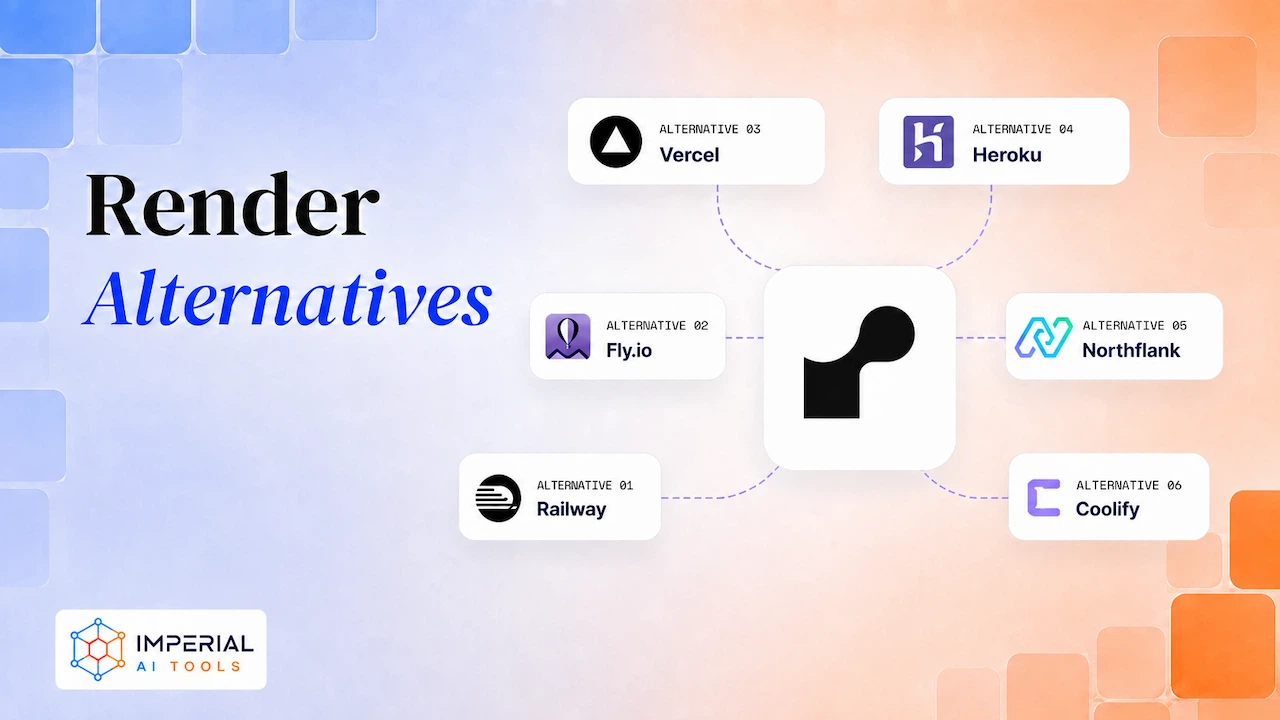

Render is a popular deployment platform for web services, APIs, databases, static sites and Docker applications, and it remains a solid choice for many projects. But its free-tier spin-down behavior, networking costs and lack of a customer-controlled Kubernetes or BYOC workflow push some developers to look elsewhere once a project moves from prototype to production. This guide ranks the eight strongest Render alternatives for 2026, compares free tiers, pricing, Docker support, static IPs and scaling, and helps you pick the right platform for your next web app.
AI is a tool, not a threat. It is meant to augment human capabilities, not replace them.
Why Look for Render Alternatives?

Most developers do not start looking for a Render alternative on day one. The motivation usually shows up when an app moves from a weekend prototype to something people actually rely on: a client demo, a paying user, a webhook that needs to respond instantly. At that point, the gap between Render’s free-tier behavior and production requirements becomes obvious, and the gap between Render’s paid pricing and a growing architecture becomes expensive.
It helps to separate the two categories. Free-tier limitations (spin-down, ephemeral storage, database expiry) mostly affect prototypes and side projects. Paid-tier limitations (workspace fees, per-seat pricing, static IP costs, the absence of a customer-facing Kubernetes or BYOC model) mostly affect teams running real production workloads. Both are valid reasons to compare alternatives.
Render Limitations That Drive Developers Away
- Pricing and usage concerns. Paid production costs combine a workspace-plan charge with compute and usage on top. Render’s plans run from Hobby at $0 up through Pro at $25 per month, Scale at $499 per month, and custom Enterprise pricing. Add a background worker, a second environment, a larger instance size or a few teammates, and the monthly total becomes harder to predict from the pricing page alone.
- Sleep and cold-start behavior. Free web services are a poor fit for anything that needs a consistently fast first response: webhooks, authentication APIs, chatbots, monitoring endpoints and customer-facing backends all suffer when a request has to wait roughly a minute for the service to wake up.
- Static IP access. Render does offer dedicated outbound IP sets, but they require the Pro plan or higher and carry an additional cost on top of compute. This matters for database allowlisting, payment-provider integrations and enterprise APIs that require a known, fixed IP.
- Kubernetes and BYOC requirements. Render does not expose a customer-facing Kubernetes or bring-your-own-cloud deployment model. Teams that need Helm charts, customer-owned infrastructure or genuine multi-cloud deployment typically look at Northflank or a self-hosted platform instead.
- Timeout and execution constraints. Render enforces fixed deployment-command limits, including a 120-minute build command, a 30-minute pre-deploy command and a 15-minute start command. These are workload-specific execution limits rather than a sign that Render caps HTTP response time unusually short; Render web services can serve responses lasting up to 100 minutes.
Quick Comparison Table
| Tool | Best for | Starting price | Free plan |
|---|---|---|---|
| Railway | Simple backend deployment | Hobby $5/mo min. | 30-day $5 trial, then $1/mo credit |
| Fly.io | Global, latency-sensitive apps | Usage-based, from ~$2/mo | Trial credit only, no permanent free tier |
| Coolify | Self-hosting and full control | Free (self-hosted) + server cost | Yes, unlimited on your own server |
| Northflank | Kubernetes and BYOC | From ~$2.70/container | Always-on free sandbox |
| Heroku | Classic PaaS workflows | Eco $5/mo; Basic $7/mo | No permanent free tier |
| Vercel | Next.js and full-stack JS | $0 Hobby; Pro $20/mo | Yes, generous for frontend |
| Netlify | Static sites and JAMstack | $0; Personal $9/mo | Yes, 300 monthly credits |
| Sliplane | Predictable Docker hosting | €9/mo | No permanent free tier |
01

Railway
Research · App Deployment Platform
Fast setup and a genuinely clean interface make Railway the closest overall match for developers who liked Render’s simplicity but want different scaling limits. It handles web apps, APIs, workers, databases and containerized services from a single dashboard, with GitHub deploys and Dockerfile support built in from day one.
- Git-based deployment feels almost identical to Render, minimizing the learning curve for switchers.
- Usage-based billing with per-second granularity instead of fixed instance tiers.
- Automatic builds, logs and one-click deployment rollbacks are all included by default.
- Static outbound IPs require the Pro plan, so it is not automatically the cheapest option for database allowlisting.
- The permanent free tier is thin: a 30-day trial credit drops to just $1 in monthly credit afterward.
Best for Startups and solo developers migrating from Render with minimal workflow changes.
02

Northflank
Research · Kubernetes + BYOC
(Bring Your Own Cloud)) Platform
Northflank is a container and application platform built for teams outgrowing a basic PaaS. It supports Kubernetes-based orchestration and bring-your-own-cloud deployment across AWS, Google Cloud, Azure and other providers, directly addressing the gap Render leaves for enterprise and multi-cloud workloads.
- Always-on free sandbox with no sleeping, including two free services, one free database and two free cron jobs.
- BYOC and Bring Your Own Kubernetes support that Render simply does not offer.
- Autoscaling, preview environments, GPUs and release workflows built in for growing teams.
- The larger feature set creates a steeper learning curve than Railway or Render for a solo developer.
- BYOC and enterprise costs depend heavily on the underlying cloud infrastructure chosen.
Best for Enterprise teams, regulated workloads and multi-cloud environments.
03

Vercel
Research · Global App Hosting
Optimized for Next.js and modern JavaScript frameworks, Vercel is not a direct replacement for every persistent Render backend, but it is a stronger frontend workflow than anything Render offers, with preview deployments, a global CDN and serverless or Fluid Compute functions built in.
- Git-based automatic deployments with preview URLs on every pull request.
- Global CDN, edge middleware and built-in analytics without extra configuration.
- Not a general-purpose Docker host; persistent containers and arbitrary background processes are not the intended use case.
- Shared static egress IPs cost $100 per project monthly on Pro and Enterprise plans.
Best for Next.js projects, frontend-heavy apps and SaaS dashboards.
04

Coolify
Research · Self-Hosted PaaS
An open-source PaaS installed on a VPS, dedicated server, cloud VM or even a local machine, Coolify gives developers a Render-like control panel while keeping infrastructure and data fully under their own control. It supports GitHub, GitLab, Bitbucket and Gitea, along with Dockerfile and Docker Compose deployments.
- Self-hosted Coolify is free forever, removing per-service platform pricing entirely.
- Automatic SSL, backups, webhooks and multi-server deployment with Docker Swarm support.
- No sleep behavior; the user controls uptime rather than the platform’s spin-down policy.
- Server security, OS updates, backups and infrastructure availability all become the user’s responsibility.
- Static IP support depends entirely on the underlying VPS or cloud network, not a built-in platform feature.
Best for Developers comfortable managing a VPS and agencies hosting multiple apps.
05

Fly.io
Research · Global App Hosting
Built around lightweight Fly Machines, Fly.io runs applications close to users across multiple regions instead of a single data center. It is more infrastructure-oriented than Render or Railway, which makes it the strongest pick when geographic placement and network control matter more than dashboard simplicity.
- Genuine multi-region application placement with anycast networking and private networking between services.
- Static egress IPs cost roughly $3.60 per month, well under Render’s Pro-only static IP pricing.
- Managed Fly Kubernetes is available for teams that eventually need it.
- No permanent free tier for new accounts; only legacy organizations retain free allowances.
- Usage-based billing across compute, storage and bandwidth is harder to forecast than Render’s flat instance pricing.
Best for Globally distributed APIs and latency-sensitive applications.
06

Netlify
Research · Static Site + JAMstack Hosting
Netlify focuses on static sites, frontend frameworks, serverless functions and edge functionality. It is a strong alternative to Render’s static-site hosting rather than a universal backend replacement, with continuous Git deployment and Deploy Previews at the core of its workflow.
- Deploy Previews and a global CDN make frontend review cycles fast and reliable.
- Forms, blob storage and edge functions cover common frontend needs without extra services.
- No standard general-purpose Docker-container runtime for persistent backend services
- Not a substitute for long-running workers or arbitrary Docker applications that Render can host.
Best for Static websites, documentation, blogs and JAMstack projects.
07

Sliplane
Research · Docker Hosting Platform
A European cloud platform built around simple, predictable container hosting, Sliplane charges per server rather than per application container. That single change addresses one of the most common complaints about Render’s per-service pricing model as an app portfolio grows.
- Flat monthly pricing per server, with unlimited services on that server subject to available resources.
- Push-to-deploy from GitHub or a Docker image, with zero-downtime deployments and free SSL included.
- No permanent free hosting tier, unlike Render’s free static sites and eligible free web services.
- A smaller ecosystem and more limited region selection than large global platforms.
Best for Docker-based side projects, European applications and small agencies.
08

Heroku
Research · Classic PaaS
A long-established PaaS known for Git-based deployments, buildpacks and a mature add-on marketplace, Heroku is no longer a free Render replacement, but it remains relevant for teams that already know its workflow or rely on its extensive integration ecosystem.
- A deep add-on marketplace and Review Apps make it strong for conventional web apps and APIs.
- Both Git and Docker deployment paths, through Container Registry or heroku.yml.
- No permanent free compute tier; Eco starts at $5 per month and still sleeps after 30 minutes.
- A fixed 30-second web response timeout, far shorter than Render’s allowance for long-running responses.
Best for Teams already familiar with Heroku’s ecosystem and workflow.
Best by Use Case
- Best overall
- Railway, for developer experience and simplicity
- Best for global apps
- Fly.io, for multi-region and edge deployment
- Best self-hosted
- Coolify, for full infrastructure control
- Best for Kubernetes/BYOC
- Northflank, for enterprise and regulated workloads
- Best for frontend
- Vercel or Netlify, depending on framework and hosting needs
- Best predictable Docker hosting
- Sliplane, for per-server flat pricing
Imperial AI Tools Verdict
No single platform replaces every Render feature, so the right pick depends on the workload. Railway is the top pick overall: it offers the closest match to Render’s simplicity, with Git-based deployment, Docker support and usage-based pricing that suits startups and solo developers who want minimal workflow changes.
Northflank is the strongest runner-up for teams that have outgrown a basic PaaS and need Kubernetes, BYOC or enterprise-grade compliance. Fly.io remains the best choice when global, latency-sensitive deployment is the deciding factor, and Coolify is the clear winner for anyone willing to manage a VPS in exchange for zero platform fees.
Compare actual compute, bandwidth, database and networking requirements rather than choosing by advertised starting price alone. For a deeper side-by-side, explore the detailed Railway vs Render comparison guide.
Frequently Asked Questions
Render offers free static sites and eligible free web-service instances, but the free tier has real restrictions. Free web services spin down after 15 minutes without traffic, share 750 monthly instance hours, and use ephemeral storage. Free PostgreSQL databases also expire after 30 days, so production applications usually require paid resources.
Render’s cloud-hosting platform is not an AI image-rendering tool. To use Render hosting for free, create an account, connect a Git repository, then create an eligible web service or static site and select the Free instance type. Check the sleep, storage, bandwidth and database restrictions before deploying anything production-facing.
Coolify is often the cheapest option across multiple applications, since self-hosted Coolify is free and you only pay for the underlying VPS. Railway can be cheaper for a single very small application. Always compare actual CPU, RAM, storage and bandwidth usage rather than trusting advertised starting prices alone.