
Finance teams still lose hours to the same manual grind. They chase receipts, code transactions, key in invoices, enforce policies, and prep month-end reports by hand. This Ramp AI guide shows how the platform removes most of that busywork, how its AI agents actually work, and whether it earns a spot in your stack. You will get the core features, real pricing, a setup walkthrough, integrations, security controls, and honest limits. We also cover global availability and who should skip it. Every figure here was checked against Ramp’s official pages in July 2026. One thing to set straight early: Ramp is a business finance platform, not a consumer budgeting chatbot. If Ramp does not match your workflow, browse all AI tools on Imperial AI Tools to compare more options for finance, automation, productivity, and business operations.
What Is Ramp AI?
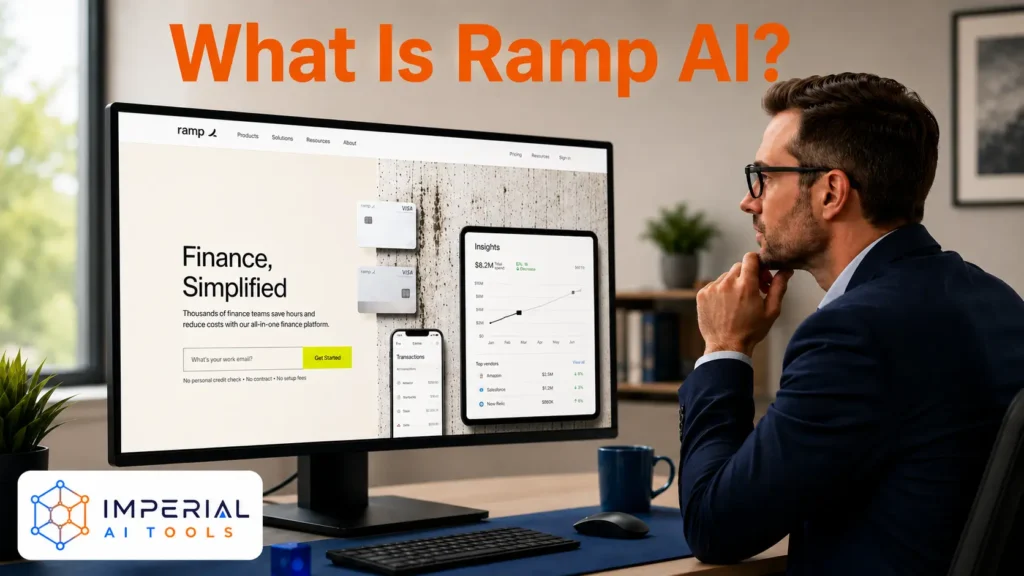
Ramp AI is a set of AI features built into Ramp’s finance platform. It handles receipts, expense coding, invoice processing, approvals, fraud checks, and reporting. Ramp calls this layer Ramp Intelligence. It leans on AI agents, OCR, and your own company data.
Ramp sits at the center of a company’s spending. The AI supports corporate cards, expense management, accounts payable, accounting automation, procurement, reporting, and spend controls. It is not a general chatbot bolted onto a dashboard. Instead, it uses specialized agents, optical character recognition (OCR), your written policies, past transactions, and workflow rules to get work done.
According to Ramp, its agents run on leading large language models and learn each company’s policies and historical data. That context is what lets them code an invoice the way your accountant would, rather than guessing.
Is Ramp an AI Company?
Not exactly. Ramp is first a financial technology and finance operations company. Its core products are corporate cards, bill pay, expense management, and accounting automation. AI runs through the whole platform, yet the business being sold is spend management, not a model.
Ramp AI vs. Ramp Intelligence
People search “Ramp AI,” but Ramp’s official name for these capabilities is Ramp Intelligence. Treat them as the same thing with two labels. Throughout this guide, “Ramp AI” refers to Ramp Intelligence and its agents.
How Does Ramp AI Work?

Ramp AI captures data from cards, receipts, invoices, and connected systems. OCR and AI pull out the key details, then code and check each item. Routine tasks run automatically, while unclear or risky ones get escalated for a human to review.
You can picture the flow as five simple steps:
- Ramp receives information from cards, receipts, invoices, policies, and connected accounting tools.
- OCR and AI extract the important transaction details, including line items.
- The system categorizes, codes, and checks the data against your rules.
- Routine or low-risk tasks move through automated workflows.
- Unclear, unusual, or high-risk activity gets flagged for human review.
- Rules-based automation
- Follows the fixed conditions you set in advance.
- Artificial intelligence
- Reads context and learns from past activity.
- AI agents
- Complete multi-step finance tasks inside defined controls.
Ramp is direct on the guardrail: “no money ever moves without a human confirmation,” and every agent decision stays transparent, auditable, and adjustable.
Ramp AI Features and Capabilities

Ramp AI is really a bundle of connected tools. The table below maps each feature to what it automates and who uses it most.
| Feature | What it automates | Primary user |
|---|---|---|
| Receipt automation | Collecting and matching receipts | Employees and finance teams |
| Expense coding | Assigning categories and accounting fields | Accountants |
| Invoice processing | Extracting and coding invoice data | AP teams |
| Policy agent | Checking expenses against company rules | Finance admins |
| Approval summaries | Reviewing routine requests and exceptions | Managers and controllers |
| AI reporting | Building reports and spending insights | CFOs and FP&A teams |
| Fraud detection | Flagging suspicious charges or invoices | Finance and risk teams |
| Ramp Sheets | Spreadsheet analysis and questions | Analysts |
| AI spends intelligence | Tracking AI, API, and software costs | Finance and engineering |
AI-Powered Expense Management
This is where most teams feel the difference first. Ramp handles the receipt and expense chores that usually eat up a Friday afternoon. Key jobs include:
- Automatic receipt collection through SMS, email, and Slack
- Receipt-to-transaction matching without manual hunting
- Memo drafting and expense categorization
- Policy violation detection before spending is approved
- Missing-document reminders sent to the right person
- Card controls set by role, merchant, or amount
Ramp AI Agents
Agents are the headline feature. They do not just flag work; they complete it inside your controls. Ramp’s agents can:
- Answer policy questions in plain language
- Recommend routine approvals with vendor context
- Escalate risky or unusual transactions
- Apply your past invoice-coding logic to new bills
- Spot suspicious activity and possible fraud
- Give approvers the background they need to decide fast
Ramp ships specialized agents for accounts payable and for controllers. The company reports that its Agents for Controllers automate roughly 85% of expense reviews and catch far more out-of-policy spend than older rule-based flags. Read these as company-reported figures, not independent test results. If agents are new to you, our explainer on how AI agents work is a good primer.
Ramp’s CTO framed the AP agents as “nearing 100% automation in certain cases,” while stressing that humans still confirm payments.
AI Invoice Processing and Accounts Payable
Accounts payable is Ramp AI’s strongest lane. The AP flow runs from an invoice landing in the inbox to a synced payment. It covers:
- Invoice data and line-item extraction
- GL coding suggestions based on your history
- Two-way and three-way matching against POs and receipts
- Approval routing by amount, role, or department
- Vendor payment prep and ERP sync
Ramp states that its invoice OCR captures details and line items with 99% accuracy, and that it moves invoices about 2.4x faster than legacy AP software. Again, those are Ramp’s own numbers.
AI Reporting and Financial Insights
Reporting turns raw spend into answers. Ramp AI helps teams build custom reports, run spend analysis, track budget versus actual, watch policy compliance, review vendor trends, and schedule report exports. The goal is fewer late nights rebuilding the same spreadsheet each month.
Ramp Sheets AI
Ramp Sheets is an AI-first spreadsheet and analysis surface. You can ask plain questions about your workbook data and dig into why a number moved. Think of it as a finance-aware assistant sitting inside a familiar grid, useful when a chart raises more questions than it answers.
AI Token Spend Intelligence
This is the newest and most modern piece. Ramp now pulls usage and cost data from AI providers, then shows it next to your invoices, subscriptions, and card charges. Supported connections include Anthropic, OpenAI, and OpenRouter, with Gemini and Cursor also referenced and more on the way. Finance teams can break AI spend down by provider, model, user, or project. It rolled out in early access during 2026 and has been expanding since, so availability may vary by plan and account.
How to Use Ramp AI: Step-by-Step Setup
Getting value from Ramp AI is less about switches and more about clean setup. Here is a practical order that works for most teams.
- Create or access a Ramp account
- Eligibility can depend on your company’s location, structure, and financial profile, so confirm it early.
- Connect your accounting software
- Common picks include QuickBooks, Xero, NetSuite, Sage Intacct, Microsoft Dynamics, Oracle Fusion Cloud, and Workday.
- Import your accounting structure
- Bring in your chart of accounts, departments, locations, entities, vendors, cost centers, and custom dimensions.
- Create expense and approval policies
- Set spending limits, receipt rules, restricted merchants, approval levels, department rules, and travel policies.
- Enable the right AI features
- Turn on receipt matching, AI coding, policy checks, invoice processing, approval summaries, and reporting.
- Test the workflow
- Run a small pilot group before you roll Ramp out company-wide.
- Review and improve
- Correct any coding misses, watch policy outcomes, and keep humans on final approvals.
Ramp AI Use Cases
The clearest way to judge a tool is to match it to real problems. The table below pairs a common finance headache with the Ramp AI job that eases it.
| Business need | Ramp AI use case |
|---|---|
| Missing receipts | Collect and match receipts automatically |
| Slow invoice entry | Extract and code invoice data |
| Inconsistent categorization | Apply your historical accounting logic |
| Policy violations | Flag or block non-compliant spend |
| Delayed approvals | Recommend and route decisions |
| Month-end crunch | Sync coded transactions to accounting |
| Low spend visibility | Generate reports and compliance views |
| Vendor overbilling | Compare invoices, POs, and receipts |
| Runaway AI costs | Track AI usage, subscriptions, and API spend |
Small Business Use Cases
Smaller teams gain the most in time saved. Ramp cuts admin work, keeps receipts tidy, handles basic reporting, and processes invoices without a dedicated AP hire. The free tier alone often covers a lean startup.
Mid-Market and Enterprise Use Cases
Larger companies lean on the harder features: multi-entity accounting, deep ERP connections, complex approval chains, international card management, custom roles, and high invoice volumes. This is also where paid plans start to pay off.
Ramp AI Pricing
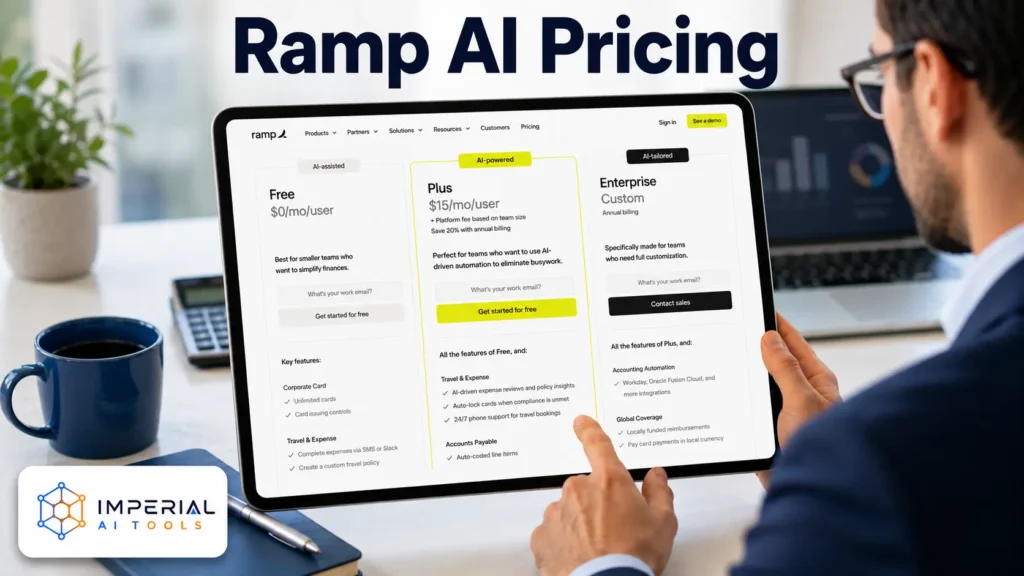
Pricing last checked: July 17, 2026. Plans and fees change, so confirm current numbers on Ramp’s official page before you buy.
A few extra notes worth knowing:
- Ramp advertises about 20% savings on annual Plus billing.
- Plus adds a platform fee that scales with team size.
- Procurement is offered as an add-on to Plus or Enterprise.
- In 2026, Ramp introduced per-transaction fees on some bill-pay methods, often waived when funded from a Ramp account.
- Enterprise pricing requires a sales conversation.
Ramp AI Integrations
Ramp is built to plug into your current stack rather than replace it. The company advertises more than 200 integrations, including 40-plus accounting systems and ERPs. Here are the ones teams ask about most, grouped by type.
Accounting and ERP
QuickBooks, Xero, NetSuite, Sage Intacct, Workday Financial Management, Microsoft Dynamics, Oracle Fusion Cloud, and Zoho Books.
HR and Identity
ADP, BambooHR, Gusto, Okta, UKG, and Workday.
Productivity and Procurement
Slack, Microsoft Teams, Asana, Jira, DocuSign, and Ironclad.
Is Ramp AI Secure and Reliable?

Ramp automates routine financial tasks while keeping humans in control of money and final approvals. Agent decisions are transparent, auditable, and adjustable. For sensitive data handling, Ramp points customers to its Trust Center for security details.
Human Oversight
The model is automation with a safety net. Routine tasks run on their own, while risky or unclear cases get escalated. Final financial controls stay with authorized employees, and AI recommendations are still meant to be reviewed, not rubber-stamped.
Transparency and Auditability
Ramp says every agent decision is transparent, auditable, and adjustable. That matters for audits and for trust: your team can trace why an agent coded or flagged something and change the logic when needed.
Data Use and Privacy
Before rollout, check how your data is handled. Ask about subprocessors, data retention, access controls, user permissions, integration permissions, and regional compliance. Ramp directs customers to its Trust Center for these details.
An Honest Reliability Note
No AI is error-free, and Ramp does not claim to be. OCR, coding, and recommendations cut manual work, yet they can still miss. The safe habit is simple: test workflows, review exceptions, and keep a human on the final call.
Is Ramp AI Available Worldwide?
Ramp is strongest in the United States and historically requires a US-registered entity. It runs card programs in the UK and EEA and, as of 2026, plans wider onboarding for UK and EU-headquartered businesses. Availability and AI features still vary by region.
The nuance matters for global readers. Ramp has long served US companies, including those with international subsidiaries. It launched localized card programs in the UK and the European Economic Area through its banking partners. In 2026, following its acquisition of a European payments provider, Ramp announced plans to begin onboarding UK and EU-based businesses and opened a waitlist. Local-currency card issuance sits on the Enterprise plan, and Ramp cards run on Visa, which is accepted in 200-plus countries. Product eligibility, payments, banking services, and some AI features can differ by market, so confirm regional availability directly with Ramp before you apply.
Ramp AI Benefits and Limitations
No platform is all upside. Here is a balanced view to weigh before you decide.
| Benefits | Limitations |
|---|---|
| Cuts repetitive finance work | Some features need paid plans |
| Automates receipts and invoices | Plus adds a platform fee |
| Improves policy enforcement | Initial setup still takes effort |
| Connects with major accounting systems | Recommendations may need correction |
| Strong reporting and spend visibility | Availability differs by region |
| Many workflows in one platform | Small teams may not need it all |
| Human review of money movement | Switching systems means migration work |
Who Should Use Ramp AI?
Good fit
- Teams are already eyeing Ramp cards or expenses
- Finance teams with heavy receipt and invoice volume
- Companies needing stronger spend controls
- Users on supported accounting or ERP platforms
- Multi-entity organizations
- Teams are consolidating several finance tools
May not fit
- Individuals managing personal finances
- Companies in unsupported regions
- Businesses wanting crypto services
- Very small teams with little spend
- Orgs needing an unsupported integration
- Teams unwilling to review AI decisions
One reminder worth repeating: Ramp AI is a business finance platform, not a personal budgeting chatbot. If you run a company, spend, it belongs on your shortlist. If you track a household budget, look elsewhere.
What Is the Ramp AI Index?
The Ramp AI Index is a research dataset, not a finance agent. Ramp Economics Lab uses real spending data from tens of thousands of businesses to measure how companies adopt and spend on AI. It tracks adoption rates, vendor trends, and now the intensity of AI use.
People often confuse the Index with Ramp’s automation tools, but they are separate. The Index is a monthly measurement of AI adoption and spend among American businesses, drawn from transaction data across 70,000-plus firms. Ramp Economics Lab, led by economist Ara Kharazian, uses it to study adoption rates, vendor concentration, industry trends, company-size patterns, and shifts in business AI spending. Its recent versions also track spend per employee and the split between subscriptions, coding agents, and API tokens. You can explore it on Ramp’s AI Index page.
Final Verdict: Is Ramp AI Worth Using
Ramp AI is most valuable for teams that want one connected system for corporate spend, expense management, invoice processing, accounting automation, approvals, and reporting. The Free plan gives smaller teams a low-risk way to test the platform. Plus and Enterprise suit organizations that need deeper automation, multi-entity support, and custom setup. Still comparing platforms? Explore our complete AI tools directory to find alternatives for accounting, expense management, automation, and team productivity. Ramp AI is a strong candidate. If your needs are tiny or region-blocked, it may be more than you require.
Conclusion
Ramp AI takes a lot of the manual grind out of finance work: chasing receipts, re-coding the same transactions, waiting on approvals, and piecing together reports by hand. What makes it stand out isn’t just the automation itself, but the balance it strikes: routine work moves fast, while anything unclear or risky still lands in front of a real person before money moves.
Whether Ramp AI is the right call for your business comes down to scale and complexity. Smaller teams can get real value out of the Free plan without spending anything. Growing finance teams that need advanced approval logic, deeper ERP connections, and AI-driven expense reviews will likely find Plus worth the added cost. And larger, multi-entity organizations will probably end up talking to Ramp’s sales team for an Enterprise setup built around their specific structure.
Whichever tier fits, the same advice applies: start small, test the workflow with a limited group, and keep reviewing the AI’s recommendations as you scale up. That’s what turns Ramp AI from a nice feature list into an actual time-saver for your team.
Frequently Asked Questions
Yes. Ramp uses specialized finance agents, including agents for accounts payable and for controllers. They handle routine tasks, recommend actions, apply your coding logic, enforce policies, and escalate uncertain or risky decisions to a human.
Sign up for Ramp’s Free plan to access receipt matching, invoice OCR, basic expense coding, and AI reporting at $0 per user. Advanced workflows and integrations require Plus or Enterprise.
No. Ramp states that money does not move without human confirmation. Unclear or risky actions are escalated for review, and every agent decision stays transparent, auditable, and adjustable by your team.
Ramp connects with QuickBooks, Xero, NetSuite, Sage Intacct, Workday, Oracle, Microsoft Dynamics, Slack, ADP, and many more. The company advertises 200-plus integrations, plus custom CSV exports and an open API for tools not listed.
No. Ramp AI belongs to Ramp Business Corporation’s finance platform. Ramp Network is a separate cryptocurrency infrastructure company. The names look alike, but the products and companies are unrelated, so do not confuse the two.