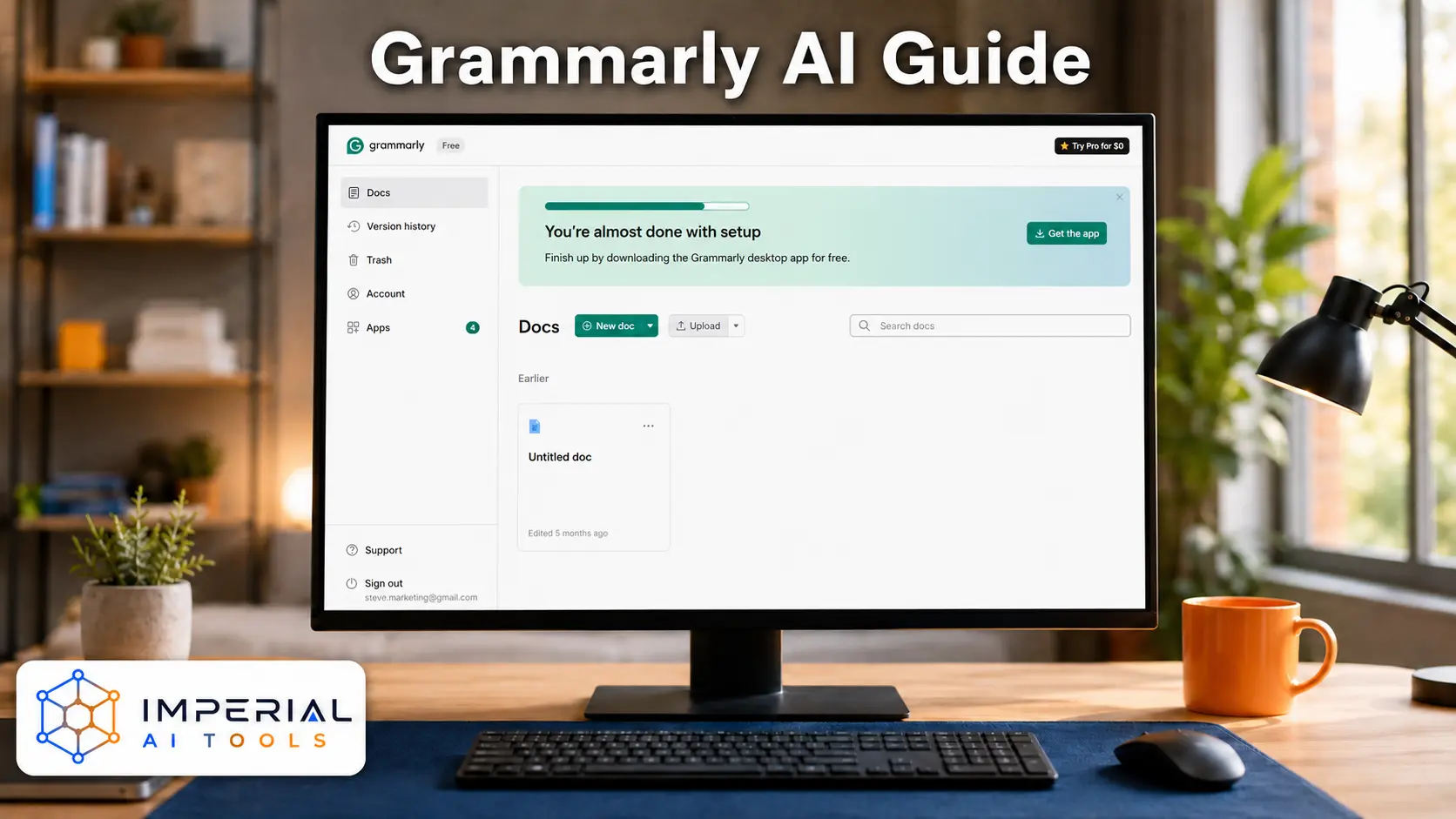

Writing a professional email, essay, or client report takes more than correct spelling. You need clarity, the right tone, solid sentence structure, and the confidence to hit send without a second read-through. Grammarly AI is built to help close that gap.
This Grammarly AI guide covers what the tool does, how its AI features work, what you get free versus what you pay for, and where it still falls short. We’ll also dig into the Grammarly AI detector, a topic most guides mention but rarely explain well, plus honest use-case advice for students, bloggers, and professionals deciding whether it’s worth adding to their workflow. Grammarly doesn’t replace a human writer or editor; it’s an assistant, not a ghostwriter, and the best results still come from reading your own work before you hit send.
What Is Grammarly AI?
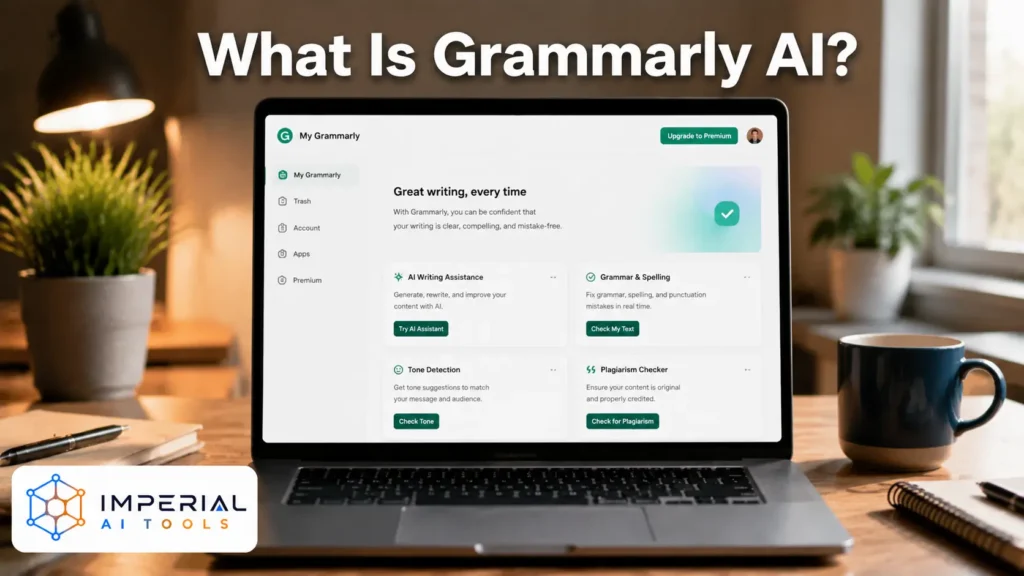
Grammarly AI is an AI-powered writing assistant designed to help people write more clearly and correctly, no matter what they’re working on. It checks grammar, catches spelling mistakes, improves sentence structure, suggests tone adjustments, rewrites clunky passages, summarizes long text, and generally acts as a second set of eyes on anything you write.
It’s built into browsers, desktop apps, mobile keyboards, and document platforms like Google Docs and Microsoft Word, so the suggestions show up wherever you’re already typing rather than forcing you into a separate app.
Grammarly AI Quick Facts
| Tool type | AI writing assistant |
|---|---|
| Main function | Writing improvement |
| Best for | Students, professionals, marketers, businesses |
| Platforms | Browser, desktop, mobile, extensions |
| AI features | Rewrite, generate, summarize |
| Pricing | Free and Premium plans |
How Does Grammarly AI Work?
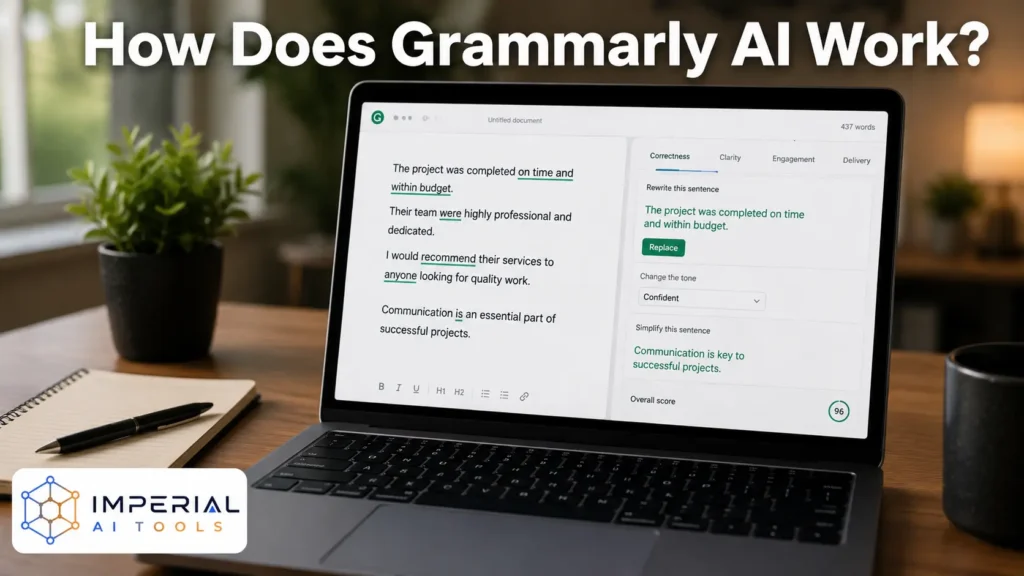
1. Analyzing Your Writing
As you type, Grammarly scans for grammar mistakes, awkward sentence structure, weak vocabulary, and tone that doesn’t match your intent: a casual message that reads too stiff, or a client email that comes off too blunt. It’s also checking things like passage length, sentence variety, and whether you’re overusing certain words or phrases without you noticing.
2. Providing AI Suggestions
Suggestions appear in real time, usually underlined or flagged in the sidebar, along with a short explanation of why the change is suggested. You can accept them with a click, reject them, or ignore them entirely. The goal is readability. Grammarly isn’t trying to rewrite your voice, just tighten it up. This distinction matters: the suggestions are recommendations, not corrections you’re forced to accept, and you stay in control of the final wording.
3. Generating and Rewriting Content
Beyond catching errors, Grammarly’s AI can rewrite full paragraphs, adjust tone (more formal, more friendly, more concise), and simplify sentences that have gotten away from you. This is where it starts to feel less like spell-check and more like an actual writing partner. You can also prompt it directly, ask it to shorten a paragraph, make an email friendlier, or turn a rough outline into full sentences, which is closer to how a lot of people now use AI writing tools generally, rather than just relying on passive suggestions.
Grammarly AI Features Explained
| Grammar checker | Fixes grammar errors | Everyday writing |
|---|---|---|
| Spell checker | Finds spelling mistakes | Documents |
| AI rewrite | Improves sentences | Better clarity |
| Tone detector | Suggests a communication style | Emails |
| Plagiarism checker | Checks copied content | Academic/business |
| AI detector | Analyzes AI-generated text | Content verification |
| Citation generator | Helps with citations | Research writing |
| Summarizer | Shortens content | Quick reading |
| Paragraph rewriter | Improves paragraphs | Blogging |
| Writing suggestions | Improves style | Professional writing |
A few of these deserve extra attention. The tone detector is genuinely useful if you send a lot of client or team communication; it flags when a message might read colder or more aggressive than you intended, before you hit send. It’s saved plenty of people from an email that looked fine on screen but landed wrong in someone’s inbox.
The AI rewrite feature is the closest thing to having an editor look over your shoulder, especially for run-on sentences or ideas that got tangled halfway through. You can ask it to make a passage more concise, more formal, or simpler, and it’ll offer a rewrite you can accept, tweak, or ignore.
The summarizer is worth using more than most people do. Drop in a long report or article, and it’ll pull out the core points handy for skimming research before a meeting or condensing your own long draft into a tighter version.
The plagiarism checker and AI detector are worth understanding clearly, since they are most often misused. The plagiarism checker compares your text against a large database of published content and flags overlapping passages, useful for students and content writers who want to confirm originality before submitting work. The AI detector works differently: it estimates the probability that text was AI-generated based on writing patterns, not by comparing against a database. That distinction matters, and we’ll cover it in more detail further down.
The citation generator is a smaller feature but a real time-saver for anyone writing research papers it formats references in common styles without you having to look up the exact punctuation rules every time.
How to Use Grammarly AI: Step-by-Step Guide
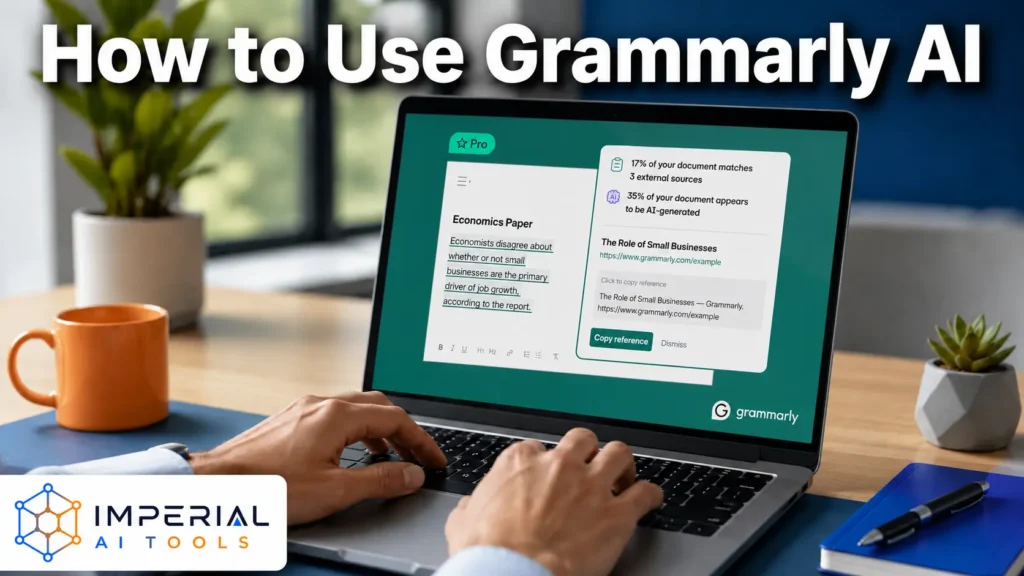
Step 1: Create a Grammarly Account
Sign up with an email or existing account, log in, and choose a plan: Free, Premium, or Business.
Step 2: Install Grammarly
Add the browser extension, install the desktop app, or connect the Microsoft Word and Google Docs integrations, depending on where you do most of your writing.
Step 3: Upload or Create a Document
Open Grammarly’s own editor for a fresh document, or just start typing in Word, Docs, or your browser; real-time suggestions kick in automatically once the extension is active.
Step 4: Apply AI Suggestions
Work through the grammar fixes, tone flags, and rewrite suggestions one at a time. Don’t accept everything blindly; some rewrites change meaning slightly, so read before you click.
Step 5: Export Your Final Document
Download the finished document, copy the content directly, or keep editing in your original platform once Grammarly’s suggestions are applied.
Grammarly AI Pros and Cons
| Pros | Cons |
|---|---|
| Easy to use | Premium features are expensive |
| Works everywhere | Suggestions aren’t always perfect |
| Improves clarity | AI detection isn’t guaranteed to be accurate |
| Real-time suggestions | Requires human review |
| Useful AI writing features | Can occasionally shift meaning during rewrites |
Grammarly AI Writing Tools and Use Cases
Academic Writing
Essays, research papers, and citations help make Grammarly a common companion for students trying to tighten arguments and clean up grammar before submission. It’s particularly useful for catching the kind of small, repeated errors that show up across a long paper once you’ve been staring at it too long.
Professional Emails
Client emails and internal business communication benefit most from the tone detector, which catches messages that read too harshly or too casually before they go out. This is often the single feature that justifies Premium for people in client-facing roles.
Marketing Content
Blog posts, social captions, and ad copy get a quick clarity pass, though marketing voice often needs a human review afterward since Grammarly optimizes for correctness, not brand personality. Treat its suggestions here as a first pass, not a final one.
Resume and Cover Letters
Grammar and tone consistency matter a lot here, and Grammarly catches the small errors that are easy to miss when you’ve read your own resume for the twentieth time and stopped seeing the typos.
Customer Support Communication
Fast, clear, and appropriately toned replies matter in support conversations, and Grammarly’s real-time suggestions help agents avoid messages that read curt under pressure — especially useful during high-volume shifts.
Team Collaboration
Business plans add shared style guides, so teams can keep a consistent voice across multiple writers, which matters more for larger content or support teams than for solo users.
Grammarly AI Pricing Plans
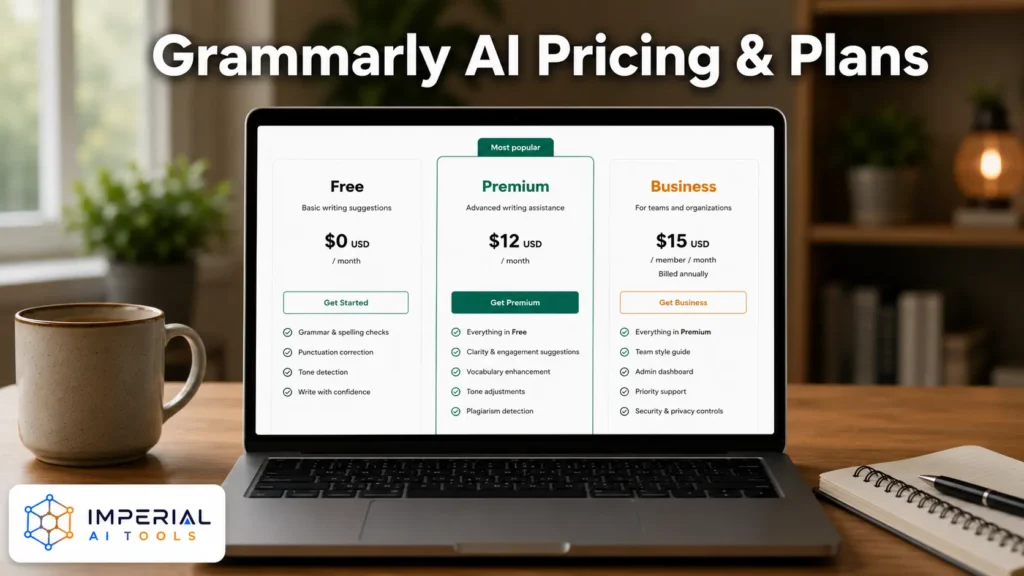
The free version includes: grammar checking, spelling corrections, and basic suggestions, enough for casual writing and everyday emails.
Premium adds: advanced rewriting, tone suggestions, plagiarism checking, and more AI prompts the tier most regular writers end up needing.
Business adds: team management, brand style guides, and analytics, aimed at organizations that want consistent writing across multiple people.
Grammarly AI vs QuillBot
Grammarly vs QuillBot are compared constantly, and for good reason: both are AI writing assistants with overlapping features. But they’re built around two different core jobs: Grammarly is primarily a grammar and clarity checker with AI layered on top, while QuillBot is built around paraphrasing first, with grammar and other tools added around it.
| Feature | Grammarly | QuillBot |
|---|---|---|
| Core strength | Grammar, clarity, and tone checking | Paraphrasing and sentence rewriting |
| Grammar checking | Yes, in-depth | Yes, but less detailed |
| Paraphrasing modes | Limited | Multiple modes (Standard, Fluency, Formal, Creative, and more) |
| Tone detection | Yes, strong | Limited |
| Plagiarism checker | Yes (Premium) | Yes (Premium) |
| AI detector | Yes | Yes |
| Summarizer | Yes | Yes |
| Citation generator | Yes | Yes, with broad style support |
| Free plan limits | Ongoing grammar checks | Capped word count per paraphrase |
| Starting price | From $12/month (Premium) | From around $9–$20/month depending on billing term, less on annual plans |
The practical difference comes down to what you’re actually doing with the text. If you’re writing something from scratch and want grammar, tone, and clarity feedback as you go, Grammarly’s real-time checking is the stronger fit. If you already have a draft and need to reword it, rephrase a paragraph, avoid repeating the same sentence structure, or make something sound more original, QuillBot’s paraphrasing modes are built specifically for that.
A lot of writers actually end up using both: QuillBot to rework a rough draft into cleaner phrasing, then Grammarly to catch grammar issues and check tone before sending or publishing. Neither tool fully replaces the other; they’re solving slightly different problems.
Grammarly AI Limitations
- Cannot replace human editing entirely; it catches errors, but it doesn’t understand your audience or your goals the way a real editor does
- AI suggestions may shift the meaning of a sentence if accepted without review, especially with aggressive rewrite suggestions.
- Not suitable for confidential information without checking data-handling policies first, particularly in regulated industries like healthcare or legal
- AI detector results aren’t fully reliable and shouldn’t be used as the sole basis for accusations of AI use.
- Premium and Business plans add up as a recurring subscription cost, which matters if you’re only writing occasionally.
Future of Grammarly AI
Grammarly is moving toward more personalized assistance suggestions that learn your specific voice over time rather than nudging every user toward the same “correct” tone. That shift matters because a lot of the current criticism of AI writing tools is really criticism of writing that all starts to sound the same.
Expect Grammarly to lean further into full drafting support, not just corrections, helping start a piece, not only clean it up after the fact. Deeper integrations across the apps people already write in, better context awareness around audience and purpose (not just grammar rules), and more refined tone control are the likely next steps. As Grammarly’s own AI-writing and AI-detection features both keep improving, the more useful question going forward probably won’t be “AI-assisted or not,” but whether the final piece is accurate, clear, and genuinely useful to the reader.
Conclusion
Grammarly AI helps improve writing quality by combining solid grammar checking with genuinely useful AI assistance, detection, rewriting, and summarization. The free version covers basic needs, while Premium is the better fit for anyone writing professionally regularly. Whatever plan you choose, human review still matters; treat this Grammarly AI guide’s advice as a starting point, not a substitute for reading your own work before you hit send.
Explore more AI writing tools and software reviews on Imperial AI Tools to find the right solution for your workflow.
FAQs
Yes. Grammarly uses artificial intelligence and machine learning to provide writing suggestions, rewriting, and tone improvements.
Using Grammarly for grammar correction doesn’t automatically mean content is AI-generated, though AI detection tools may analyze writing patterns and flag heavily edited text.
Results shouldn’t be treated as perfect proof, since AI detection technology can produce false positives on human-written text.
Yes, Grammarly provides integrations for Microsoft Word, browsers, and other writing platforms.