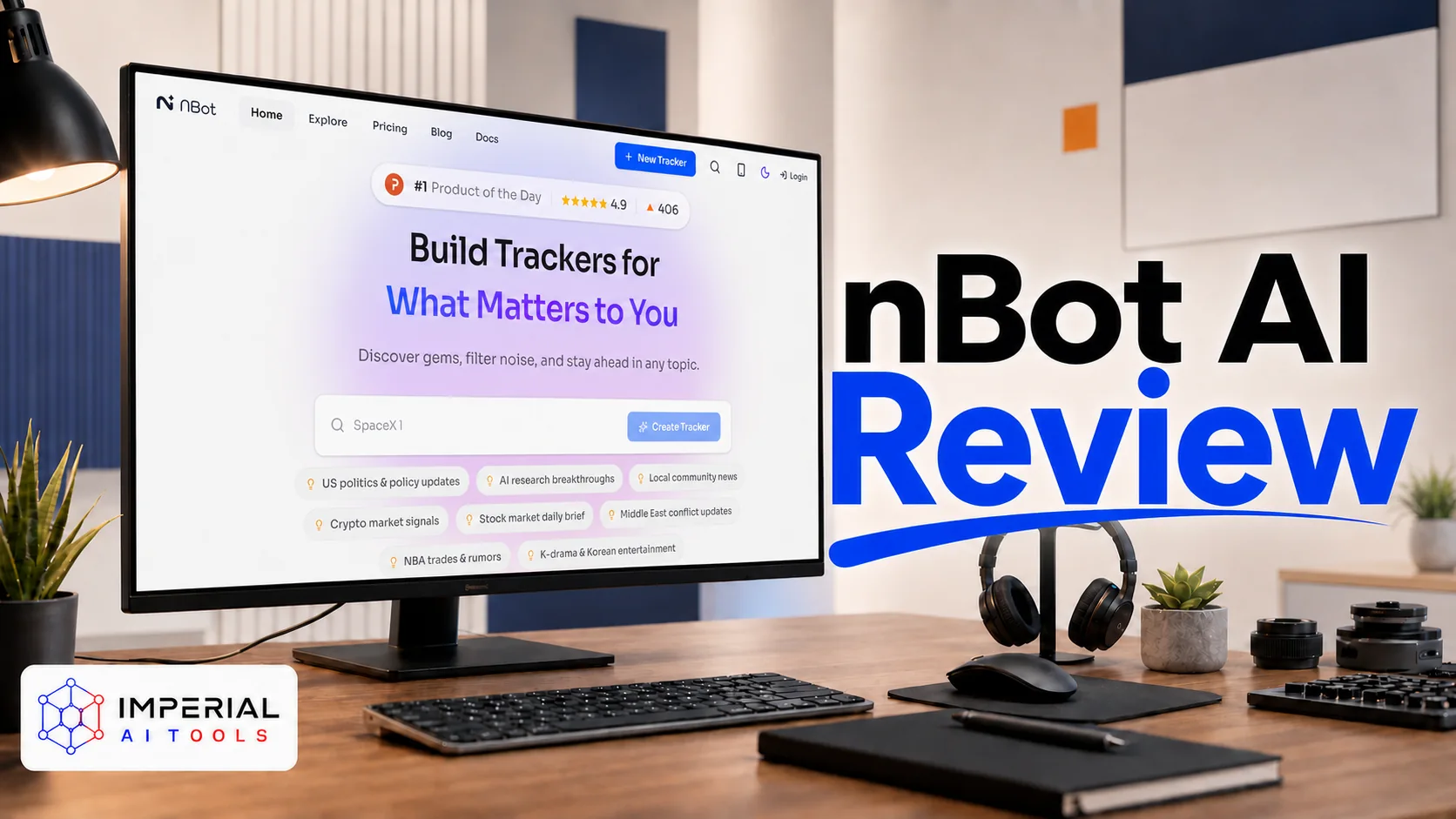
What Is NBot?
NBot is an AI tracking tool built by Local AI, Inc. It works as a personal radar that watches the web for topics you choose. Instead of checking news sites and social feeds by hand, you describe your interest once, and NBot keeps monitoring it for you.
The tool targets researchers, marketers, investors, and curious individuals who need to follow a niche subject closely. It suits anyone who feels overwhelmed by scattered information across many sources.
How Does NBot Work?
The workflow follows three simple steps. First, you describe what you want to track using natural language, such as a market trend or a technical topic. NBot then identifies strong sources and builds a custom tracker automatically.
Second, the AI scans news outlets, blogs, forums, and social platforms tied to that topic. It reads full content, not just headlines, then writes short summaries that explain why each item matters.
Third, you refine the feed through chat. You can ask questions about tracked content or tell NBot to shift focus, and it updates the tracker in real time.
Key Features
- Natural language tracker setup with automatic source discovery
- AI-written summaries with direct links to sources
- Feed Chat for asking questions or adjusting tracker focus live
- Daily AI-generated podcast summaries for audio listening
- Public and community trackers you can follow or share
- Support for RSS feeds, X accounts, YouTube channels, and Reddit
Performance and Experience
NBot feels fast during setup and browsing. The interface stays clean, with cards showing summaries and source links rather than a raw wall of headlines.
Accuracy holds up well for mainstream and moderately niche topics. Highly technical or narrow queries sometimes need a follow-up chat message to sharpen the focus. New users usually find the learning curve short since the app relies on conversation rather than complex filters.
Feed Chat Explained
Feed Chat is the feature that separates NBot from every alert tool. Your tracker isn’t a static filter; it’s something you talk to.
Ask it questions about what’s in your feed: “Summarise the main arguments against this approach.” Or redirect it mid-stream: “Stop showing me financial reports. Focus on engineering blogs.” It updates on the spot.
The catch: vague instructions produce a vague feed. Specificity pays off.
What You Can Track
NBot’s own template gallery shows the range:
- Business & Finance: Bitcoin, Federal Reserve policy, precious metals, uranium, and nuclear
- AI & Technology: open-source agent developments, research papers, model releases
- News & Politics: unsealed documents, policy shifts, legislative tracking
- Sports: trade deadlines, rumours, deal analysis
- Local: city-level news, weather alerts, incident reports
Integrations and Compatibility
NBot runs on the web and offers native apps for iOS and Android. It pulls from websites, RSS feeds, X, YouTube, and Reddit as source types. Documentation lists API key access for developers who want to connect trackers to their own workflows, though this feature remains more limited than the core app.
Imperial AI Tools Feedback
NBot solves a real problem: too many sources and not enough time. The natural language setup makes it approachable, and the Feed Chat feature adds a layer of control that most news aggregators skip. Summaries stay concise and link back to sources, which builds trust.
The main weakness sits in the update frequency on the free tier and a still-growing integration list. Overall, NBot works well as a focused research companion for anyone tired of manual searching.
Suggestions For Improvement
- Expand direct integrations with Slack and email digests
- Right now, NBot is a destination. You go to it. That’s backwards for a monitoring tool the whole point is being told, not checking. Pushing briefings into Slack, email, or Notion would let the tracker come to you. Without it, NBot competes with a browser tab you forget to open.
- Offer more granular API documentation for developers
- API keys exist and are documented, but the docs stay thin compared to the core app. Developers wanting to pipe trackers into their own tools need clear endpoints, rate limits, and payload examples. Right now the API reads like an afterthought rather than a supported path.
- Add faster refresh options on the free tier
- Free-tier refresh frequency is the real limit, not the tracker count. A monitoring tool that updates slowly isn’t monitoring it’s a digest. Even one fast-refresh tracker on free would show people what the product actually does at speed.
- Introduce team or shared workspace plans
- Community trackers let you share publicly, but there’s no middle ground for a team watching a topic together. Research teams, investment desks, and newsrooms all need shared private trackers. Right n that means everyone builds their own copy.
- Provide export options for summaries in bulk
- Summaries live inside NBot. Researchers need them out in a doc, a spreadsheet, a citation manager. Bulk export turns a feed into a research artifact you can actually use in your work.
- Raise the free tier above two trackers
- Two trackers is one interest and a spare. Anyone with a real research need hits that wall on day one, before they’ve seen the tool work. Three or four would let people test properly and convert on merit rather than frustration.
- Flag thin coverage before setup
- When a topic has few sources, NBot returns an empty-looking feed, and the user assumes the tool failed. Warning at setup “this topic has limited coverage” sets expectations and saves the blame from landing on the product.