
Both platforms promise “git push to deploy,” yet they have drifted apart in 2026. Render dropped its per-seat pricing model, while Railway’s CDN status and reliability record became hot debate points. Most older comparisons never caught up. This guide fixes that. It covers cost prediction, production readiness, and a clear decision framework, not just a feature checklist. It is written for solo developers, Node, Python, and Next.js teams, and startups picking infrastructure before a Series A.
Railway vs Render: Quick Comparison Table
A scannable side-by-side of the differences that shape most decisions in 2026.
| Feature | Railway | Render |
|---|---|---|
| Scaling model | Vertical first; manual replicas | Instance tiers; CPU/memory autoscaling on higher plans |
| Pricing model | Usage-based, billed per second | Flat per-service plans plus compute |
| Free tier | One-time $5 trial, then ~$1/mo credit | 750 instance-hours/mo per workspace |
| Databases | Postgres, MySQL, Redis, MongoDB (containerized) | Managed Postgres + Key Value (Redis-style) |
| Background workers | Runs as any other service | Dedicated worker service type |
| Multi-region | Built-in region routing | Manual per-service setup |
| CDN | Beta, per-service, opt-in (status contested) | Built-in global CDN + edge caching |
| Observability | Logs and basic metrics | Dashboards, OpenTelemetry, log streaming |
| Team / SSO | Basic team management | Enterprise SSO and audit logs |
| Best for | Bursty apps, fast iteration | Steady production, static sites |
What is Railway
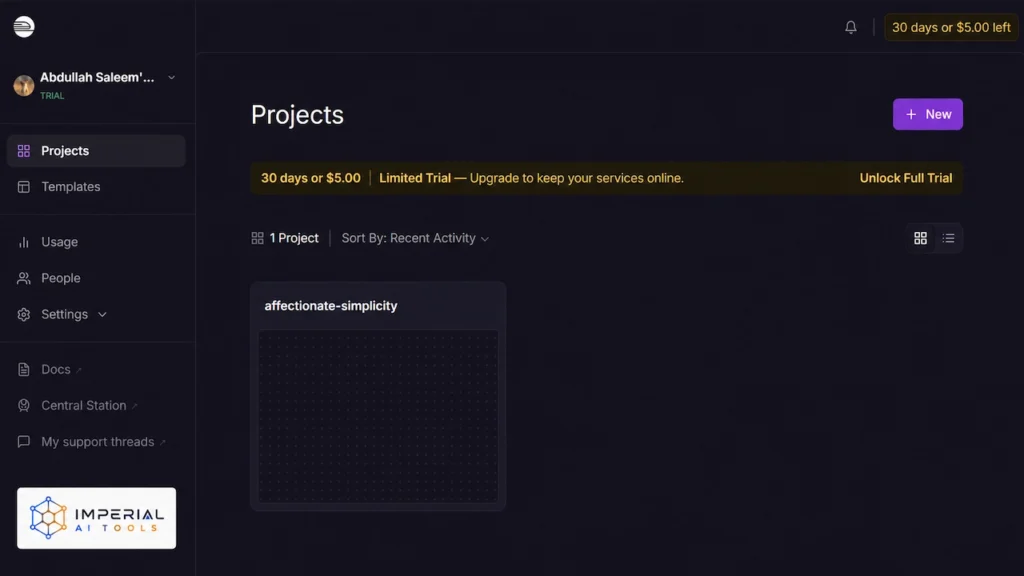
Railway is a usage-based PaaS that deploys Docker images or Git repos onto auto-scaling infrastructure. It bills per second of actual compute. The Railpack build system detects your language and framework, so many apps deploy without a Dockerfile. The interface centers on a visual project canvas where services, databases, and their links appear as a graph. Railway also runs a template marketplace that shares a 25 percent revenue kickback with template authors. Billing follows a simple formula: you pay for vCPU time, RAM, storage, and egress.
What is Render
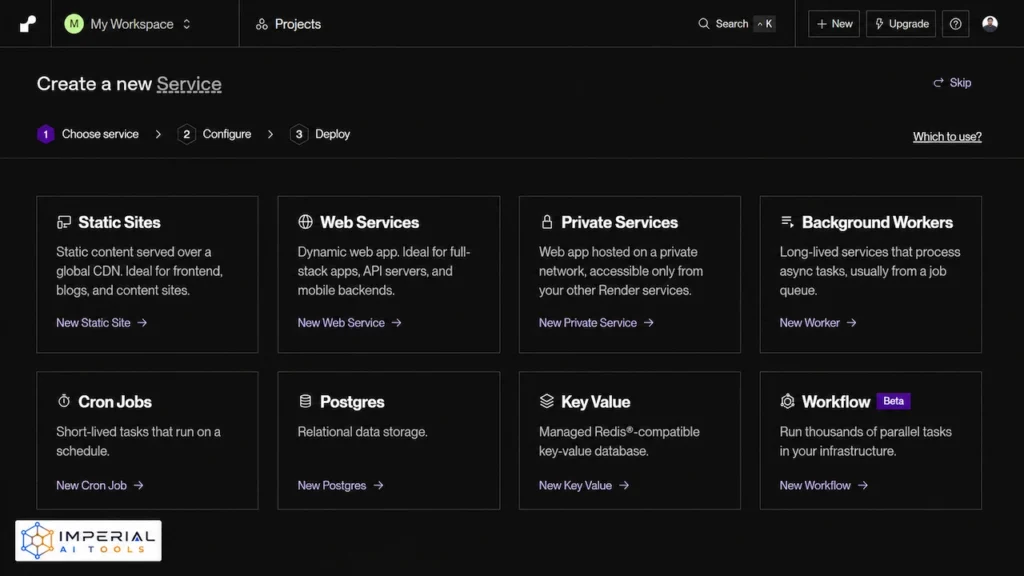
Render is an instance-based PaaS. It offers fixed-price web services, static sites, managed Postgres and a Redis-style Key Value store, background workers, and cron jobs as first-class service types. Infrastructure as code runs through Blueprints defined in a render.yaml file. Because each service is a sized box, the price does not move whether the app handles ten requests or ten thousand, up to its capacity.
What “deployed” means here
In plain English, “deployed” means your code is live and reachable on the internet. You push code, the platform builds it, then runs it on a server so real users can visit it. Both Railway and Render handle that build-and-run step for you.
Railway vs Render Cost Comparison, Real Numbers
Always-on small service
Take a small always-on service at 0.5 vCPU and 512 MB RAM. On Render, a Starter instance runs about $7 per month, flat. On Railway, the same always-on service metered by the second often lands near $10 to $15 per month once a database and worker are added. The honest read: Render is cheaper at full, predictable utilization. Railway wins when the workload is bursty or often idle, because you stop paying when nothing runs. Older blogs state this as a one-sided “X is cheaper” claim. The real answer flips with your usage pattern.
Egress and bandwidth
Render includes 100 GB of bandwidth per month, then charges $0.10 per GB, and ships a built-in CDN that serves cached responses near your users. Railway charges $0.05 per GB egress. Render’s own comparison claims Railway disabled its CDN in May 2026, which would raise egress and latency for distant users. Railway’s current docs, however, describe a per-service CDN in beta. Treat the CDN status as contested and check Railway’s networking docs directly before relying on edge caching.
Build your own estimate
Because Railway’s bill moves with traffic, model your real workload before committing. An interactive Railway vs Render pricing calculator (linked in our web development tools hub) helps you avoid surprise overage.
Scaling and Architecture, the Real Mechanical Differences
Horizontal vs vertical scaling
Render scales by instance count and can autoscale on CPU or memory thresholds on higher plans. Railway leans on vertical scaling first, meaning more CPU and RAM per service, with manual replica counts routed across regions. Neither matches AWS-grade target tracking or predictive autoscaling.
Cold starts
Both platforms cold-start in some modes. Render’s free web services spin down after inactivity and wake on the next request. Railway’s scale-to-zero also cold-starts on wake. Blogs that frame cold starts as a Render-only problem are wrong; the behavior exists on both.
Multi-region and private networking
Railway offers built-in multi-region routing and private networking between services. Render supports multi-region too, but you set it up per service by hand. For server-to-server calls, both recommend private networking to avoid egress fees.
Long-running requests
Render supports long HTTP operations and long-running Workflows, which suits report generation or slow AI calls. Railway enforces a public request ceiling of about 5 minutes, though private networking has no such time limit. For a synchronous inference endpoint, that ceiling matters.
Database Comparison
Managed vs containerized
Render’s Postgres is a managed product with automated backups, read replicas, high availability, point-in-time recovery, and extensions like pgvector and PostGIS. Railway ships databases as one-click containerized templates, which are fast to spin up but leave backups and tuning to you.
Does Railway support PITR?
Not as a managed feature. On Railway you handle backups manually or on a schedule for containerized databases. Render provides PITR, with the recovery window tied to your workspace plan, roughly 3 days on Hobby and up to 7 days on paid plans.
Read replicas
Render supports read replicas on larger paid instances. Railway requires you to self-manage replication, which adds operational work.
Database variety
Railway ships Postgres, MySQL, Redis, and MongoDB natively in one click. Render natively supports Postgres plus a Redis-style Key Value store; MongoDB needs a custom container.
Railway vs Render for Specific Use Cases
- Node.js APIs
- Both deploy Node apps in minutes. Railway feels faster to iterate; Render suits an always-on API with steady traffic.
- Bootstrapped SaaS
- Cost-sensitive founders lean Render for predictable bills, or Railway when traffic is spiky and often idle.
- AI apps
- Neither Railway nor Render offers GPU compute. For heavy inference, look at GPU-focused hosts instead. Both are fine for API-wrapper apps.
- Side projects
- Render’s 750 free hours and free static sites win for hobby use. Railway’s tiny free credit runs out fast.
- Multi-service apps
- Railway’s visual graph makes linked services intuitive. Render’s per-service plans can add up past five services.
- Static + backend
- Render bundles free static hosting with a CDN. Railway focuses on containers, so static delivery is less turnkey.
Pros and Cons of Railway and Render
Railway
- +Fast deploys: instant push-to-deploy feel
- +Clean canvas: visual service graph UI
- +Idle savings: per-second billing rewards low use
- +More engines: Postgres, MySQL, Redis, Mongo
- +No seats: no per-member charge
- −Weak free: tiny recurring credit after trial
- −Fuzzy bill: cost moves with traffic
- −Manual DB: no managed PITR or replicas
- −Basic teams: limited SSO and audit
- −Request cap: 5-minute public timeout
Render
- +Predictable price: flat per-service cost
- +Managed DB: backups, PITR, replicas
- +Real free tier: 750 hours, static sites
- +Native workers: dedicated worker and cron
- +Enterprise ready: SSO and audit logs
- −Cold starts: free services sleep when idle
- −DB expiry: free Postgres dies at 30 days
- −Adds up: many services raise the bill
- −Fewer engines: Mongo needs a container
- −Manual regions: multi-region set per service
Who Should Choose Each Platform
Choose Railway if…
- ✓Your traffic is bursty or often idle
- ✓You value fast deploys and a clean dashboard
- ✓You want Postgres, MySQL, Redis, and Mongo in one place
- ✓You run several linked services and like a visual graph
- ✓You dislike per-seat team charges
Choose Render if…
- ✓You want a flat, predictable monthly bill
- ✓Your database is mission-critical and needs PITR
- ✓You need dedicated background workers and cron
- ✓You serve global traffic and want a built-in CDN
- ✓You require enterprise SSO and audit logs
Imperial AI Tools Verdict
There is no single winner, because the right pick depends on your workload. Railway is the stronger choice when you want fast iteration, a clean visual canvas, and per-second billing that rewards idle or fitful apps. Its multi-engine databases and no-seat pricing suit small, fast-moving teams. Render is the safer production bet. Managed Postgres with backups, point-in-time recovery, and read replicas, plus dedicated workers, a built-in CDN, and enterprise SSO, make it easier to run user-facing apps at scale. For steady, always-on services with a fixed budget, Render usually costs less and worries less. A third path: if you need GPU compute for heavy AI inference, neither platform fits, so look at GPU-focused hosts. Match the platform to your traffic shape and reliability needs, not to hype.
Frequently Asked Questions
Render’s free web services spin down after about 15 minutes of inactivity. The next request triggers a cold start that can take from a few seconds up to a minute. Paid Render instances stay always on and do not have this issue.
Yes, with caveats. Many teams run production workloads on Railway. It lacks some production-grade primitives Render has natively, such as dedicated background workers and managed Postgres with HA and PITR. Suitability depends on your reliability and compliance needs, not a blanket yes or no.
Go to Render and connect your GitHub or GitLab. Start a new Web Service or Static Site, pick your repo, then select the Free plan. Render builds and deploys your app automatically, giving you a live URL right away.
Fly.io uses usage-based pricing billed for compute per second by VM size and region, plus separate charges for storage and outbound bandwidth. Its base plans carry no platform or seat fee, which puts it closer to Railway’s model than to Render’s flat tiers. Check Fly.io current pricing page, since pricing pages change often.