
Zendesk vs Intercom is the comparison most support teams get stuck on, usually right after their first help desk stops keeping up. Both platforms promise faster replies, fewer tickets, and AI that handles the easy questions on its own. Both also cost far more than the price on their pricing page suggests. The confusion is understandable. On paper the feature lists look almost identical: shared inbox, help center, live chat, automations, AI agent, integrations. Read three review articles and you will find three different winners, most of them working from pricing that changed months ago.
The real difference is structural. Zendesk was built as a ticketing system, so it thinks in queues, routing rules, and SLA clocks. Intercom was built as a messaging platform, so it thinks in conversations that live inside your product. That single split explains almost every other difference between them, including the one that hurts most: how each vendor bills for AI.
Quick Answer: Which Is Better, Zendesk or Intercom?
Zendesk is the better pick for support teams handling high ticket volume across email, phone, and chat, because it was built as a ticketing system with routing rules, SLA tracking, and queue management at its core. Intercom is the better pick for product-led SaaS companies and teams under about 15 agents, because its Messenger and Fin AI agent resolve conversations inside the product before they become tickets. The deciding factor is usually channel mix, not features. Phone and email heavy support points to Zendesk. In-app chat points to Intercom.
Zendesk vs Intercom at a Glance
Five things that actually change the decision. Full detail sits in the sections below.
| Factor | Zendesk | Intercom (Fin) |
|---|---|---|
| Best for | High-volume, multi-channel, SLA-driven teams | SaaS, product-led, chat-first teams |
| AI engine | Zendesk AI Agents and Copilot, underlying model not publicly confirmed | Fin, running on Apex, a proprietary support-tuned model |
| Setup time | Days to several weeks | Hours to a few days |
| Standout strength | Ticketing depth: routing, SLAs, voice, reporting | Vendor-reported 76% autonomous resolution rate |
| Main weakness | Add-ons stack fast, real cost far above sticker price | Uncapped AI fees, plus Salesforce acquisition uncertainty |
What Is Zendesk?
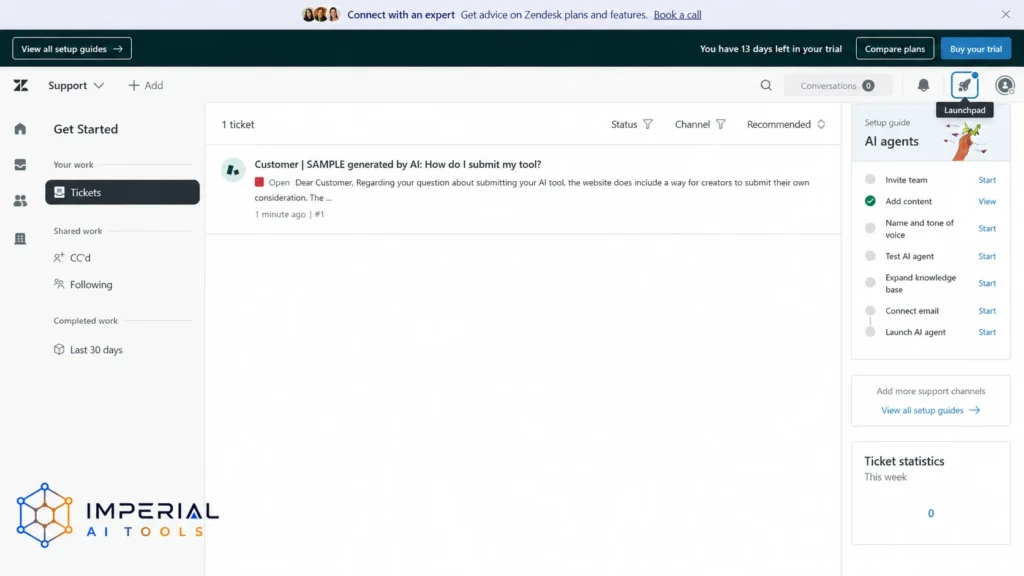
Zendesk is a cloud-based customer service platform built around ticketing. Every email, chat, call, and social message becomes a ticket that agents route, prioritise, and close against a service level agreement. Zendesk launched in Copenhagen in 2007 and now operates from San Francisco. The company was taken private in 2022 by Hellman & Friedman and Permira, and serves roughly 100,000 paying customers worldwide.
Zendesk is built for support organisations that receive requests through many channels at once and need structure to keep up.
What Is Intercom?.
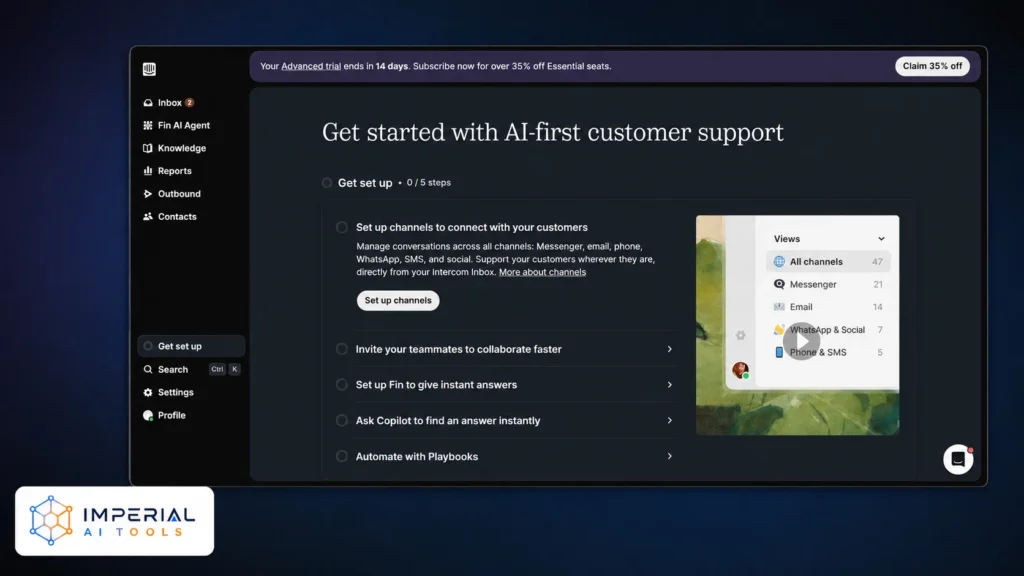
Intercom is a customer messaging platform built around in-app chat and AI answers. Conversations, not tickets, are the core unit, and the Messenger widget sits inside your product or website.
Important 2026 update: the Dublin company founded in 2011 as Intercom rebranded the whole business to Fin in May 2026, taking the name of its AI agent. On June 15, 2026, Salesforce signed a definitive agreement to acquire Fin for approximately $3.6 billion. The deal is expected to close in the early months of 2027, after regulatory approvals. Most buyers still search for “Intercom”, so this page uses both names. Intercom serves more than 30,000 companies. It suits product-led SaaS teams that want support to feel like a conversation inside the app.
AI-first has to be built in; you can’t bolt it on.
Intercom vs Zendesk AI and LLM Capabilities
Both tools sell AI deflection. Only one of them publicly names the model underneath.
Intercom Fin: How the AI Agent Works
Fin reads your help centre, past conversations, and connected data sources, then answers customers directly. It escalates to a human when it cannot answer, and you are not billed for that escalation.
On the model question, Intercom is unusually specific. Fin runs on Apex, a proprietary model the company purpose-built for customer support, which it says outperforms top commercially available frontier models on resolution rates. Apex is described as a suite of seven purpose-built models, each handling a discrete stage of resolving a support query, rather than a single LLM. Fin claims Apex beats frontier models from OpenAI and Anthropic when measured by resolution rates. For another CRM-connected approach to customer-service automation, see our HubSpot AI guide, covering Breeze agents, service automation, credits and pricing.
Zendesk AI Agents and Copilot
Zendesk splits AI in two directions. Copilot faces agents, suggesting replies and summarising threads. AI Agents face customers and resolve tickets autonomously.
Since a May 2026 change, autonomous AI agents are included in every Zendesk plan rather than sold as the old Advanced AI add-on. Copilot bundles Auto Assist, Admin Copilot, Intelligent Triage, and the analytics layer into one $50 per agent charge. The underlying model family behind Zendesk AI is not publicly confirmed by the vendor, and we will not guess at it.
Winner on AI: Intercom, because Fin publishes a named model and a specific resolution rate, while Zendesk discloses neither.
Ticketing vs Messaging: Two Different Philosophies
This is the real architectural split, and it predicts which tool will frustrate your team.
How Zendesk Handles Tickets, Queues, and SLAs
Zendesk turns every request into a ticket with a status, owner, and clock. Triggers fire on ticket events, automations run on time conditions, and macros insert canned responses. Skills-based routing sends tickets to qualified agents, and SLA policies track first reply and resolution targets. Voice, email, chat, and social all land in one agent workspace.
How Intercom Handles Live Chat and In-App Conversations
Intercom starts from the Messenger widget embedded in your product. Conversations stay open and threaded rather than closing as tickets. Proactive messages trigger on user behaviour, such as a customer stalling on a checkout page. Workflows handle routing, and the shared inbox is organised by conversation rather than queue. Intercom added a ticketing layer, but ticketing is not its native shape.
Winner on workflow depth: Zendesk, because SLA tracking, skills routing, and queue management are native rather than added later.
Integrations and Ecosystem
Both tools connect to the usual stack. The difference shows in how deeply data lands in the agent’s view.
Salesforce, HubSpot, and CRM Connections
Zendesk offers a mature native Salesforce integration with two-way sync, plus a native HubSpot connector. Intercom connects to both as well, though historically its Salesforce sync has been lighter. The Salesforce acquisition changes this calculation. If you run Service Cloud today, Intercom’s roadmap now points toward your CRM. If you deliberately avoid Salesforce, that same deal is a reason for caution. Teams also comparing the wider CRM ecosystems can read our Salesforce vs HubSpot comparison for a closer look at AI agents, integrations, setup and scalability.
E-commerce Integrations (Shopify, WooCommerce, Magento)
Zendesk pulls Shopify order data into the agent view more cleanly, through both the native Shopify app and deeper marketplace apps that surface line items, refunds, and order variables directly inside macros. Intercom’s Shopify app shows order context in the conversation sidebar, but agents more often click through to Shopify for detail. WooCommerce and Magento support is stronger on the Zendesk side, mostly through third-party marketplace apps.
App Marketplace Size and Open-Source Options
Zendesk’s marketplace lists roughly 1,700 apps and integrations. Intercom’s App Store sits closer to 450. Zendesk also exposes a broader REST API surface for custom builds.
Neither tool is open source, and neither has an open-source edition. Teams that want self-hosted control usually look at Chatwoot or Zammad instead, both of which offer community editions you can run yourself. Expect to trade polished AI for that control. Our chat and support tools category covers the wider field, and the best help desk software guide ranks the paid options.
Winner on integrations: Zendesk, because the marketplace is roughly four times larger and e-commerce order data lands deeper in the agent view.
Setup, Login, and Migration
Time to value differs sharply, and switching costs are the reason most teams stay put.
How Long Setup Takes for Both Tool
Intercom is usually live in hours for chat, and a few days for a full configuration. You can get the Messenger widget on your site in under an hour. Zendesk takes days to several weeks. The difference is not software quality. Zendesk asks you to define ticket forms, custom fields, triggers, SLA policies, and routing rules up front, and those decisions take meetings.
Admin Access and Login Basics
Zendesk admins work from the Admin Center at yoursubdomain.zendesk.com/admin, with agents signing in at yoursubdomain.zendesk.com/agent. Intercom admins use Settings inside app.intercom.com. Both support SAML single sign-on and Google or Microsoft login. Zendesk gates enterprise SSO features and custom agent roles behind higher tiers, while Intercom includes SSO more broadly but limits custom roles to Expert. Adding agents is a billing event in both tools, so check your contracted seat count before inviting people.
Migrating from Zendesk to Intercom (or the Reverse)
What transfers cleanly: contacts, organisations, conversation history with attachments and internal notes, tags, custom field values, agent profiles, and help centre articles including categories and sections.
Learning Curve for Your Agents
New agents pick up Intercom faster. The inbox looks like a messaging app, so most people are productive in a day. Zendesk’s agent workspace exposes ticket fields, macros, views, and side conversations at once, which typically takes a week to feel natural and longer for admins. Admin complexity is where Zendesk really costs time.
Winner on setup and learning curve: Intercom, because chat goes live in under an hour and agents need roughly a day rather than a week.
Pros and Cons of Both Tools
The honest trade-offs on both sides.
Zendesk
Pros
- Ticketing depth. Routing, SLAs, and queues are native.
- Integration breadth. Roughly 1,700 marketplace apps.
- Reporting power. Explore handles custom analytics well.
- Voice support. Full contact centre with IVR built in.
- Enterprise governance. Audit logs, roles, data residency.
Cons
- Add-on stacking. Copilot, WFM, and QA each cost extra.
- Slow setup. Days to weeks before you go live.
- Opaque AI. No public model or resolution rate.
- Tier gating. SLAs and routing sit behind upper plans.
- No free plan. Only a 14-day trial.
Intercom
Pros
- Fast setup. Messenger live in under an hour.
- Strong AI. Named model, 76% vendor-reported resolution.
- Easy inbox. Agents onboard in about a day.
- Proactive messaging. Behaviour-triggered in-app outreach.
- Startup discount. Up to 90% off in year one.
Cons
- Uncapped AI. Fin fees scale with volume, not headcount.
- Acquisition risk. Salesforce deal closes early 2027.
- Weaker ticketing. SLA rules only on Expert.
- Smaller ecosystem. Around 450 apps.
- Year-two shock. Startup discount ends abruptly.
Who Should Choose Each Tool
Choose Zendesk if
- Phone and email carry most of your support volume
- You have contractual SLAs to track and report on
- Your AI resolution volume exceeds roughly 500 a month
- You need audit logs, data residency, or multi-brand help centres
Choose Intercom if
- Most support happens through in-app or website chat
- You want a working AI agent live within days, not weeks
- Your team is under about 15 agents with moderate volume
- You qualify for the Early Stage startup discount
Imperial AI Tools Verdict
Zendesk and Intercom solve different problems, and the honest answer depends on your channel mix rather than a feature count. Choose Zendesk when support is an operation. High ticket volume, phone and email as primary channels, SLA commitments, and compliance requirements all point one direction. The cost is configuration time and a bill that grows through add-ons rather than usage.
Choose Intercom when support is part of the product. Chat-first, in-app, product-led teams get a working AI agent live in days, and Fin’s published resolution rate is the strongest public number in this category. Budget carefully, though, because per-resolution billing has no default ceiling.
Frequently Asked Questions
Zendesk offers better e-commerce integration. Its Shopify apps surface order line items, refund status, and shipping data directly in the agent’s ticket view, and marketplace apps make those variables usable inside macros. Intercom shows order context in the sidebar, but agents click through to Shopify more often for detail.
Yes, with conditions. Intercom replaces Zendesk well for chat-led teams under about 15 agents with moderate ticket volume. It falls short if you need contractual SLA tracking below the Expert plan, skills-based routing, IVR voice support, or enterprise audit and data residency controls. Heavy phone volume is the clearest disqualifier. Teams that find both platforms too expensive can also explore our ranked guide to the best HubSpot alternatives, which includes Zendesk, Salesforce and other CRM and support options.
Intercom has no permanent free plan. It offers a 14-day free trial with no credit card required and unlimited Fin outcomes included. Early-stage startups under $1M ARR, with fewer than 5 employees, under 2 years old and VC-backed, can apply for 90 percent off year one through the Early Stage program.