
If you only remember one thing from this guide, make it this: neither tool “wins” outright. The Claude vs ChatGPT question in 2026 is really a question about what your day looks like, because the two assistants have evolved in genuinely different directions.
This is a 2026 comparison based on pricing, current models, features, writing quality, coding tools, research handling, and real workflow use, not benchmark hype.
Claude vs ChatGPT at a Glance
| Feature | Claude | ChatGPT |
|---|---|---|
| Best for | Writing, coding depth, long context | All-in-one AI, images, voice, tools |
| Paid plan | Claude Pro / Max | ChatGPT Plus / Pro |
| Coding tool | Claude Code | ChatGPT Codex |
| Projects | Claude Projects | ChatGPT Projects |
| Image generation | No native image generation | Yes |
| Best user | Writers, developers, analysts | Creators, teams, general users |
What Is Claude?
Claude is Anthropic’s AI assistant for chat, writing, coding, document analysis, research, and general workflow help. It is known for a natural writing voice, careful reasoning and strong performance on long-context tasks, such as full manuscripts, contracts, or large codebases in a single session. Key features include Projects for organized workspaces, Claude Code for agentic development work, Claude Cowork for non-developer knowledge work, file analysis, and web search, where available.
People tend to reach for Claude when they want clean long-form writing, careful reasoning over a long document, or a coding partner that explains its work.
Our own understanding of ethics is limited, and we ourselves often fall short of our own ideals… And where Claude sees further and more truly than we do, we hope it can help us see better, too.
What Is ChatGPT?
ChatGPT is OpenAI’s AI assistant for writing, coding, research, image generation, voice conversation, file analysis, and agentic workflows. Its standout trait is breadth: one subscription covers text chat, native image generation, advanced voice mode, custom GPTs, Projects, and Codex, OpenAI’s coding agent. ChatGPT Plus and Pro are consumer subscriptions and are priced separately from OpenAI’s API, which developers pay for per token.
People often pick ChatGPT when they want that wide feature set in one place, especially built-in image generation and voice.
A.I. will probably most likely lead to the end of the world, but in the meantime, there’ll be great companies.
Claude vs ChatGPT: Pricing and Plans in 2026

Pricing is one of the first things people check in any Claude vs ChatGPT comparison. Subscription pricing and API pricing are entirely separate on both platforms. Subscriptions cover the chat apps; the API is pay-per-token for developers.
Claude Pro vs ChatGPT Plus
- Claude Pro
- $17/month billed annually, or $20 billed monthly.
- ChatGPT Plus
- $20/month.
At the monthly rate, these plans cost the same, and both unlock higher usage limits and premium models. Claude Pro is slightly cheaper if you commit annually. Plus includes ChatGPT’s image generation and voice features, which Claude Pro does not offer natively.
Claude Max vs ChatGPT Pro
- Claude Max
- Starts from $100/month.
- ChatGPT Pro
- $100/month and $200/month tiers.
Both target heavy users. Claude Max is aimed at people who live in Claude all day, especially Claude Code users with substantially higher limits. ChatGPT Pro offers expanded access to OpenAI’s most capable models and tools across its two tiers.
Anthropic API Pricing vs OpenAI API Pricing
Per one million tokens, at the time of writing:
Anthropic (Claude) API:
- Claude Fable 5: $10 input / $50 output
- Claude Opus 4.8, 4.7, 4.6, and 4.5: $5/1M input tokens and $25/1M output tokens.
- Claude Sonnet 5: $2 input / $10 output introductory pricing through Aug 31, 2026, then $3 / $15
- Claude Sonnet 4.6 and 4.5: $3 per million input tokens and $15 per million output tokens.
- Claude Haiku 4.5: $1 per million input tokens and $5.00 per million output tokens.
OpenAI (ChatGPT) API:
- GPT-5.4 nano: $0.20 input / $1.25 output
- GPT-5.4 mini: $0.75 input / $4.50 output
- GPT-5.4: $2.50 input / $15 output
- GPT-5.4 Pro: $30 input / $180 output
- GPT-5.5: $5 input / $30 output
- GPT-5.5 Pro: $30 input / $180 output
- GPT-5.4A is not publicly listed in official pricing at the time of writing.
OpenAI is cheaper at the budget end, thanks to nano and mini tiers. In the mid-range, Claude Sonnet 5’s introductory pricing undercuts GPT-5.4. At the frontier, Claude Fable 5 costs less per token than GPT-5.5 Pro, though real costs depend heavily on how many tokens each model uses to complete your task.
Claude vs ChatGPT for Writing
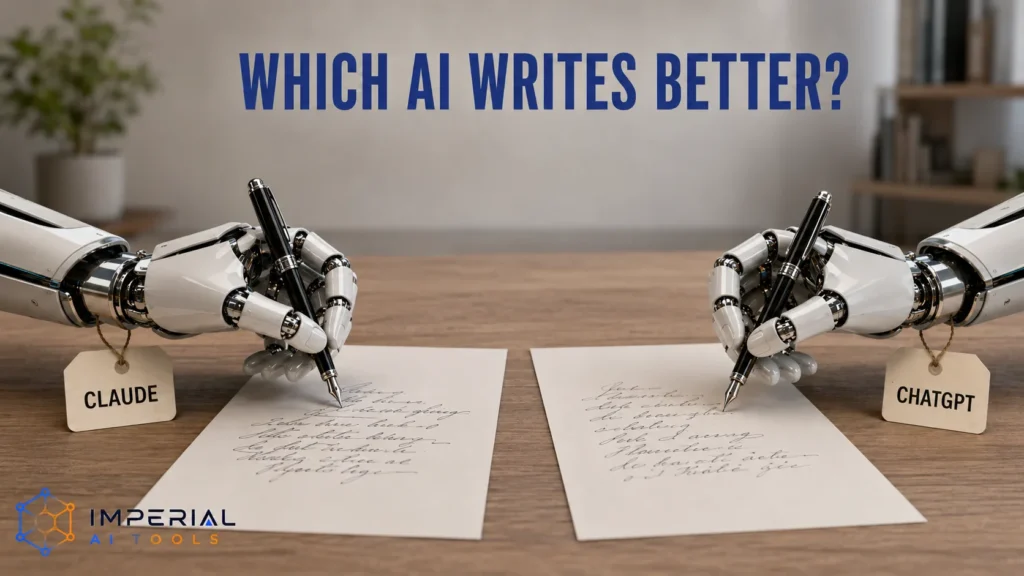
Ask professional writers which is better for writing, Claude or ChatGPT, and most will say Claude with caveats. This is where the Claude vs ChatGPT gap is most visible in everyday use.
- Claude’s long-form output tends to sound more human, with better story flow, more natural transitions, and fewer formulaic patterns. It also excels at editing: feed it a full draft, and it holds tone and structure across thousands of words.
- ChatGPT is the stronger pick for volume and speed. Quick drafts, structured content, social captions, and short-form pieces come out fast and clean, and its templates-and-tools ecosystem suits content teams producing at scale.
If your income depends on prose quality, Claude is the safer bet. If you need fifty captions before lunch, ChatGPT wins.
Claude vs ChatGPT for Coding
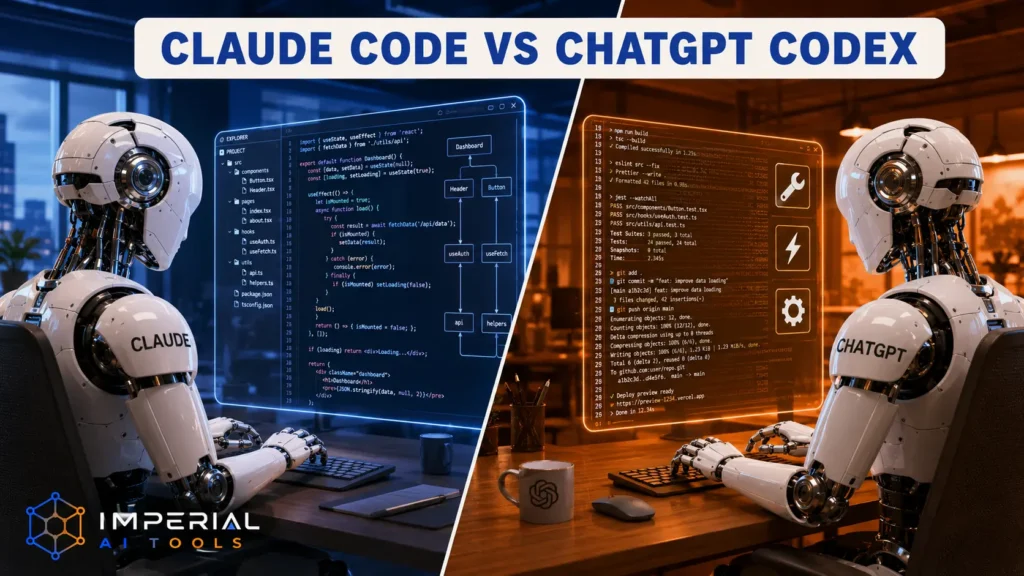
This is the most consequential Claude vs ChatGPT matchup for developers, because both companies now ship dedicated coding agents rather than just chat-based help.
| Area | Claude Code | ChatGPT Codex |
|---|---|---|
| Strength | Long code reasoning, refactoring, codebase understanding | Broad coding workflows, debugging, automation |
| Style | Deep, deliberate, context-heavy | Fast, tool-rich, versatile |
| Access | Terminal, desktop app, mobile, IDEs | ChatGPT app and developer tools |
| Best for | Large refactors, complex repos | Everyday dev tasks, quick fixes |
Claude Code has built a strong reputation for working across large, messy codebases: it reads context carefully, plans before editing, and handles multi-file refactors well. Codex shines in breadth, debugging, automation, tool use, and quick iteration inside the workflows developers already have.
Many engineering teams in 2026 run both, using Codex for speed and Claude Code for the hard, structural work.
Is Claude Better Than ChatGPT for Math and Reasoning?
There is no honest, absolute answer to this part of the Claude vs ChatGPT debate. Performance depends on the specific model, the prompt, the task type, and whether the tool can use code execution or other aids. Frontier models from both companies solve hard reasoning problems that stumped models two years ago, and both still fail in surprising ways on edge cases.
The practical advice: For anything high-stakes, test your actual problem in both, and let the model use tools (like running code) rather than reasoning purely in text.
Should You Switch From ChatGPT to Claude?
Consider a switch from ChatGPT to Claude if most of your usage is long-form writing, document analysis, or serious coding, the areas where Claude’s advantages are clearest. Stay put if you rely on image generation, voice mode, or custom GPTs, because Claude has no native equivalents.
How to Migrate From ChatGPT to Claude
There is no official one-click way to migrate chats from ChatGPT to Claude, so plan a manual transition:
- Move your prompts manually. Copy your best-performing prompts into a document, then test and adjust them in Claude. Phrasing that works in one tool often needs light edits in the other.
- Rebuild Projects. Recreate your ChatGPT Projects as Claude Projects, re-uploading key files and re-writing custom instructions.
- Run both in parallel for a week or two. Test the same real workflow in both tools before canceling anything.
Most people find migration takes an afternoon of setup plus a week of adjustment.
When Should You Use Claude and ChatGPT Together?
For many professionals, the best answer to the Claude vs ChatGPT debate is “both.” A sensible split:
- Use Claude for
- Long writing projects, deep coding sessions with Claude Code, thoughtful editing, and analyzing large documents.
- Use ChatGPT for
- Image generation, voice interaction, quick research, custom GPTs, Codex tasks, and everyday productivity.
At roughly $37-40/month combined for entry-level paid plans, running both costs less than most single SaaS tools and eliminates the frustration of forcing one assistant to do everything.
Which One Should You Choose?
Here is the honest bottom line on Claude vs ChatGPT in 2026:
- Choose ChatGPT if you want one flexible AI tool that handles text, images, voice, and everyday tasks in a single app. It is the better generalist.
- Choose Claude if writing quality, long-context work, and coding depth matter most to your work. It is the best specialist.
- Choose both if AI is genuinely part of your daily workflow. The combined cost is modest, and the strengths barely overlap.
Neither company is standing still, so revisit this decision every six months. But in mid-2026, the pattern is stable: breadth belongs to ChatGPT, depth belongs to Claude.
Conclusion
Claude vs ChatGPT debate in 2026 doesn’t end with a single winner; it ends with a clearer picture of what each tool is built for. ChatGPT is the stronger all-rounder, packing images, voice, custom GPTs, and Codex into one app that covers almost any everyday task. Claude is the stronger specialist, leading in long-form writing, long-context document work, and deep coding through Claude Code.
Pricing is close enough at the entry level that cost shouldn’t drive your decision; your workflow should. If you’re still unsure, run the same real tasks in both free tiers for a week your own results will settle the question faster than any comparison article. And if AI sits at the centre of your daily work, stop choosing altogether: pairing Claude and ChatGPT is the setup most power users quietly land on.
Frequently Asked Questions
No single AI is “the best” across everything. Claude leads in long-form writing and agentic coding for many users, while ChatGPT leads in multimodal breadth. The best AI is the one that fits your specific tasks.
“Everyone” is an exaggeration, but Claude has grown fast among writers, developers and analysts largely because of Claude Code’s reputation and Claude’s natural prose. Meanwhile, ChatGPT retains the largest overall user base.
Claude’s clearest exclusives are Claude Code’s deep agentic coding workflow and Claude Cowork for agentic knowledge work. Users also frequently cite more natural long-form writing and more consistent handling of very long documents, though these are qualitative edges rather than missing features in ChatGPT.
Casual users don’t. If you use AI heavily for work, the case for both is strong: they specialize in different areas, and the combined subscription cost is low relative to the productivity gain.
At the entry level, they are nearly identical. Claude Pro is $17/month annually (or $20 monthly) versus ChatGPT Plus at $20/month. On the API side, OpenAI’s nano and mini models are the cheapest options overall, while Claude’s mid-tier Sonnet models are competitively priced, especially at Sonnet 5’s introductory rate.