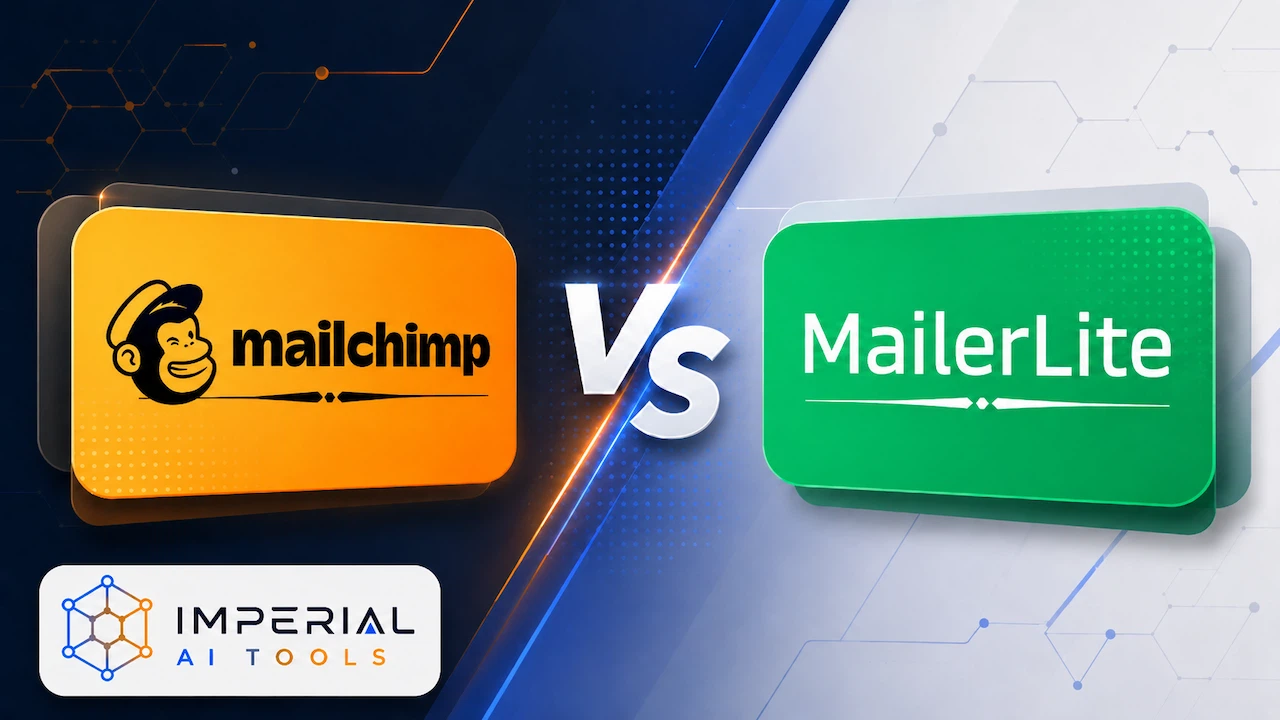

MailerLite vs Mailchimp is the classic first decision in email marketing, and 2026 quietly rewrote the answer. Both companies cut their free plans this year, and their entry prices moved closer than ever. The real choice now sits between budget-focused simplicity and ecosystem depth with brand recognition. This guide is for creators, small businesses, and nonprofits picking their first platform or planning a switch.
We compare free plans, deliverability, integrations, and migration, every figure verified in July 2026. One question gets a direct answer along the way: what is the cheapest email marketing service right now? Let’s settle the Mailchimp vs MailerLite debate with verified numbers.
Quick Answer
MailerLite is a budget-friendly email marketing platform for creators, newsletters, and small businesses. Mailchimp is a feature-rich, Intuit-owned platform built for e-commerce stores and data-driven teams. MailerLite wins on price, simplicity, and recent deliverability. Mailchimp wins on reporting depth, revenue attribution, and 300+ integrations.
What Is MailerLite?
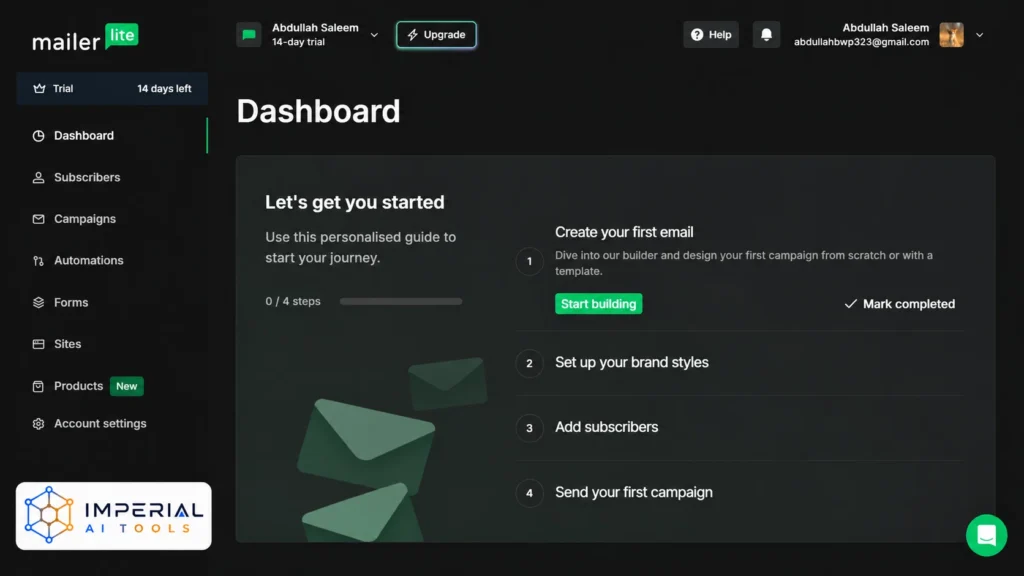
MailerLite is an email marketing platform, founded in 2010, that helps creators and small businesses build subscriber lists, send newsletters, and automate campaigns with simpler tools and lower pricing than most competitors. Core features include a drag-and-drop editor, visual automations, landing pages, a website builder, and digital product sales. It exists as a deliberate low-cost, low-complexity alternative to heavier tools, and both platforms now bundle AI writing assistants.
What Is Mailchimp?
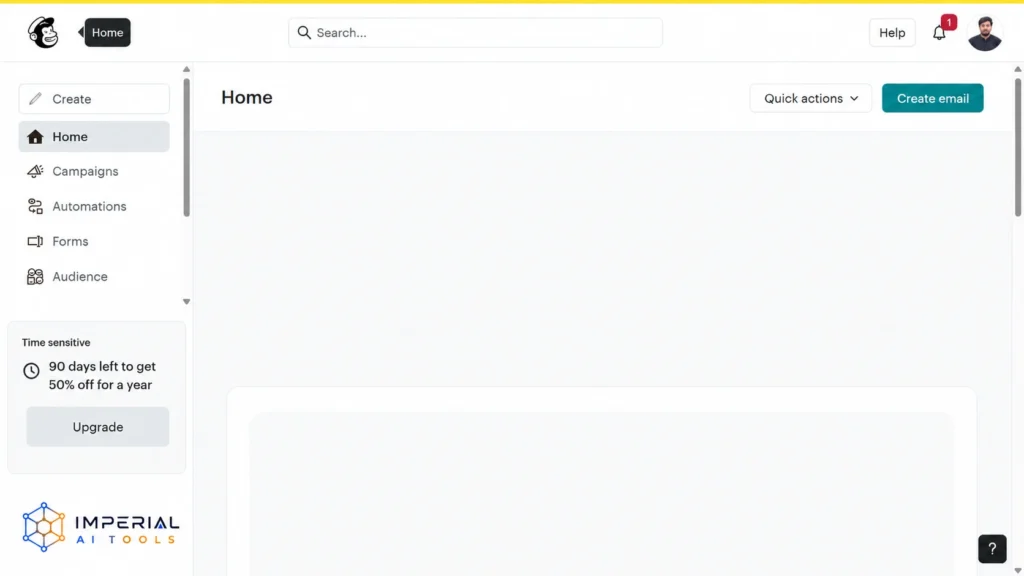
Mailchimp is an email and marketing automation platform owned by Intuit that helps small and mid-sized businesses create, send, and track email campaigns across email, landing pages, social media, and ads. The company launched in 2001 and was acquired by Intuit in 2021 for $12 billion. For anyone asking what is Mailchimp in practice, it is the biggest brand in Mailchimp email marketing: a drag-and-drop builder, a large template library, and a 300+ app marketplace acting as one marketing hub.
When a small business fails, the whole family feels it.
MailerLite and Mailchimp at a Glance
| Factor | MailerLite | Mailchimp |
|---|---|---|
| Free plan limits | 250 subscribers, 2,500 emails/mo | 250 contacts, 500 emails/mo (250/day cap) |
| Deliverability reputation | ~94% average over recent EmailToolTester rounds, Best of 5 award | Strong historically, weaker in recent independent test rounds |
| HIPAA compliance | Not offered, no BAA (GDPR-focused instead) | Not compliant, will not sign a BAA |
| Templates | 90+ designs, limited set on Free | Larger library, basic designs only on Free |
| Integrations | 100+ native integrations | 300+ marketplace integrations |
| Nonprofit discount | 30% off paid plans | 15% off |
Which Is Easier to Use for Templates and Email Design?
Both tools use drag-and-drop editors. MailerLite’s editor stays cleaner and faster to learn, and free users get all three editor types. Its one frustration: the Free plan unlocks only a limited template set, and the full 90+ library requires Comfort. Mailchimp templates form a larger, more polished library, but the Free plan restricts you to basic designs and custom-coded templates sit behind paid tiers. Mailchimp’s interface also feels heavier, since ads, social, and CRM features crowd the navigation.
- Want Mailchimp-style templates elsewhere?
- Several similar tools ship template libraries alike Mailchimp’s.
- Size of a Mailchimp header
- Mailchimp emails render at 600 pixels wide, so upload a header image around 1,200 pixels wide for sharp retina display.
Better here: Mailchimp, because its template library is larger and more polished across paid plans, even though MailerLite’s editor is simpler.
Which Free Plan Is Better in 2026?
Older comparisons are now wrong on both sides. MailerLite cut its free plan from 1,000 subscribers to 500 in September 2025, then to 250 subscribers and 2,500 monthly emails in 2026. Mailchimp halved its own free Mailchimp plan in January 2026 to 250 contacts and 500 monthly sends, capped at 250 per day. Both lists are now equal in size, so sending volume and features decide it. MailerLite gives you five times the emails, 3 active automations, a website, a landing page, and 2 seats. Free Mailchimp removed automations, blocks scheduling, and limits support to your first 30 days.
How to use Mailchimp free in 3 steps
- Sign up at mailchimp.com and verify your sending email address.
- Import your contact list (up to 250) as a CSV file.
- Build your first campaign with a basic template and send it the same day, since scheduling is locked.
That covers how to use Mailchimp for email marketing at zero cost, but the ceiling arrives fast.
Better here: MailerLite, because 2,500 monthly sends with automations beats 500 sends with none at the same 250-contact limit.
Which Has Better Deliverability and Reliability?
Does MailerLite have good deliverability? Yes, and a mechanism explains it. MailerLite manually reviews every new account and imported list before sending unlocks. That gatekeeping keeps spammers off its shared IPs, and independent seed tests show it: EmailToolTester’s rounds put MailerLite near a 94% average across the five most recent tests, earning its Best of 5 award. Mailchimp scored strongly for years and still does in some methodologies, but it slipped in recent rounds and lacks built-in list-cleaning tools. Results fluctuate, so treat any single number as a snapshot.
Sending a large Mailchimp email blast is reliable at scale. If you suspect Mailchimp is down, check status.mailchimp.com before troubleshooting your account. MailerLite publishes the same at status.mailerlite.com.
Better here: MailerLite, because its approval process produces consistently higher inbox placement in recent independent tests.
Which Gives You Better Reporting and Analytics?
Mailchimp reporting is the deeper toolset. Standard and Premium plans add comparative reports, custom reporting, and revenue attribution that ties campaigns to actual sales. Data-driven stores pay for that ROI view. MailerLite counters with clean real-time reports, click maps, e-commerce sales tracking, and custom date ranges. Most solo senders never miss the extra depth; the gap matters once attribution drives your decisions.
User sentiment backs the split. Mailchimp reviews praise feature depth but criticize pricing and clutter, while MailerLite holds 4.6 out of 5 across 1,100+ verified G2 reviews.
Better here: Mailchimp, because revenue attribution and comparative reporting go further than MailerLite’s simpler dashboards.
Which Tool Has Better Integrations?
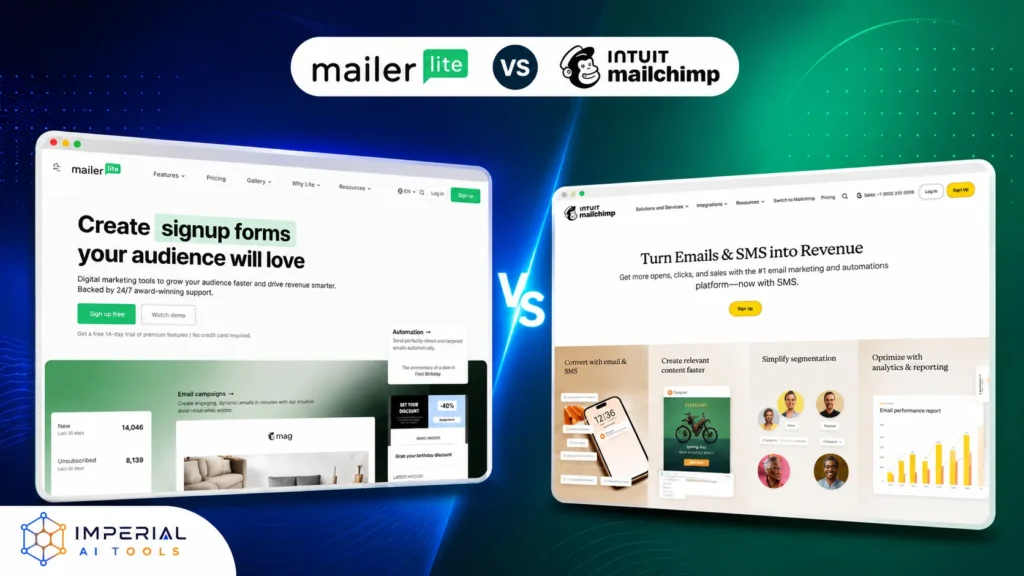
Mailchimp integrations win on marketplace size, with 300+ apps against MailerLite’s 100+. Here is how the most-searched connections actually work. Both platforms sit in our marketing automation category with their main rivals.
- Acuity Scheduling + Mailchimp
- Native. Acuity lists Mailchimp in its built-in email marketing integrations panel.
- Google Forms + Mailchimp
- No native connection. Use Zapier or a Google Workspace add-on.
- Google Sheets to Mailchimp
- No native sync. Zapier, Make, and similar tools handle it.
- Mailchimp Gmail integration
- No native app. Contact imports and Zapier workflows cover most needs.
- Mailchimp Salesforce integration
- Yes, but changed. The old free plugin left AppExchange in 2024; the current official connector comes from partner Beaufort 12 on AppExchange.
- Pure Chat + Mailchimp
- Connect through Zapier rather than a maintained native app.
- Mailmunch + Mailchimp
- Native. Mailmunch is a lead-capture tool built around Mailchimp syncing.
- Mailchimp MailerLite integration
- No live two-way sync exists. Zapier passes subscribers between them, and MailerLite’s import tool pulls your Mailchimp audience in directly, which sets up the migration section below.
Most third-party connections need your Mailchimp API key. Find it in account settings under Extras, then API keys. MailerLite matches the essentials with native Shopify, WooCommerce, WordPress, Stripe, Zapier, and Make integrations plus its own API, so a typical small-business stack connects fine on either tool.
Better here: Mailchimp, because three times the marketplace coverage means fewer Zapier workarounds.
Imperial AI Tools Verdict
There is no blanket winner here, only a right fit. Pick MailerLite if you send newsletters, run a small business, or want the lowest cost as your list grows. Its simpler editor, stronger recent inbox placement, and friendlier billing rules make it the safer default for most beginners. Pick Mailchimp if you run an online store or a data-driven marketing team. Its deeper reporting and far larger integration marketplace justify the higher spend once campaign ROI drives your decisions. The 2026 changes cut both free plans down to trial size, so plan for a paid tier from day one either way.
Neither tool suits healthcare senders handling patient data, and even cheaper niche tools exist for tiny budgets; our alternatives roundups cover those paths. Whichever way you lean, switching between the two takes an afternoon, so this decision is not permanent.
Frequently Asked Questions
Yes. MailerLite’s direct import tool transfers subscribers, tags, and groups after a list approval review. Automation workflows, templates, and historical reports do not transfer, so rebuild those manually and archive old reports first. MailerLite’s success team also assists with larger migrations on request.
Head to the Mailchimp website and create an account. Pick the free plan when you’re setting things up. Just keep your list under 500 contacts and don’t send more than 500 emails a month, and it stays free.
Mailchimp for beginners, though it’s costly. ActiveCampaign for automation depth. Klaviyo (or Omnisend) for ecommerce. No universal ranking exists the best tool depends on your list size, budget, and whether you need automation, ecommerce, or just newsletters.
Mailchimp Essentials $75, Standard $100; MailerLite Comfort $49, Power $69. Bigger gap: Mailchimp bills unsubscribed contacts and locks multi-step automation behind Standard. MailerLite counts only active subscribers and includes automation on its cheapest paid plan.