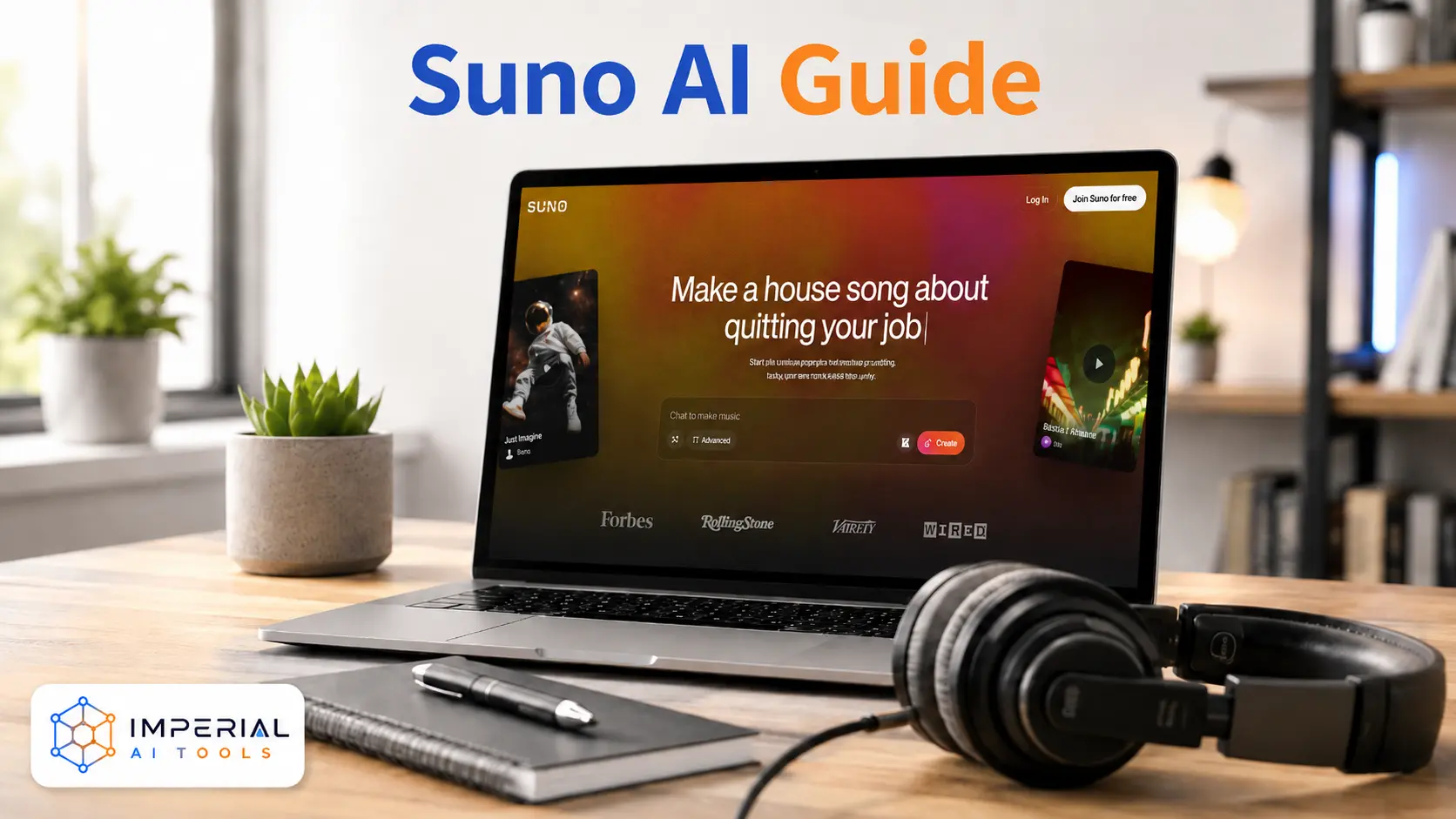

You do not need a studio, a mixing desk, or years of training to make a real song anymore. This Suno AI guide shows you how to go from a single sentence to a finished track with vocals, and how to shape that track once you want more control.
Suno is an AI-assisted music platform that turns a short description, your own lyrics, or uploaded audio into a complete song. Beginners can create music with zero production background. More advanced users can edit sections, extend tracks, split stems, build reusable voice personas, and open full projects inside Suno Studio.
The platform operates on a credit system, and this is the part that people often overlook: free songs and paid songs come with significantly different ownership and commercial-use rights. Get that wrong, and you can build a whole catalog you are not allowed to monetize. By the end, you will know how Suno works, how to create your first song, how to write prompts, what the plans cost, how editing and downloads work, who owns your music, and how to fix common problems.
What Is Suno AI?

Suno AI is an online music-generation platform that creates complete songs from written descriptions, lyrics, style instructions, or uploaded audio. It can generate vocals, instrumentals, melodies, arrangements, and full song structures without requiring traditional recording gear or a digital audio workstation.
Where most AI music tools give you a loop or a backing bed, Suno aims for a finished, listenable song, with verses, choruses, vocals, and an ending included. That is why it sits near the top of the creative people reach for alongside popular voice-generation platforms like ElevenLabs AI.
What can you create with Suno AI?
- Full songs with vocals
- Instrumental and background music
- Jingles and podcast intros
- YouTube theme music and rap tracks
- Pop, rock, country, electronic, and cinematic songs
- Songs built from your own original lyrics
- Extended versions and alternate sections of existing tracks
- Remastered tracks, covers, and style variations.
- Character- or persona-based songs
- Separated vocal and instrumental stems
Who is Suno AI designed for?
Suno serves a wide crowd: first-time music creators, songwriters testing ideas, singers and vocalists, producers building demos, YouTubers, podcasters, social media creators, marketers and ad teams, game and film creators, teachers and students, and musicians shaping early concepts.
Suno currently describes itself as a free, browser-based music generator that can produce complete songs without a credit card or prior production experience. That low barrier is a big reason it keeps showing up in our AI tool comparisons.
How Does Suno AI Work?
The workflow breaks into three simple stages: input, generation, and refinement.
Input
You can start with a short song description, custom lyrics, a genre, mood instructions, vocal preferences, instrument choices, uploaded audio, an existing Suno track, a reusable persona, or a single section you want to edit or extend.
AI music generation
From your instructions, Suno generates melody, harmony, rhythm, instrumentation, vocals, song structure, production style, and mixing character. You usually get two takes per generation, so you can pick the one that fits.
Review and refinement
After a track lands, you can listen to alternatives, edit lyrics, replace sections, extend the song, create covers, remaster the audio, separate stems, download the result, or open the project in Suno Studio. Suno supports both quick creation through Simple Mode and detailed control through Custom Mode, with advanced editing documented in its help center.
Main Suno AI Features

Simple Mode and Custom Mode
Simple Mode takes a short natural-language description and does the rest. Custom Mode hands you control over lyrics, song style, title, and instrumental settings. Use Simple Mode for speed, and Custom Mode when you want repeatable, detailed creative direction.
Song Editor, Extend, Cover, and Remaster
These four tools cover most day-to-day editing. Song Editor changes selected lyrics or musical regions. Extend continues an existing track. Cover recreates a track with a fresh interpretation. Remaster produces an updated version while keeping the original concept. The official Song Editor flow lets you select a region, change the lyrics, add a new instruction, generate alternatives, and smooth the transition into the edited part.
Personas and reusable voices
Personas help you keep a recognizable creative identity across a series of songs. The Voices feature lets you build a verified voice profile from recorded, uploaded, or authorized audio. Only upload voices you own or have clear permission to use, and expect Suno to require verification of the source.
Stem separation and audio uploads.
Suno can split vocals from instruments, with more advanced stem splitting on eligible plans. You can also upload demos, riffs, melodies, or recordings and use that material as a starting point rather than beginning from a blank prompt.
How to Use Suno AI Step by Step
This is the part of the Suno AI guide most beginners come for. Follow these eleven steps in order, and you will have a finished, exportable track.
Create a Suno account
Visit the official platform, register or log in, then check your remaining credits and review your current plan and rights.
Open the Create page
This is where every new project begins. You will see options for Simple Mode, Custom Mode, instrumental creation, audio upload, and existing projects.
Choose Simple or Custom Mode
Pick Simple Mode for a quick idea, or Custom Mode when you want original lyrics and detailed control.
Describe the song
Name the genre, mood, tempo, instruments, vocal type, theme, era or production style, energy, and structure.
Add or generate lyrics
Let Suno write them, paste your own, or write structured verses and choruses with clear section labels. Always read the lyrics before generating.
Add style instructions
Think “female soul vocal,” “energetic pop-rock,” “slow cinematic piano ballad,” “dark electronic production,” or “acoustic folk duet.”
Select instrumental or vocal output
Choose vocal songs, instrumental music, background tracks, or karaoke-style arrangements depending on the use.
Generate the song
Check the credit cost, generate the alternatives, and listen to each version in full. Do not judge a track on its first five seconds.
Review the result
Evaluate vocal quality, lyrics, pronunciation, genre accuracy, structure, instrument balance, repetition, ending quality, and any audio artifacts.
Edit, extend, or remaster
Use Replace Section, Edit Lyrics, Extend, Cover, Remaster, Personas, or stem separation to shape the track.
Download or open in Studio
Export as MP3 or WAV, pull stems or MIDI where available, or open the project in Suno Studio if you are on an eligible plan.
Tip: generate two or three versions of the same idea before you touch the editor. It is faster to pick a strong starting point than to fix a weak one.Lorem ipsum dolor sit amet, consectetur adipiscing elit. Ut elit tellus, luctus nec ullamcorper mattis, pulvinar dapibus leo.
How to Write Better Suno AI Prompts
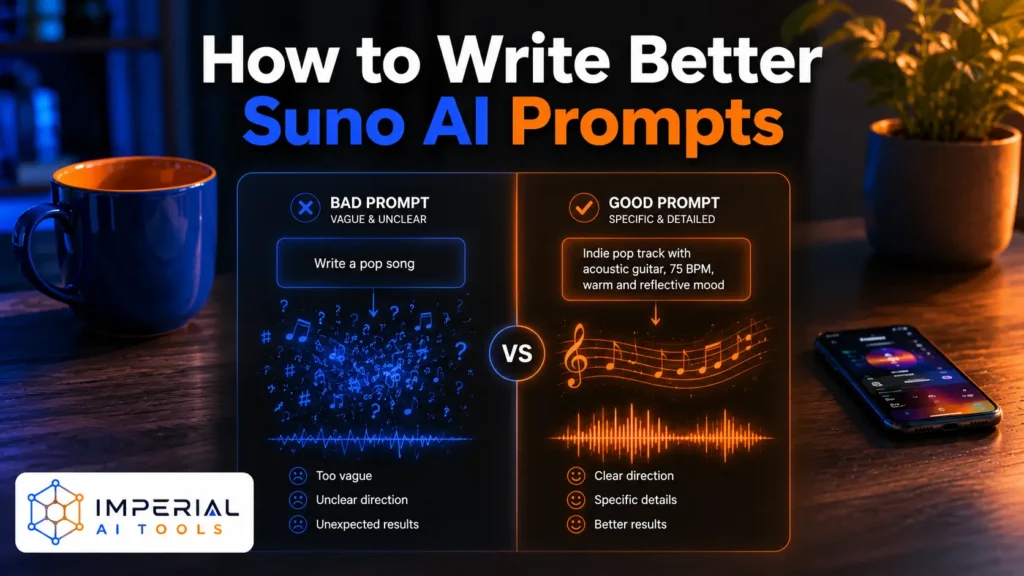
Prompt quality is the single biggest lever you control. A vague prompt gives you a generic song. A specific one gives you the track you heard in your head.
Genre + Subgenre + Mood + Tempo + Instruments + Vocal style + Theme + Structure + Production
Prompt framework
| Genre | Main music category | Alternative rock |
|---|---|---|
| Subgenre | More specific direction | Atmospheric post-rock |
| Mood | Emotional tone | Reflective and hopeful |
| Tempo | Speed and energy | Slow build, 82 BPM feel |
| Instruments | Main sound sources | Electric guitar, bass, live drums |
| Vocal style | Singer and delivery | Warm male vocal, restrained verses |
| Theme | Subject of the song | Starting again after failure |
| Structure | Arrangement | Verse, pre-chorus, big chorus, bridge |
| Production | Mixing and sound character | Wide cinematic mix, natural drums |
Suno prompt best practices
- Put genre and mood first.
- Name specific instruments instead of vague terms.
- Describe the vocal delivery, not a real singer.
- Avoid naming living artists.
- Keep your instructions compatible with each other.
- State clearly whether you want vocals or instrumental output.
- Add structural instructions when a song feels repetitive.
- Use fewer ideas per generation, and adjust one variable at a time.
- Save the style prompts that work as reusable templates.
What not to include in Suno prompts
Skip conflicting genres, an overload of instruments, unclear emotional direction, copyrighted lyrics, unauthorized artist imitation, instructions that fight your selected mode, and long unprioritized paragraphs. Clarity beats volume every time.
How to Structure Lyrics for Suno
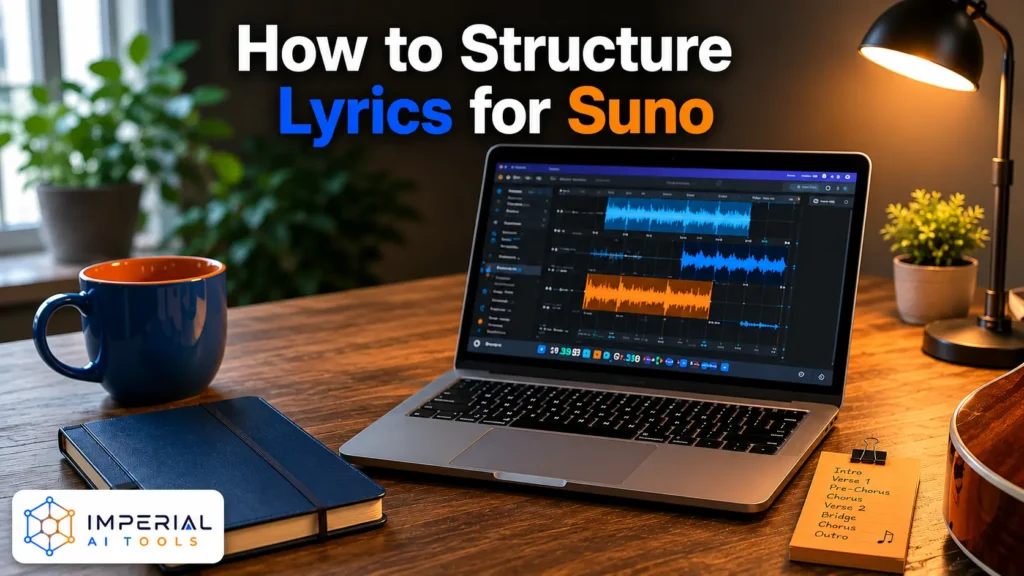
Most people obsess over the style prompt and ignore lyric structure, which is where a lot of awkward phrasing comes from. A little formatting goes a long way.
Use clear section labels
Label your song so Suno knows how to build it: [Intro], [Verse 1], [Pre-Chorus], [Chorus], [Verse 2], [Bridge], [Final Chorus], [Outro].
Keep syllable length consistent
Lines of similar length are easier to phrase musically. Very long lines can sound rushed, and a mix of very short lines can create awkward timing. Aim for an even rhythm across a section.
Use repetition strategically
Repeat the main hook, but not every line. Keep the chorus recognizable, and change the final chorus slightly when it fits the song’s arc.
Add performance directions carefully
Directions like [Softly], [Spoken], [Harmony], [Instrumental break], [Build], or [Whispered intro] can guide the delivery. Treat them as suggestions, not guaranteed commands.
Protect originality
Write your own lyrics, avoid copying copyrighted songs, review generated lyrics before publishing, edit any generic lines, and add a meaningful human contribution. That human layer matters for both quality and rights.
Suno AI Pricing and Credits
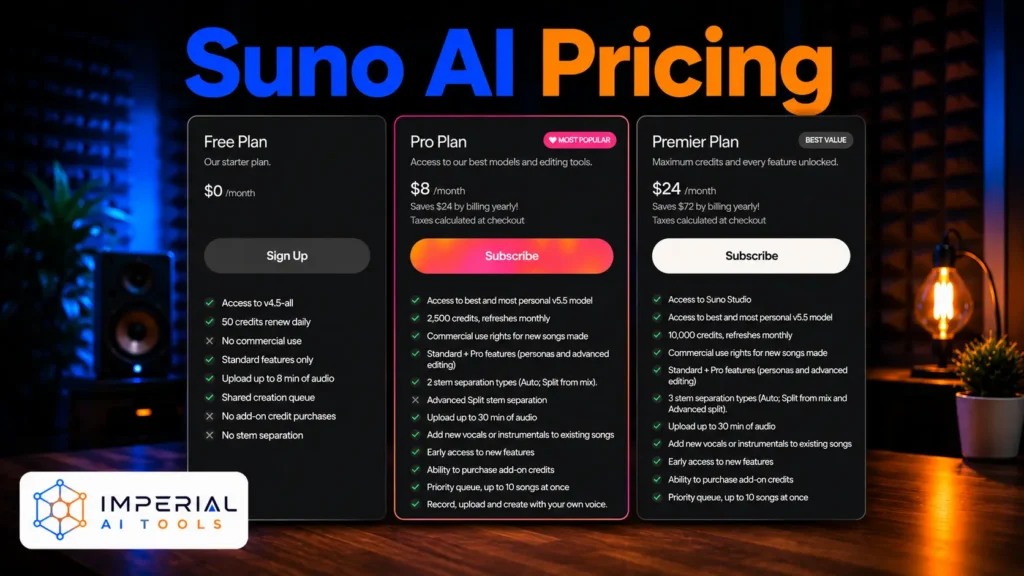
Pricing checked in July 2026. Taxes, regional pricing, discounts, features, and credit allowances can change. Verify the official Suno pricing page before subscribing.
What happens when paid credits run out?
Pro and Premier credits refresh monthly. Suno states that paid users may receive up to the standard daily free credits once their monthly allocation is used, and paid users can also purchase extra credits. Monthly balances do not turn into a single annual lump sum, so plan your work across the billing cycle rather than saving it all for the last day.
Want to see how Suno stacks up against other music and creative AI tools before you pay? Explore AI tools on Imperial AI Tools
Downloading Songs, Stems, and Project Files
How to download a Suno song
Open the generated track, open the song menu, select an available download format, save the file, and check your usage rights before publishing anywhere publicly.
Available export formats
Depending on your plan and feature access, you may be able to export MP3, WAV, video, vocal stems, instrumental stems, advanced separated stems, and MIDI through eligible Studio workflows. Suno currently makes MP3 downloads broadly available, while paid plans unlock additional formats and production exports.
Best Suno AI Use Cases
- Songwriting and demos
- Test hooks, explore genres, develop melodies, and try alternate arrangements before committing.
- YouTube and podcast music
- Intros, outros, background beds, theme songs, and channel jingles.
- Marketing and advertising
- Brand jingles, social ad audio, product-campaign music, and short promo clips.
- Film, games, and storytelling
- Concept soundtracks, character themes, scene music, and trailer ideas.
- Personalized songs
- Birthdays, weddings, gifts, and classroom projects. Commercial use requires an eligible paid plan to be active when the song is generated.
Common Suno AI Problems and Fixes
| Music sounds generic | The prompt is too broad | Add subgenre, instruments, structure, and mood |
|---|---|---|
| Vocal style is wrong | Vocal instruction unclear | Specify range, tone, energy, and delivery |
| Wrong genre generated | Too many conflicting styles | Use one main genre and one supporting influence |
| Lyrics sound rushed | Lines are too long | Shorten lines and balance syllable counts |
| The chorus is weak | Hook not clearly defined | Repeat a concise central phrase |
| Structure is repetitive | No structural direction | Add verse, pre-chorus, bridge, final chorus |
| Pronunciation is off | Complex spelling or names | Rewrite words phonetically where needed |
| The song ends abruptly | Generation hits its limit | Use Extend to build a proper ending |
| Track changes too much after editing | Edit range too broad | Select a smaller section |
| The prompt is flagged | Restricted name or content | Remove copyrighted lyrics or artist imitation |
| Credits disappear fast | Too many repeated generations | Refine one variable at a time |
| Upload gives poor results | Reference audio is unclear | Use a cleaner, shorter source file |
When Suno is down, or the generation is slow
Check the official service status or support channels, refresh the project, and avoid resubmitting the same job repeatedly. Save your lyrics and prompts externally, retry outside peak hours, and confirm credits were not already deducted before you resubmit.
Tips for Getting Better Results With Suno
- Start with a clear genre and mood, then define the vocal style.
- Include two to four key instruments, not a dozen, and give the song a central theme.
- Write a memorable chorus, use structured lyrics, and avoid stacking too many genres.
- Generate multiple versions before editing, and listen past the first 20 seconds.
- Use Extend instead of forcing a long initial track, and edit only the weak section.
- Save the style prompts that work, and create personas for recurring projects.
- Track which songs were made under a paid plan, and download final files before deleting projects.
Testing note: keep a simple log of the prompt, model, credit cost, generation time, strongest result, and the changes you made. First-hand records like this make your creative process repeatable and easier to explain to clients.
Is Suno AI Worth Using?
For most creators, yes. Suno is at its best as a fast songwriting and production assistant. This Suno AI guide has one core message: the results improve dramatically when you bring original lyrics, clear musical direction, careful editing, and real human production choices.
Best suited for
- Beginners creating their first songs
- Songwriters testing ideas and producers building demos
- YouTubers, podcasters, and marketers producing jingles
- Musicians exploring genres, and Premier users needing Studio workflows
Less suitable for
- Users needing guaranteed control over every note
- Projects requiring assured copyright registration
- Free users planning to monetize their songs
- Producers who need a full traditional DAW, or anyone unwilling to edit generated lyrics
- Projects based on unauthorized voices or copyrighted material
Conclusion
Suno turns text, lyrics, and audio into complete songs. Simple Mode gets beginners moving, while Custom Mode and Suno Studio give serious creators real control. Strong prompts and structured lyrics lift the quality of everything you make, and pricing stays credit-based across all plans. The rule to remember from this Suno AI guide: commercial rights depend on the plan active when the track was created, and copyright protection is a separate question from commercial permission.
Start with one short concept, generate two versions, refine only the strongest result, and save that winning prompt as a reusable template for your next track.
Frequently Asked Questions About Suno AI
Suno has a free plan that gives 50 credits daily, roughly 10 songs a day. Free tracks are limited to personal, non-commercial use. To monetize your music, you need a Pro or Premier subscription active at the time the song is created.
Yes. Simple Mode lets you type a short description and generate a full song with vocals in seconds, with no music-production experience required. Move to Custom Mode later once you want lyric control and detailed creative direction.
Songs generated while you are subscribed to Pro or Premier come with commercial-use rights, so you can monetize them. Free-plan songs are non-commercial, and upgrading later does not retroactively grant commercial rights to tracks made on the free plan.
Paid subscribers can distribute eligible songs to Spotify, Apple Music, and other platforms through a distributor of their choice. Confirm your plan grants commercial rights and check each distributor’s current rules on AI-generated music before releasing.
On the free plan, Suno retains ownership of the output. On Pro or Premier, subscribers are treated as the owners of songs generated during the active subscription. Commercial permission is separate from copyright registration.
Commercial rights and copyright are not the same thing. Copyright registration usually requires meaningful human authorship, and the relevant copyright authority decides on a case-by-case basis. Adding original lyrics, arrangement, and editing strengthens any human-authorship claim.