
Introduction
ChatGPT is no longer just a chatbot for random questions. In 2026 it can help you write, study, plan, code, read files, look at photos, talk out loud, and research the web. It has become a general helper you can keep open all day.
The trouble is that most people use only a tiny slice of it. This ChatGPT guide is written for beginners, in plain English, so you can go from confused to confident. We will cover access, plans, models, prompts, files, images, voice, safety, errors, and use cases.
What is ChatGPT?
ChatGPT is an AI chatbot from open ai that can understand your simple text-based inputs and then provide responses, solutions, and ideas in output almost like a human would. Just imagine having a personal assistant who has knowledge of every topic in the world. That’s exactly what ChatGPT is an AI trained on a massive amount of data, like websites, articles, books, courses, and many other kinds of resources found on the internet. This data helps ChatGPT understand the patterns of human language, grammar, and context. Based on these patterns, ChatGPT is then able to generate completely new answers.
That’s the reason why, if I ask ChatGPT to write a nursery rhyme in Badshah’s style, even though no such nursery rhyme actually exists in reality ChatGPT’s training data still includes many of Badshah’s rap songs, and based on the patterns within them, it can write a nursery rhyme in a similar style. I’m sure you now understand a bit better why this AI chatbot is so powerful, and why every content creator should be using it.
“AI is an enabling technology, like electricity. ChatGPT is like the first telephone that works.”
How to Access ChatGPT
Use ChatGPT in Your Browser
The fastest way to start is in a web browser. Go to chatgpt.com (also reachable at chat.com), sign up with an email, Google, Apple, or Microsoft account, then click “New chat” and type your question. You do not need to install anything to try it.
Use the ChatGPT App
There is also a ChatGPT app for iPhone, Android, Mac, and Windows. It is great for quick questions on the go, talking by voice, and snapping a photo to ask about it. Sign in with the same account and your chats stay in sync across devices.
How to Set Up ChatGPT for the First Time
Spend two minutes in settings first. It makes ChatGPT guide feel personal and keeps your data under control.
- Profile settings
- Add your name and what you do, so replies fit you better.
- Data controls
- Decide whether your chats help improve the models. You can also delete single chats or clear everything, which is how to delete ChatGPT history when you want a clean slate.
- Custom instructions
- Set how you want replies every time, such as “keep answers short and simple.”
- Memory preferences
- Turn memory on to remember useful facts across chats, or off for a blank page each time.
ChatGPT Free vs Paid Plans: Which One Should You Use?
ChatGPT Free Plan
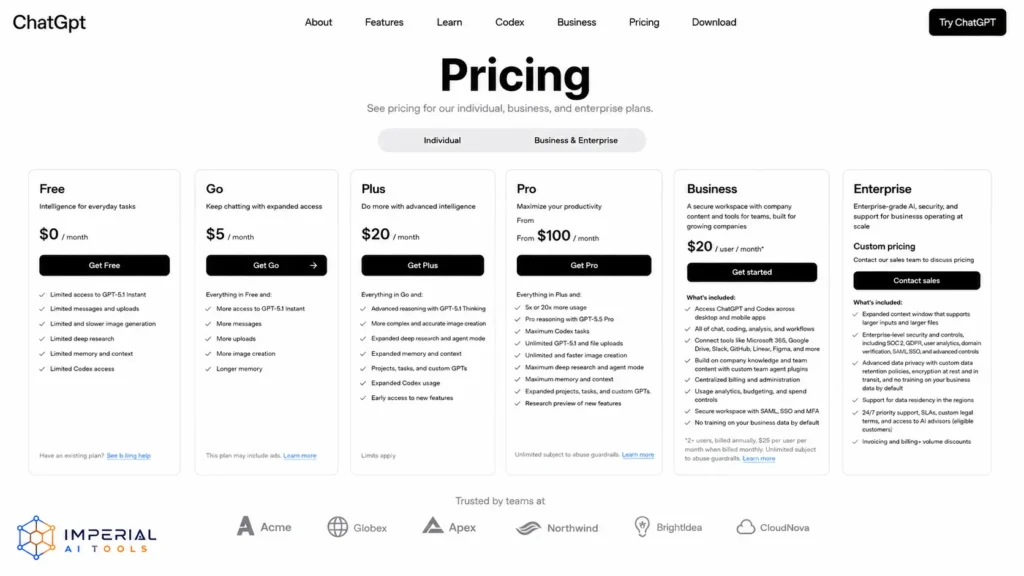
The free plan is the best place to start and fine for casual use. You can chat, upload the occasional file, and try image and voice features. The main free version limitations are smaller limits and less access to advanced tools. For many people, free is genuinely enough.
ChatGPT Go, Plus and Pro
OpenAI also offers paid tiers called Go, Plus, and Pro, each raising limits and adding more. Prices and features change often, so check the official OpenAI pricing page before you pay.
| Plan | Best for | What you generally get |
|---|---|---|
| Free | Casual users and first-timers | Core chat, basic file and image use, limited advanced tools, standard limits |
| Go | Light regular users on a budget | Higher limits than free and steadier access to better models |
| Plus | Power users, students, professionals | Advanced reasoning, expanded deep research, more memory and context, projects, tasks, and custom GPTs |
| Pro | Heavy users, researchers, creators, coders | The highest limits and most powerful models for demanding or complex work |
ChatGPT Pro vs Plus Comparison
The ChatGPT Pro vs Plus comparison comes down to how hard you push the tool. Plus suits most professionals and students who want smart help without hitting walls. Pro is built for people who run big jobs all day and need the largest limits.
Is ChatGPT Pro worth it? If you only chat now and then, no. If ChatGPT guide is part of your daily work and Plus limits slow you down, Pro can pay for itself in saved time.
Best For: Quick Plan Picks
- Just curious: Start with Free.
- A few times a week: Go or Plus.
- Daily real work: Plus, moving to Pro if you hit limits.
- Research, coding, or content all day: Pro.
ChatGPT Models Explained
A “model” is the brain behind your chat, and you can often pick one from a menu at the top. Names change over time, so check OpenAI for the newest list.
GPT-5.5 Instant
The fast, everyday brain. It answers quickly and suits simple questions, short writing, and casual chat. Use it when you want speed over deep thinking.
GPT-5.5 Thinking
This model reasons step by step, so it is better for planning, coding, math, and analysis. Use it when the answer needs care, not just speed.
GPT-5.5 Pro
The heavy-duty brain for advanced work, usually on higher plans. It handles the hardest problems and the longest tasks. Most people will not need it daily, but it shines on complex jobs.
ChatGPT Prompting Guide for Beginners
A prompt is just the message you send. A good one tells ChatGPT who to be, what to do, and how to do it. Here is a formula you can reuse forever.
The Prompt Formula
Role + Task + Context + Format + Tone + Constraints
Example: “Act as a career coach (role). Write a resume summary (task) for a nurse with five years of experience (context). Use three short sentences (format). Keep it confident but warm (tone). Avoid buzzwords (constraint).”
Bad Prompt vs Good Prompt Examples
- Bad
- “Write about marketing.”
- Good
- “Act as a digital marketing expert. Write five simple tips to help a small bakery get more local customers on Instagram. Use short bullets and a friendly tone.”
The good prompt wins because it sets a role, a clear task, real context, a format, and a tone. That is the whole secret.
Best ChatGPT Prompts by Use Case
Copy these starters and swap in your own details.
- Resume
- “Turn these notes into three strong bullet points for a sales job.”
- Study guide
- “Create a study guide with key points, simple definitions, and five quiz questions.”
- Lesson plan
- “Build a 45-minute lesson plan on fractions for grade five, with an activity.”
- Business plan
- “Outline a one-page plan for a mobile car-wash, with costs and target customers.”
- Self-improvement
- “Give me a 30-day plan to build a daily reading habit.”
- Workout plan
- “Create a beginner home workout for three days a week, no equipment.”
- HTML
- “Write HTML and CSS for a simple contact form with name, email, and message.”
- Rewrite
- “Rewrite this paragraph to be clearer and friendlier, same meaning.”
- Photo prompt
- “Describe what is in this photo, then suggest a caption.”
- Presentation
- “Turn these notes into a five-slide outline, three bullets per slide.”
5 Hacks To Use ChatGPT So Well It’s Almost Unfair
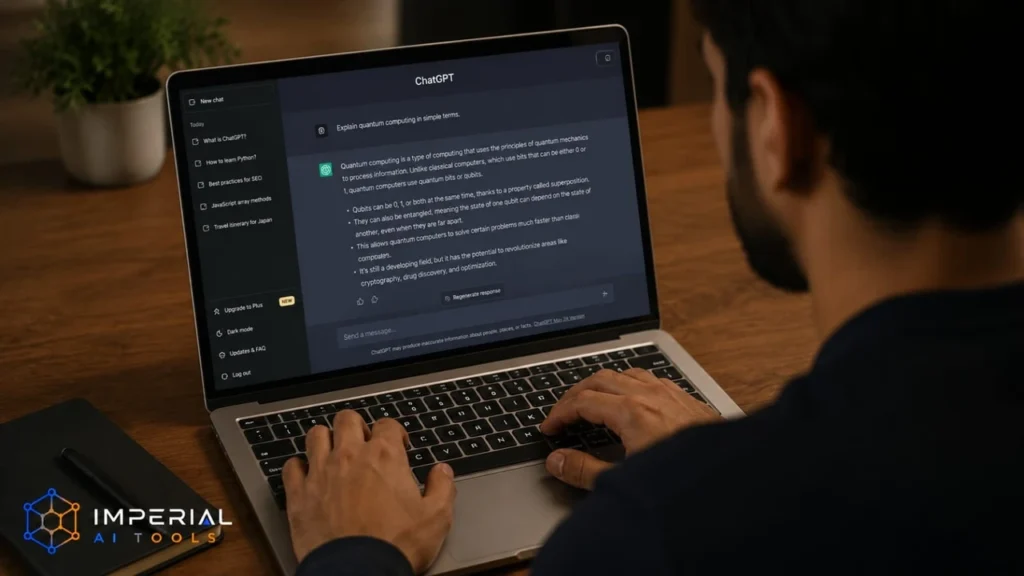
- The Clone
- Turn ChatGPT guide into a persistent assistant that knows your context. Use the ESPE Framework to define your goals, style, and preferences, and use Projects to keep different areas of work separated so context doesn’t mix.
- The Swarm
- Combine multiple ChatGPT capabilities at once instead of relying on plain chat. Agent Mode browses and acts on the web for you, Vision reads and interprets images or screenshots, and Deep Research autonomously searches dozens of sources and returns a cited report.
- Devil’s Advocate
- Prompt ChatGPT to argue against your ideas instead of agreeing with you, so you’re forced to stress-test your thinking and catch blind spots before committing to a decision.
- Neural Link
- Use ChatGPT to build real understanding of a topic instead of just collecting quick answers. Ask it to quiz you, question your reasoning, or have you explain concepts back, so learning sticks instead of creating false fluency.
- Executive Coach
- Treat ChatGPT as a sounding board under pressure. Use it to reflect your thinking back at you during tough decisions or emotional moments, the way a coach would, so you respond with more clarity instead of reacting.
ChatGPT Features Beginners Should Know
Beyond plain chat, ChatGPT has tools that make it more useful. Not every feature is on every plan, so some may be limited or missing for you.
- Search and web browsing
- Pulls fresh information for recent events.
- Deep research
- Reads many sources and writes a longer, organised report.
- File uploads
- Read PDFs, Word docs, spreadsheets, and more.
- Image upload
- Show a photo and ask questions about it.
- Image generation
- Create new pictures from a text description.
- Voice and audio
- Talk out loud and hear replies back.
- Canvas
- A side workspace for editing long writing or code together.
- Projects
- Keep related chats, files, and instructions in one folder.
- Custom instructions
- Set default preferences for every chat.
- Custom GPTs
- Mini versions of ChatGPT guide built for one job.
- Memory
- Remembers helpful details about you over time.
- Scheduled tasks
- Ask ChatGPT guide to do something at a set time.
How to Upload Files, Photos and Excel Sheets to ChatGPT
How to Send a Photo in ChatGPT
Tap the plus or paperclip icon near the message box, then choose your image, or take a new photo in the app. Once it uploads, ask your question, such as “what does this label say?” or “explain this chart.”
How to Upload Excel to ChatGPT
Click the same icon and pick your .xlsx or .csv file, then say what you need, like “sum the sales column.” On capable plans it can run calculations and make simple charts from your sheet.
ChatGPT File Upload Limits
Limits vary by plan and change over time, so treat these as general guides and check OpenAI help for current rules.
- A hard limit of around 512 MB per file.
- Text and document files up to roughly 2 million tokens, a very large amount of text.
- Spreadsheets often capped near 50 MB.
- Images up to about 20 MB each.
- Daily upload counts depend on your plan, which is the “file upload limit per day.”
A token is a small chunk of text, roughly three-quarters of a word, which is how AI tools measure size.
How to Use ChatGPT Effectively
Good results are less about magic words and more about clear communication.
- Start with a clear goal. Say exactly what you want, like “write a polite reminder email to a client.”
- Give context. Add who it is for, the situation, and any facts to include.
- Tell it the format. Ask for a list, a table, an email, or five bullets.
- Set the tone. Friendly, formal, funny, or simple. ChatGPT guide will match it.
- Add constraints. Set a word count, a reading level, or things to avoid.
- Ask follow-up questions. Tell it to ask you anything unclear before writing.
- Verify important answers. Double-check facts, numbers, and advice that matter.
You can improve any reply with a follow-up like “make it shorter” or “add an example.”
Practical Use Cases by User Type
Here is how different people get real value, with a starter idea for each.
| User type | What to use it for | Try this prompt |
|---|---|---|
| Students | Summaries, flashcards, explanations | “Explain photosynthesis simply and give me five flashcards.” |
| Writers | Outlines, rewrites, tone, editing | “Outline a post about slow travel, then improve my intro.” |
| Marketers and SEO | Keyword ideas, briefs, FAQs, meta descriptions | “Write ten FAQs and a meta description for ‘home coffee setup.'” |
| Business owners | Emails, SOPs, replies, plans | “Write a friendly reply to a customer asking for a refund.” |
| Developers | Code explanation, debugging, small apps | “Explain this error and suggest a fix for my Python script.” |
| Teachers | Lesson plans, quizzes, rubrics | “Create a ten-question quiz and a rubric on the water cycle.” |
One caution stands out: Students should use ChatGPT guide to understand a topic, not to hand in its answers as their own.
“We can make a separate space for AI art, but AI trash passed as human art, is an abomination of creativity.”
Is ChatGPT Safe?
ChatGPT is safe for most everyday tasks, but a little caution goes a long way.
Privacy and Data
Your chats may be used to improve the models unless you turn that off in data controls. Avoid pasting anything you would not want stored, and delete sensitive chats when done.
Accuracy and Hallucinations
ChatGPT can “hallucinate,” meaning it can state wrong facts with total confidence. It is not always correct, so verify names, numbers, dates, and advice before you rely on them.
Copyright and AI-Written Text
Rules about who owns AI-written text are still settling and vary by country. If it matters, add your own edits and check any workplace or school policy on AI use.
Things You Should Not Put Into ChatGPT
- Passwords, PINs, or security codes.
- Private business or client data.
- Medical, legal, or financial documents, unless handled with care and permission.
- Sensitive personal information about you or others.
Common ChatGPT Problems and Fixes
- ChatGPT not responding
- Refresh the page, check your internet, and look at the OpenAI status page for outages.
- ChatGPT internal server error
- Usually temporary. Wait a minute, reload, or start a new chat.
- ChatGPT will not let me type
- The box can lock while a reply is generating. Wait for it to finish, or reload.
- Cannot send message in ChatGPT
- You may have hit a usage limit or lost connection. Wait for the reset, switch network, or try later.
- ChatGPT forgot password
- Click “Forgot password” on the login screen and follow the reset email.
- ChatGPT 5 not showing up
- New models can roll out slowly or need a paid plan. Update your app and check the model menu.
- File upload limit reached
- Wait for your daily limit to reset, upload smaller files, or upgrade your plan.
Best ChatGPT Alternatives for Different Users
If ChatGPT is not the right fit for a task, these ChatGPT alternatives each do one job especially well. The smart move is to match the tool to the task.
- Fast web research: Perplexity.
- Long writing and coding: Claude or ChatGPT.
- Google users: Gemini.
- Real-time social: Grok.
Conclusion
ChatGPT is most useful when you give a clear goal, add real context, pick the right plan, and check important answers before you trust them. Start free, learn the prompt formula, and lean on features like files, voice, and Projects as you grow more comfortable.
Keep this ChatGPT guide handy, remember that models and limits can change, and confirm pricing and features on the official OpenAI pages. When you are ready for more, explore additional AI tools, and comparisons on Imperial AI Tools.
Frequently Asked Questions
Publish clear, original content that answers common questions in your niche. Use plain headings, add tables and FAQs, cite trustworthy sources, and keep pages current. Then test relevant prompts in ChatGPT and improve the pages where your brand does not appear.
Click the plus or paperclip icon near the message box, then select your Excel or CSV file. Once it uploads, tell ChatGPT what to do, such as “total the revenue column” or “show the top ten rows.” On supported plans it can calculate and build simple charts from your data.
Limits change and depend on your plan, so check OpenAI help. As a guide, single files are often capped near 512 MB, text files can reach roughly 2 million tokens, spreadsheets around 50 MB, and images about 20 MB. A token is a small chunk of text, so 2 million tokens is a very large document.
Ask ChatGPT to write the game code, for example “make a simple browser game in HTML, CSS, and JavaScript.” Copy the code into a file, save it with the right ending like .html, then open it in your browser to play. For Python games, save the file and run it with Python on your computer.
You cannot run the real ChatGPT on your own computer, since it lives on OpenAI’s servers. You can run other open-source AI models offline using free tools like Ollama or LM Studio. These are separate models, not ChatGPT guide itself, but they work without the internet.