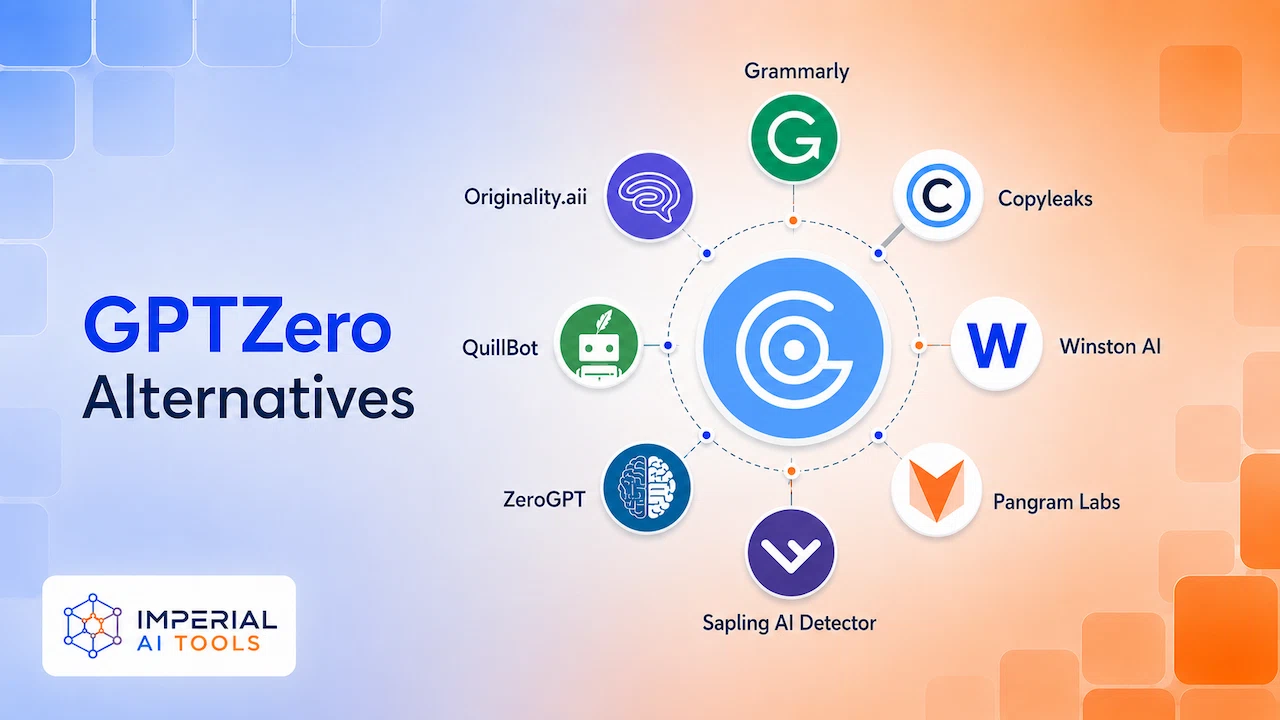

GPTZero built its reputation as one of the earliest AI content detectors, but in 2026 its tight 10,000-word free tier, rising prices, and documented false-positive issues, especially with ESL (English as a Second Language) writers, have pushed educators, publishers, and developers to look for better options. This guide compares 8 verified GPTZero alternatives on accuracy, false-positive resistance, pricing, and integration depth, so you can pick the right detector without running your own trial.
Humans deserve the truth.
Why Look for a GPTZero Alternative?
GPTZero remains a popular starting point for AI detection, but its free tier is capped at roughly 10,000 words a month, and independent testing has repeatedly found GPTZero’s false-positive rate sitting well above research-grade tools, particularly on ESL and lightly edited text. Paid plans get pricey fast even the starting tier costs a fair bit, and the top plan with unlimited scans is quite expensive. Full API access only comes with that priciest plan. Users switching away are usually chasing one of three things: a lower false-positive rate for high-stakes decisions, a cheaper or more generous free tier, or deeper API and LMS integration for institutional workflows.
How We Ranked Every GPTZero Alternative
Each tool below was scored using a weighted framework covering detection accuracy, false-positive resistance, speed, and integration depth, not price. Scores are editorial, based on published benchmarks, independent third-party studies, and hands-on review of vendor documentation as of July 2026.
- Detection accuracy
- How reliably the tool flags AI-generated text across GPT, Claude, and Gemini output.
- False-positive resistance
- How often human and ESL (English as Second Language) writing gets wrongly flagged.
- Speed and usability
- Scan turnaround and how easy the report is to read.
- Integration depth
- API access, LMS (Learning Management System) plugins, browser extensions, and batch processing.
Quick Comparison Table
| Tool | Best For | Free Plan |
|---|---|---|
| Pangram Labs | Lowest false-positive rate | 4 to 5 free daily credits |
| Copyleaks | Multilingual, institutional API | 2,500 words (or 10 pages) to use upon signing up. |
| Originality.ai | Content marketers and publishers | None (just 50 credits) |
| Winston AI | Agencies and schools needing PDF reports | 14-day trial, 2,000 free credits included. |
| QuillBot AI Detector | Writers who also need paraphrasing | 1,200 words per individual scan |
| Grammarly | Everyday writers already using Grammarly | Yes, built in |
| Sapling AI Detector | Developers needing a lightweight API | Free plan, no signup needed, but limited to 2,000 characters per check |
| ZeroGPT | Quick, no-login free scans | Yes, no signup |
01
Copyleaks
API-First Enterprise Detection
Copyleaks pairs its long-running plagiarism-detection engine with an AI detector covering 30-plus languages, which makes it the strongest pick for institutions running multilingual scanning at scale. Its API is bundled into every paid plan, undercutting GPTZero’s higher-tier-only API access.
- Detection across 30+ languages plus a dedicated code-plagiarism detector for programming work.
- Google Classroom and LMS integrations built for institutional rollout.
- API access starts on entry paid plans, not locked behind an enterprise tier like GPTZero.
- Independent testing has found its false-positive rate higher than Pangram’s on ESL writing.
- Dashboard density can overwhelm first-time users setting up API-only integration.
Best for AI + plagiarism workflows and multilingual classrooms.
02

Originality.ai
Publisher’s Go-To
Content marketing teams vetting freelance-written pages tend to land on Originality.ai because it combines AI detection and plagiarism scoring in a single scan, with a team dashboard built for reviewing many articles at once rather than one document at a time.
- Combined AI and plagiarism scan in one pass, saving a second tool subscription.
- Team-based scan history built for agencies reviewing freelancer submissions.
- Detects output from GPT, Claude, and Gemini model families in the same report.
- No free tier at all, unlike GPTZero’s 10,000-word monthly allowance.
- Optimized mainly for English long-form content, less suited to academic-specific workflows.
Best for Content marketing teams, agencies, and publishers.
03

Pangram Labs
Research-Grade Accuracy
Independent testing from the University of Chicago Booth School of Business has placed Pangram’s false-positive rate near zero across passage lengths, making it the tool researchers cite most often when GPTZero’s false positives become a real problem. It suits institutions and publishers who need a defensible, evidence-backed detection number.
- Independently verified false-positive rate around 0.01%, the lowest of any tool in this list.
- Four-tier classification (fully human to fully AI-generated) instead of a single binary score.
- Strong performance against humanizer and paraphrasing tools that beat cheaper detectors.
- Priced roughly double GPTZero’s entry tier, which matters for individual users.
- Smaller ecosystem of third-party LMS integrations than Copyleaks or Turnitin.
Best for Catching AI-humanized and paraphrased text with ultra-low false positives.
04

Winston AI
Agency & School Reporting
Agencies screening freelancer content at volume tend to favor Winston AI for its branded, shareable PDF reports and readability scoring layered on top of AI detection, a combination few competitors match natively.
- PDF and scanned-document OCR scanning, useful for handwritten or printed submissions.
- Visual highlighting of flagged sentence clusters for faster human review.
- Google Docs integration for direct in-document scanning.
- Free-tier scan volume is limited compared to GPTZero’s monthly free allowance.
- Occasional score variance reported on mixed human and AI text.
Best for Educators and freelancers needing clean, shareable PDF reports.
05

QuillBot
Detect + Paraphrase in One
Writers who already lean on QuillBot for grammar and paraphrasing get a built-in AI detector in the same subscription, which removes the need to juggle a second tool for a quick sanity check before submission.
- Integrated paraphraser, grammar checker, citation generator, and detector in one ecosystem.
- Free tier covers 1,200 words, useful for a quick check without signing up for a paid plan.
- Simple single-page UX built for fast scans, not deep forensic reports.
- Detection model is less specialized than dedicated detectors like Pangram or Copyleaks.
- Higher sensitivity to lightly-edited AI text than research-grade tools.
Best for Students conducting self-checks and looking for sentence-level analysis.
06

Grammarly
Built Into Your Writing Flow
For everyday writers already running Grammarly across docs, email, and browser tabs, its layered-in AI detector removes the friction of opening a separate site to check a draft before sending it.
- Native integration across docs, email, and browser, no separate upload step.
- Detection paired with tone and clarity scoring in the same pass.
- Enterprise-grade admin controls available for teams already on Grammarly Business.
- Detection is a secondary feature bolted onto a grammar tool, not the core product focus.
- Less granular sentence-level flagging than dedicated detectors like GPTZero or Pangram.
Best for Daily confidence checks directly within typing workflows.
07

Sapling AI Detector
Developer-First API
Teams building detection into their own content pipeline or agent workflow tend to reach for Sapling because its API returns minimal-latency, simple JSON output built for automated systems rather than a human reading a dashboard.
- Minimal-latency API responses suited to real-time or high-volume pipelines.
- Simple JSON output that drops straight into developer workflows.
- Free web-based checker available for quick manual spot checks.
- Fewer institutional or education-specific features than Copyleaks or Winston AI.
- Reporting UI is less polished for non-technical users who want a readable summary.
Best for Enterprise recruiters and short-form communication spot checks.
08

ZeroGPT
Free, No Signup Required
For a truly ad-hoc check with zero friction, ZeroGPT is hard to beat: paste text and get a result with no account and no word-count negotiation, which suits casual users more than anyone needing a defensible score.
- No-login quick-scan option, faster to use than GPTZero’s signup-gated free tier.
- Multi-language detection support at no cost.
- Fast turnaround on short-form text like social posts or emails.
- Independent testing has reported a notably higher false-positive rate than paid, research-grade tools.
- Methodology documentation is far less transparent than Pangram’s published benchmarks.
Best for Quick, frictionless free checks with no account setup.
Does AI Detection Accuracy Actually Hold Up in 2026?
AI detector accuracy in 2026 No, AI detection still isn’t reliable enough in 2026 to fully trust. Accuracy actually varies a lot from tool to tool, and what really sets platforms apart isn’t raw detection power it’s how often they wrongly flag genuine human writing.
Understanding False Positive Rates Across Tools
Published and independently verified false-positive rates range from near zero for Pangram to double-digit percentages for some free tools on ESL or heavily edited text. GPTZero’s own reported rate has been disputed in independent university research, which found it higher than the company’s marketing claims in some test conditions.
Why Detectors Give Different Scores on the Same Text
Each detector is trained on a different corpus and weighs perplexity and burstiness signals differently, so the same document can score as clearly human on one tool and borderline on another. Treat any single score as one input, not a verdict.
The ESL Writer Bias Problem, Explained
Multiple studies, including widely cited Stanford research, have found that non-native English writing patterns overlap statistically with common AI-generated phrasing, which raises false-positive rates for ESL writers across most detectors. Pangram and QuillBot have both been highlighted in recent reviews for lower ESL misclassification than the market average.
Imperial AI Tools Verdict
Pangram Labs is our top pick for anyone who needs a defensible, low-false-positive result, backed by independent university research rather than Co-marketing alone. For teams that need Multi-language coverage or deep LMS (Learning Management System) integration on a tighter budget, Copyleaks is the strongest runner-up, particularly for institutions already managing plagiarism checks. Individual writers who just need an occasional free check are still well served by QuillBot or ZeroGPT, with the understanding that free tools carry a higher false-positive risk.
Frequently Asked Questions
Yes. Independent testing has found GPTZero’s false-positive rate varies by study and content type, and it can misclassify human-written, particularly ESL, text as AI-generated. No detector, including GPTZero, is immune to this.
Research including widely cited Stanford findings has shown AI detectors, GPTZero included, can flag non-native English writing at a higher rate than native writing, since certain ESL sentence patterns statistically resemble AI-generated text.
Winston AI offers a limited free trial with a capped number of scans before requiring a paid plan. It is best suited to testing the tool’s reporting format before committing to a subscription.
ZeroGPT offers free, no-login scanning without GPTZero’s monthly word cap, though independent testing places its false-positive rate above paid, research-grade tools.