
The best Midjourney alternatives in 2026 range from free browser tools to open-weight models you can run on your own machine, and the right one depends entirely on what you are making. This guide is written for beginners, designers, marketers, developers and commercial creators who want a clear, honest comparison rather than a list of logos. We looked at eight of the strongest Midjourney alternatives using the same criteria for each: image quality, usability, editing, pricing and licensing. Every tool here was assessed using current plans, licences and product information as of July 2026, with official pricing and terms pages used for the figures wherever possible. Prices and free tiers change often, so anything that could shift is flagged for you to confirm before you commit.
AI is a tool, and it doesn’t diminish the quality or validity of the outcome.
Why Look for Alternatives to Midjourney in 2026?
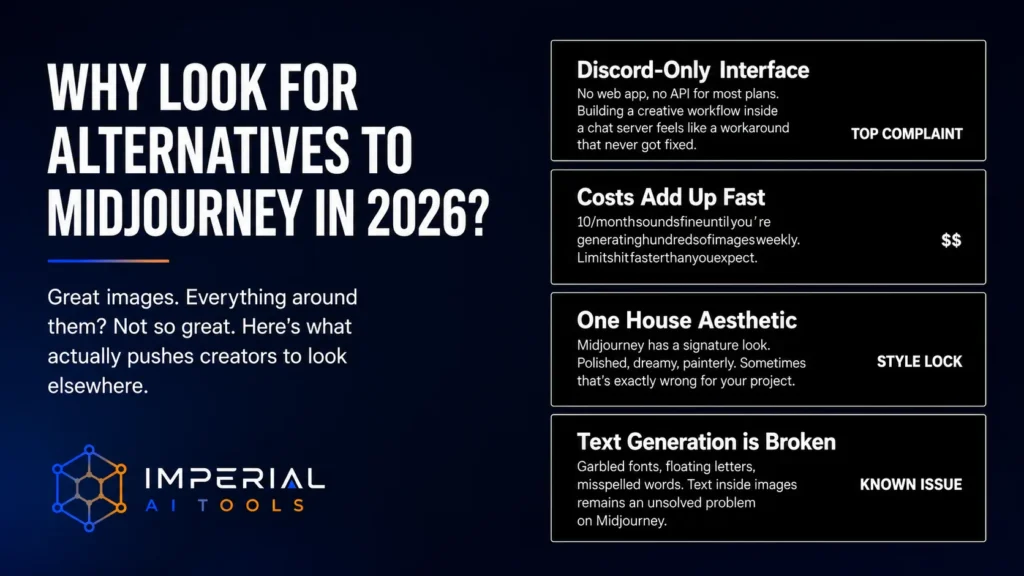
Most people search for alternatives to Midjourney because of pricing, workflow preference, free access, licensing, typography, control or video requirements. Midjourney has no standard free tier, its output style is distinctive but not always what a project needs, and its commercial and legal position has become more complicated. Those are practical reasons, not criticism, and they point different users toward different tools.
The market has also widened. Midjourney competitors now include browser-first apps, conversational tools, open-weight models you can self-host and multimodal platforms that generate video as well as images. That variety is exactly why a single “best” answer rarely fits.
Midjourney’s Main Strengths in 2026
Midjourney remains a benchmark for image quality and artistic style. Its aesthetic is instantly recognisable, with strong lighting, composition and texture that many designers still prefer for concept and editorial work. V8.1 became the default model in June 2026, adding faster generation, native 2K HD output and better prompt adherence, and it can now animate a still image into a short video. Personalisation profiles, style references and moodboards give experienced users a level of control that alternatives are still catching up to.
Best Midjourney Alternatives in 2026: Quick Comparison
The table below summarises the eight best Midjourney alternatives at a glance, so you can shortlist before reading the full reviews. Free-plan labels use consistent wording: “Yes” for a genuine ongoing free tier, “Limited” for daily or monthly free credits, “Trial” for a time-limited taste, “No” where there is none, and “Free when self-hosted” for open models you run yourself. Prices are entry-level starting points and exclude tax. Because credits and model access change often, treat every figure as a starting point to confirm on the official page.
01

FLUX
Research · Writing Assistant
FLUX is the image model family from Black Forest Labs, the team of former Stable Diffusion researchers. The current FLUX.2 generation is aimed at developers and teams who want strong prompt accuracy, reliable text and the option to self-host.
- High prompt adherence, strong text rendering, multi-reference editing for consistency.
- Clear split of hosted API access and downloadable weights for self-hosting.
- Klein 4B is Apache 2.0, genuinely free for commercial use.
- Token costs vary by model and setting, hard to predict in advance.
- Free generations are public; Leonardo retains broad rights to them.
- Character consistency and custom training are paid-only.
Best for Developers and model flexibility.
02

ChatGPT Images 2.0
Research · Writing Assistant
Many people still search for DALL·E 3, but OpenAI retired it on May 12, 2026. The current experience is ChatGPT Images 2.0, a rebuilt model with a native reasoning step that plans layout and text before generating pixels, generating and editing images through natural conversation inside ChatGPT.
- Conversational iteration: describe a change in plain English and it edits rather than starting over.
- Reasoning-led “Thinking mode” gives a real jump in text accuracy and dense-scene layout.
- Basic generation is free for everyone in Instant mode, no paid plan required.
- Free tier is tightly capped; works as a taster rather than a production tool.
- Thinking mode is noticeably slower, sometimes near a minute per image.
- Strict content filters can block benign prompts.
Best for Conversational Generation and Editing.
03

Adobe Firefly
Research · Writing Assistant
Adobe Firefly is the generative layer inside the Adobe ecosystem, available as a standalone web app and built into Photoshop and Illustrator. Its pitch is commercial safety: Adobe trains its own models on licensed and public-domain content.
- Deep Creative Cloud integration, including Generative Fill and Generative Expand.
- Positioned as commercially safe, with IP indemnification on qualifying paid and enterprise plans.
- Paid plans include unlimited standard image and vector generation.
- Output is predictable rather than striking; Midjourney wins on artistic flair.
- Credit system for premium features and partner models can be confusing; credits don’t roll over.
- Indemnification depends on your plan and staying within Adobe’s usage guidelines.
Best for designers who need legally defensible images inside Adobe apps.
04

Leonardo AI
Research · Writing Assistant
Leonardo AI is a browser-based image platform, now owned by Canva, that pairs multiple models with editing tools and a guided interface. It is the most natural landing spot for beginners moving away from Midjourney because there is no Discord and a real free daily allowance.
- No Discord, real editing tools (Canvas, inpainting, Consistent Character on paid tiers).
- Wide model choice in one place, including third-party models.
- Paid plans include unlimited standard image and vector generation.
- Token costs vary by model and setting, hard to predict in advance.
- Free generations are public; Leonardo retains broad rights to them.
- Character consistency and custom training are paid-only.
Best for Beginners and asset-producers who want a guided web tool with editing built in.
05

Ideogram
Research · Writing Assistant
Ideogram was built around one problem most models fail: rendering readable text inside an image. Its 3.0 model handles headlines, posters, logos and marketing graphics far more reliably than most rivals.
- Strongest text rendering of any mainstream model, especially short headline copy.
- Style Reference, Style Codes and Canvas inpainting for design-focused control.
- No-watermark free tier makes posters and typography easy to test.
- Accuracy drops on longer strings; practical ceiling is around 60 characters per image.
- Free generations are public; private work needs a paid plan.
- Clean, design-led look is weaker for painterly or editorial art.
Best for Designers and marketers making posters, ads, thumbnails.
06

Stable Diffusion
Research · Writing Assistant
Stable Diffusion is the open model line from Stability AI and the backbone of the self-hosting community. You download the weights and run them locally with tools like ComfyUI or Automatic1111, which gives you privacy, control and no per-image fees.
- Full local control, no cloud dependency.
- You retain ownership of the outputs you generate.
- Older models like SDXL use a permissive licence with no revenue cap.
- Local setup and good hardware needed for the best results.
- Licensing differs by model: SD 3.5’s Community License is free under $1M annual revenue, enterprise above that.
- Out-of-the-box quality can trail the newest closed models without careful prompting.
Best for Open-source and self-hosting.
07

NightCafe Creator
Research · Writing Assistant
Stable Diffusion is the open model line from Stability AI and the backbone of the self-hosting community. You download the weights and run them locally with tools like ComfyUI or Automatic1111, which gives you privacy, control and no per-image fees.
- Full local control, no cloud dependency.
- You retain ownership of the outputs you generate.
- Older models like SDXL use a permissive licence with no revenue cap.
- Local setup and good hardware needed for the best results.
- Licensing differs by model: SD 3.5’s Community License is free under $1M annual revenue, enterprise above that.
- Out-of-the-box quality can trail the newest closed models without careful prompting.
Best for Open-source and self-hosting.
08

Dreamina
Research · Writing Assistant
Dreamina is ByteDance’s creative platform, formerly part of CapCut, that bundles image generation, video generation and talking avatars into one workflow. Its edge is the prompt-to-edit-to-publish pipeline that hands straight off to CapCut.
- Combined image and video generation, powered by Seedance video and Seedream image models.
- Direct handoff into the CapCut editor, unmatched for short-form social workflows.
- Usable free daily credit pool shared across image, video and avatar tools.
- Free outputs carry a watermark and cap at 720p; video drains credits quickly.
- Clips limited to around 15 seconds, and some users report subscriptions expiring or crediting inconsistently
- Out-of-the-box quality can trail the newest closed models without careful prompting.
Best for Short-form Creators making TikTok, Reels and Shorts.
How to Choose the Right Midjourney AI Alternative
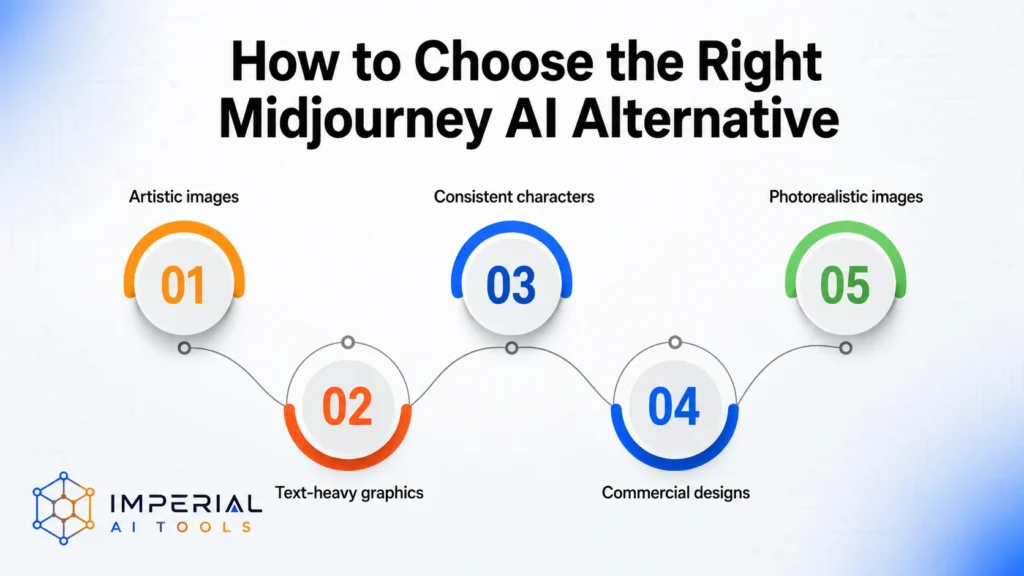
Start from your primary output, then test before you pay. The right Midjourney AI alternative is the one that matches the kind of work you do most, not the one with the flashiest demo.
Choose Based on Your Primary Output
- Artistic images
- Midjourney or NightCafe
- Photorealistic images
- FLUX or ChatGPT Images
- Text-heavy graphics
- Ideogram
- Consistent characters
- Leonardo AI or Stable Diffusion with a LoRA
- Commercial designs
- Adobe Firefly
- Local generation
- Stable Diffusion
- Video or animation
- Dreamina
Test the Same Prompt Before Paying
A repeatable check saves money and disappointment. Before subscribing:
- Use the same three to five prompts across your shortlist
- Compare prompt accuracy, anatomy, text, style and editability
- Record generation limits and credit cost
- Check the downloadable resolution
- Read the current rights before any client use
Is Midjourney Still the Best AI Image Generator?
Midjourney is still the best for artistic image quality and style, but it is no longer the automatic choice for every workflow. It remains strong on aesthetic polish, personalisation, style references and now short image-to-video. Where alternatives win is free access, readable text, local control, commercial safety and full video pipelines. Rather than a universal champion, think of it as a strong specialist among many.
Choose Midjourney when you want the most striking artistic output and a premium single-tool workflow.
Choose an alternative when you need free access, readable text, local generation, commercial indemnification or serious video.
Conclusion
The best Midjourney alternatives in 2026 each own a lane: Leonardo AI is the best overall for beginners, NightCafe is the best free community option, Ideogram wins for readable text, Adobe Firefly leads for commercial workflows, Stable Diffusion is the best open-source and self-hosted pick, and Dreamina is the strongest for video and animation. Midjourney can still be the right choice when you prioritise its visual style and ecosystem. Pricing and rights change, so verify both before you commit. The practical next step is simple: compare your top two options using the same prompts before subscribing.
Frequently Asked Questions
Yes, though “free” varies. Stable Diffusion is genuinely free and unlimited when self-hosted on your own hardware. Cloud tools like NightCafe and Leonardo AI give free daily credits rather than unlimited access, and free cloud generations are often public.
Midjourney’s main paid service has no standard free plan, and paid subscriptions start at $10 per month. Any free access tends to come through limited, inconsistent promotions or the separate niji·journey mobile trial, not the core Midjourney product.
Often yes, but it depends on the platform, plan and model licence. Adobe Firefly and paid tiers of Leonardo AI, Ideogram and NightCafe generally permit commercial use, while free tiers may restrict ownership or keep work public.
Yes, Midjourney can generate highly realistic and photorealistic images, especially with its current V8.1 model. Results improve when you specify camera, lens and film terms in the prompt and use Raw or realistic style settings. For maximum photorealism, alternatives like FLUX and ChatGPT Images are also worth testing against it.