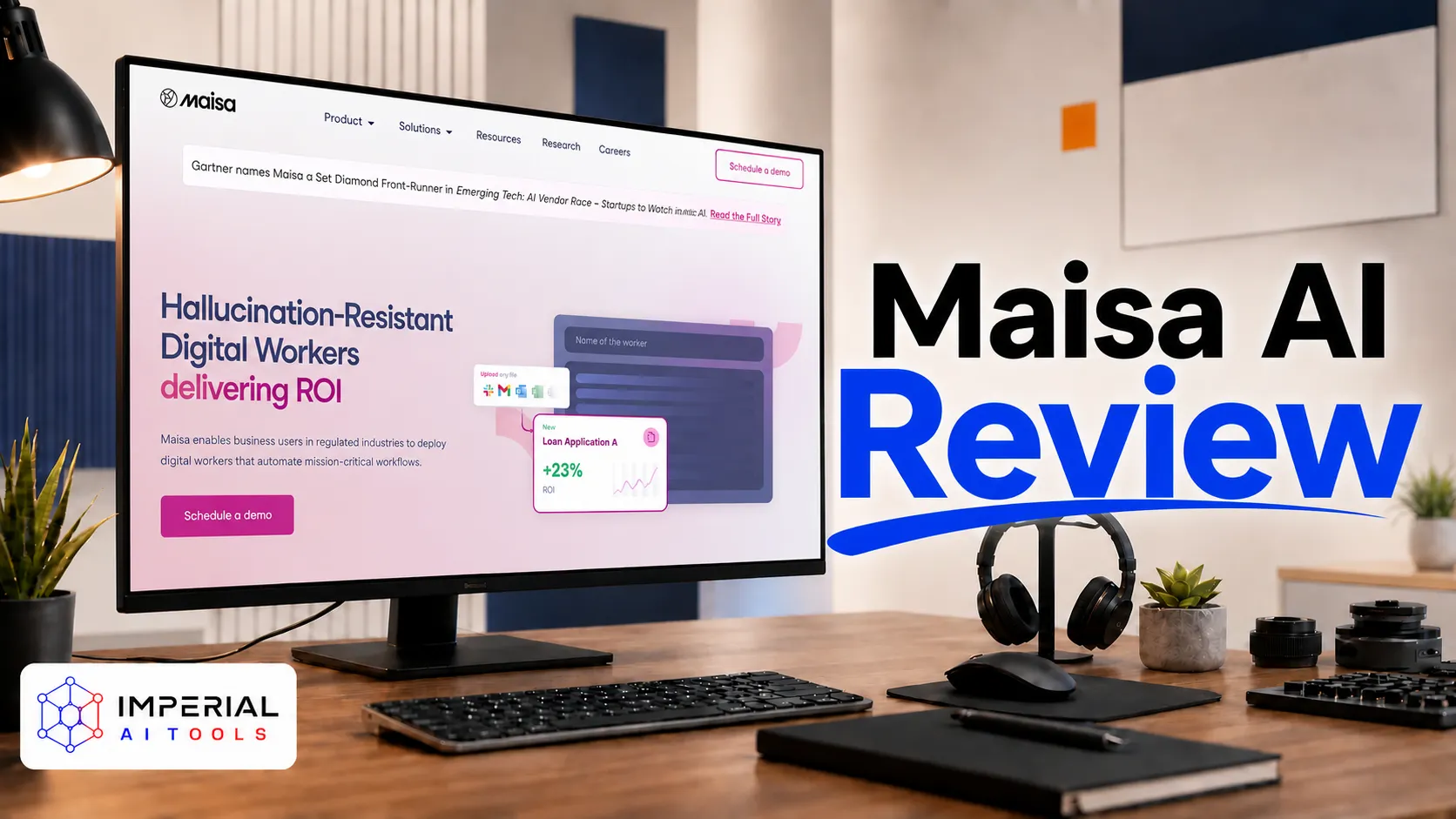

Maisa AI is an enterprise platform that builds auditable AI digital workers. Founded in 2024 by David Villalón and Manuel Romero, it is headquartered in Valencia and San Francisco.
The problem it targets is trust. Most AI agents hide their reasoning, so when they get something wrong, nobody notices until it matters. That is a dealbreaker in banking, insurance, and healthcare, where every decision must be justified to a regulator. Maisa’s answer is to make the AI show its work.
The company raised $25 million in a round led by Creandum, an early backer of Spotify and Klarna, and it has been named in the Gartner 2025 Hype Cycle. It reports 400% growth. This is a serious enterprise player, not a consumer app.
Quick Overview: Maisa AI builds auditable AI digital workers that automate business processes and record every decision. Its KPU engine makes reasoning traceable and hard to fake, built for regulated industries like banking and insurance not consumers.
“We’re not building chatbots. We’re building doers, AI digital workers that execute tasks with precision, reliability, and human-level adaptability.”
Key Maisa AI Features
- Knowledge Processing Unit (KPU)
- The KPU is Maisa’s core invention and the reason the platform exists. A normal LLM predicts its next word, which means it can sound confident while being wrong, fine for a chatbot, dangerous for a loan approval. The KPU wraps the LLM in a deterministic layer: it forces reasoning into structured, step-by-step logic backed by actual code, then validates the output at each stage. The result is far harder to hallucinate, because every step is checked rather than guessed. Maisa calls it an “AI Computer”; the LLM supplies the thinking, the KPU supplies the discipline.
- Chain of Work
- This is what auditability actually looks like in practice. Every action a digital worker takes is recorded: what data it accessed, which rules it applied, and why it reached each decision. A compliance officer or auditor can open any completed task and inspect the full trace. For regulated industries, this is the whole ballgame. A regulator doesn’t accept “the AI decided”; they demand to see the reasoning. Chain of Work produces that evidence automatically, as a by-product of how the system runs.
- Maisa Studio
- The Studio is how non-technical staff build digital workers without waiting on the IT department. You describe a process in plain language, the steps you take manually, what a complete case looks like, which policies apply and Studio converts it into executable instructions. Maisa’s term for these users is “citizen developers”: people who are experts in their business field but can’t code. This matters because the bottleneck in enterprise AI is rarely the technology; it’s the queue for developer time. Studio removes that queue.
- Model-Agnostic
- Maisa doesn’t tie you to one underlying LLM. The KPU sits above whichever model you use, so you’re not locked into a single vendor’s roadmap, pricing, or outages. As models improve, you can swap the engine underneath without rebuilding your digital workers. For an enterprise making a multi-year commitment, that flexibility is a real hedge against betting on the wrong model.
- Flexible Deployment
- Maisa runs either in its own secure cloud or entirely on-premises, inside your own perimeter. For banks, insurers, and healthcare providers, this isn’t a nice-to-have regulation often forbids sensitive data from leaving the organisation’s control. With on-premises deployment, processing occurs within your environment, and data doesn’t leave unless you explicitly configure it to do so. That single option is often what makes Maisa viable for a regulated buyer where a cloud-only tool would be a non-starter.
Who Should Use Maisa AI?
- Best suited for:
- Banks, insurers, and healthcare providers are automating document-heavy, judgment-based work such as loan origination, claims processing, KYC, and trade finance, for which an audit trail is mandatory.
- Not ideal for:
- Individuals, small teams, and anyone with simple, stable automation needs. As Maisa itself says, if your processes are predictable inputs and stable integrations, standard workflow tools handle that fine and cost far less.
Imperial AI Tools Feedback
Maisa is solving the real barrier to enterprise AI, which is not capability but trust. One auditable digital worker should beat a fleet of clever but unaccountable agents. In regulated industries, that bet is correct. The KPU and Chain of Work directly answer what compliance teams and regulators actually ask: prove the decision.
The honest limits are about fit, not quality. This is heavyweight enterprise software. There is no free tier to try; onboarding means a real implementation, and the price only makes sense against expensive, high-stakes processes. For anyone outside that world, it is far more than they need.
Our view: a strong, credible platform for regulated automation. If you are a bank or insurer drowning in manual document work, it belongs on your shortlist. If you are an individual looking for an AI assistant, this is not that.
Suggestions For Improvement
- Offer a guided demo or sandbox so buyers can see the KPU before a sales process.
- Publish clearer pricing guidance, even as ranges, to help buyers self-qualify.
- Share independent benchmarks on accuracy against LLM-only agents.
- Expand public case studies with named outcomes in each regulated sector.
- Provide a smaller-scale tier for mid-market firms, not just large enterprises.