
Choosing between Salesforce vs HubSpot is one of the biggest CRM (Customer Relationship Management) decisions a growing company makes in 2026. Both platforms promise to unify your marketing, sales, and service teams. Yet they solve the problem in very different ways. HubSpot builds everything on one native data model. Salesforce gives you a customizable infrastructure you can bend to almost any process.
This guide is not a feature scrape. It comes from real deployment experience across startups and mid-market RevOps teams. We built the same custom object in both tools, ran identical nurture workflows, and tested each platform’s AI agent side by side. Along the way we tracked the details that actually matter: time-to-first-value, admin overhead, and where each tool starts to strain. See our full AI and business tool comparisons for more head-to-head breakdowns like this one.
What Is Salesforce?
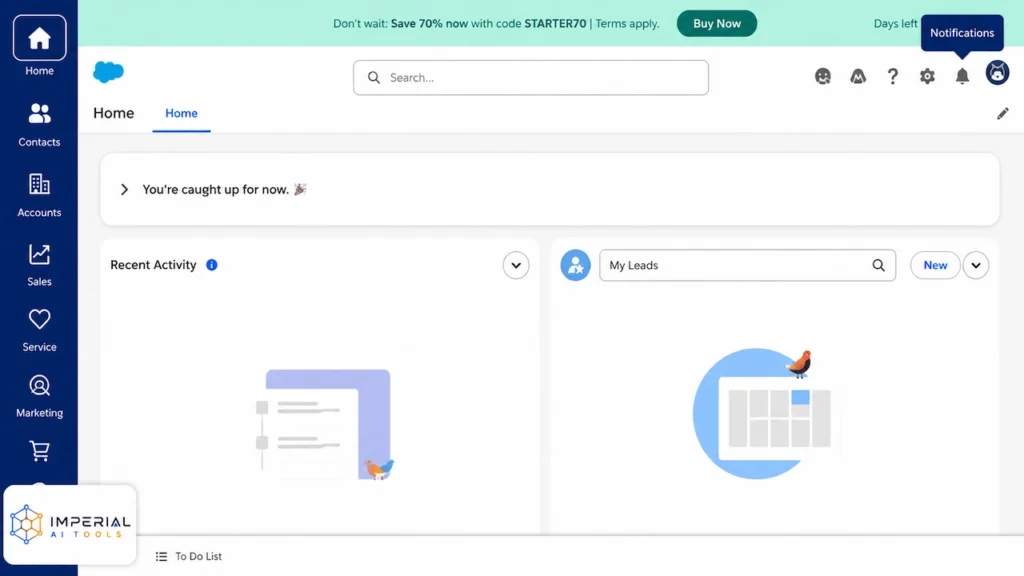
Salesforce is the world’s leading cloud-based CRM (Customer Relationship Management) platform, offering configurable software for sales, service, marketing, commerce, and analytics. Marc Benioff, a former Oracle executive, founded Salesforce in March 1999 in San Francisco alongside Parker Harris, Dave Moellenhoff, and Frank Dominguez. Its original mission, “The End of Software,” challenged traditional on-premise licensing by delivering applications entirely over the internet.
Salesforce pioneered the software-as-a-service (SaaS) model and grew into an enterprise giant. Its core products include Sales Cloud, Service Cloud, Marketing Cloud, Commerce Cloud, and Tableau, extended through the AppExchange marketplace and Apex and Flow customization. The company went public in 23 june 2004 under the ticker CRM and reported record revenue of US$41.52 billion for fiscal year 2026. As of 2024, Salesforce held roughly 21% of the global CRM market, more than its next four competitors combined, and serves over 90% of Fortune 500 companies.
What Is HubSpot?
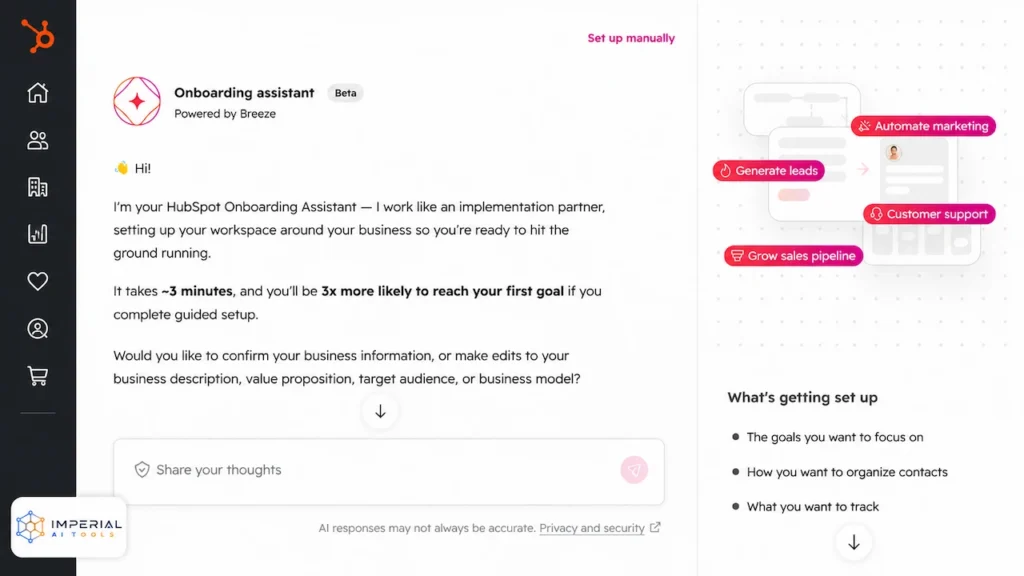
HubSpot is a customer relationship management (CRM) and inbound marketing platform that unites marketing, sales, and customer service on one native data model. Brian Halligan and Dharmesh Shah founded HubSpot in June 2006 in Cambridge, Massachusetts, after meeting as graduate students at MIT. The company popularized the term “inbound marketing,” the idea of attracting customers with helpful content instead of interruptive ads.
Today HubSpot runs an AI-powered Smart CRM, now led by CEO Yamini Rangan. The platform is organized into connected “Hubs” for marketing, sales, service, content, and operations, all built on shared data rather than stitched-together acquisitions. HubSpot went public on the New York Stock Exchange in october 9 in 2014 under the ticker HUBS and reported US$2.63 billion in revenue for 2024. HubSpot has over more than 216,840 businesses across over 135+ countries.
You can’t out-spend the giants, but you can out-think, out-teach, and out-help them.
At-a-Glance Comparison
The fast side-by-side on plans, and fit. Figures verified against official pricing pages as of July 2026.
| Dimension | HubSpot | Salesforce |
|---|---|---|
| Best for | Fast-moving, unified teams | Complex, customized enterprises |
| Starting price | Free CRM; Starter from ~$20/seat/mo | Free (2 users); Starter Suite $25/user/mo |
| Free plan | Yes, unlimited users, capped features | Yes, capped at 2 users |
| Ease of use | Low-to-moderate learning curve | Moderate-to-steep learning curve |
| Standout feature | Native unified data model | Near-unlimited customization (Apex/Flow) |
| AI agent | Breeze AI, from $0.50 per resolution | Agentforce, ~$2/conversation or Flex Credits |
| Integrations / API | Native app marketplace, strong APIs | AppExchange, deepest API ecosystem |
If you’re evaluating AI copilots more broadly rather than just inside a CRM, our Grammarly AI Guide and Claude Guide 2026 cover how similar credit-based AI pricing models play out in other software categories
Architecture and Scalability: Crafted vs Cobbled
This is the architect’s-chair view. How each platform is assembled decides how it scales and where it strains.
HubSpot’s unified codebase
HubSpot runs on a single object model. Contacts, companies, deals, and tickets inherit natively across every Hub. Add a custom property once and marketing, sales, and service all see it. There is no sync layer to babysit. That inheritance is the platform’s quiet superpower.
Salesforce’s acquired ecosystem
Salesforce Core, Marketing Cloud, and Commerce Cloud came from different lineages. They are stitched together through APIs and configuration, not one native design. Data 360 (formerly Data Cloud) now exists partly to unify that fragmented context. The reach is enormous. The plumbing is real work.
Winner: HubSpot, because time-to-first-value is dramatically faster for everyday users and admins alike.
Core Capabilities: Marketing Automation and Sales Pipelines
Here is how each platform handles the daily work of nurturing leads and moving deals.
Marketing automation
HubSpot’s workflow builder is native and visual. Triggers, branches, and actions live in one canvas that any marketer can read. Salesforce splits this across the core platform and Marketing Cloud Account Engagement (formerly Pardot). The power is there, but the handoff between systems adds steps and, sometimes, a second login.
Sales pipeline configuration
Deal-stage automation in HubSpot is quick to set up and forecasting is built in. Salesforce offers deeper, more configurable forecasting and territory logic, which serious sales orgs value, at the cost of more setup.
For teams evaluating automation platforms beyond CRM-native workflows, see our Automation tools category
Winner: HubSpot, because native marketing automation stays in one place, while Salesforce splits the flow across tools.
Salesforce renamed much of its own stack around Agentforce at Dreamforce 2025, yet third-party analysis suggests only a small share of its install base has actually scaled it, making it one of the loudest products in the category and one of the least-scaled relative to its own base.
HubSpot and Salesforce Pros & Cons
The honest trade-offs on each side.
Stacked software costs are a common theme in business tooling we saw the same pattern when comparing Brex vs Ramp corporate cards
Can You Use Both, or Migrate Between Them?
HubSpot ships a native, certified Salesforce integration that syncs contacts, companies, deals, and activity in both directions. Many marketing teams keep HubSpot for campaigns while sales lives in Salesforce. If you migrate fully, the record import is quick; the slow part is rebuilding Salesforce custom objects, Apex, and Flows as native HubSpot workflows. Export cleanly, decide which system owns each object, and test the sync before you trust it.
Conclusion
Salesforce vs HubSpot decision comes down to one architectural choice: crafted unity or configurable power. HubSpot wins on speed, ease of use, and time-to-value, which makes it the stronger fit for fast-moving teams with lean IT. Salesforce wins on deep customization, integrations, and enterprise scale, which suits complex orgs with dedicated admins and multi-system needs.
Neither platform is simply “better.” The right call depends on your team size, technical maturity, and how much complexity you truly need. A 15-person startup with a single RevOps owner will thrive on HubSpot. A several-hundred-person org with custom objects and connected billing systems will get more from Salesforce. Many teams even run both, using HubSpot’s native Salesforce integration to bridge the two.
Frequently Asked Questions
Yes. HubSpot ships a native, certified Salesforce integration that syncs contacts, companies, deals, and activity both ways. You control which objects and fields flow in each direction. It works well, but running two systems of record means deciding which platform owns each data point.
It depends on your setup. HubSpot Breeze switches on faster and is useful out of the box for HubSpot-native teams. Salesforce Agentforce is more powerful for complex, multi-system automation, but it leans on Data 360 and heavier configuration before agents act reliably.
A small team with clean data can move in two to four weeks. Mid-market orgs with custom objects and heavy automation usually need one to three months. Importing records is quick; recreating logic, testing workflows, and retraining users takes most of the time.
Salesforce does not publish a single largest customer. It serves major enterprises across finance, tech, and manufacturing, and names brands like Amazon and American Express in its marketing. Its enterprise strength comes from deal size and depth, not one flagship account.
HubSpot offers a free CRM for unlimited users with basic marketing, sales, and service tools. Salesforce offers a free Starter tier capped at two users. Both let you test core features at no cost, but AI agents and advanced automation require paid plans.